On the road to an orchestral career, violist/composer Nate Schram decided to take a major detour.
He started playing the viola at age 10 and for a while “was in love with the alto clef,” he says. “I dabbled in other instruments, but I really took to the viola, I really loved it.”
The Princeton resident had begun to plan his profession while studying at Indiana University’s Jacobs School of Music but questioned whether he wanted to live and express his musical life within the boundaries and traditions of the orchestra.
“I didn’t want to become an orchestral violist, I didn’t find a lot of joy there,” Schram says. “So, I went on some of the stranger paths that aren’t quite as trodden, and this is where I’ve found the most satisfying parts of my musical career.”
Schram is a member of the Grammy-winning Attacca Quartet, which will appear Saturday, June 17, at the Performance Pavilion at the Morven Museum and Garden, as part of the Princeton Festival.
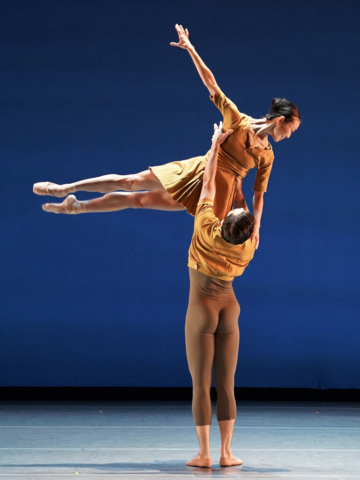
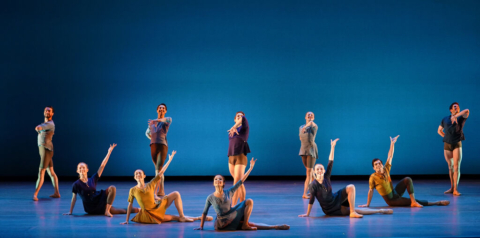
The Attacca Quartet will collaborate with dancers from the American Repertory Ballet, blending two art forms into an electrifying evening of music and contemporary ballet.
The concert includes works by John Adams, Gabriella Smith, and Caroline Shaw, as well as “Wood Works,” Nordic folk tunes, arranged by the Danish String Quartet.
For the launch of its 2021-’22 season, ARB artistic director Ethan Stiefel choreographed a ballet titled “Wood Works” to the same music, and the June 17 event includes excerpts from Stiefel’s creation.
The Scandinavian pieces are quirky, folksy, and edgy, and Stiefel remarked, in a September 2021 article in US1, that the dancing and music of “Wood Works” could become quite boisterous at times. The Attaca Quartet welcomes the wildness.
“It’s exhilarating, any time music is based around dance or movement, and it inspires a different kind of musicianship in the quartet,” Schram says. “We’ll be enjoying the physicality of it.
“I’ve played some of the Nordic folk music before and am really looking forward to it,” he adds. “We’re huge fans of the Danish Quartet as well as the (Scandinavian trio) Dreamers’ Circus. It fits into a category we believe in, which is more folk-oriented new music, and it feels designed for the string quartet. And, it’s inspired by a culture that’s not always represented in classical music.”
In addition, the quartet will be playing Shaw’s “Evergreen,” also the title of the group’s album of Shaw’s music, which won the 2023 Grammy for Best Chamber Music/Small Ensemble Performance. It’s actually the Attacca Quartet’s second Grammy in this category.
In 2020, the quartet won for its collaboration, also with Shaw, on the album “Orange.”
“Evergreen” has become a kind of signature piece for Attacca (pronounced ah-TOCK-ah).
“We identify with it and people identify us with her music, but also we say something unique with her work,” Schram says. “It’s entered our DNA in such a way that the music exists far beyond the page. We don’t just read the notes on the page.”
“It’s not like we’re composing alongside her, but we feel this intrinsic connection with her musicianship,” he adds. “We understand it so well that we can augment that, it can be fulfilled beyond what’s written on the page.”
Although the quartet has never collaborated with the ARB before, the ensemble has worked frequently with dance companies.
“We feel very comfortable with dance, we love it in fact,” Schram says. “Dance inspires us to think about movement in a different way. It makes our timing a little more natural, more related to gravity, and it makes our music more organic.”
For the June 17 concert, the ensemble will explore “Carrott Revolution,” a particularly animated work by American composer Gabriella Smith (who did her graduate studies at Princeton University), where the string players will, at times, be using their instruments as percussion. The vigorous music will accompany excerpts from the work “Circadian,” by choreographer Caili Quan.
“We’re drawn to (Gabriella Smith’s music) because it’s so percussive,” Schram says. “It’s a new and interesting frontier for string quartets, and for classical music in general. Music has been so harmonically based for so long, but people are now starting to use different instruments for percussive purposes. I think the string quartet is an incredible percussive instrument that Gabby explores beautifully.”
Schram is a fairly recent transplant to Princeton, having moved here from Brooklyn with his wife, singer/guitarist Becca Stevens, and their young daughter. They love their new adopted town.
You may have seen and heard him perform his distinctive works for viola, augmented by synthesizers and electronics, at various Princeton Sound Kitchen concerts at Taplin Auditorium.
“I like combining all my musical worlds,” he says, speaking from his home studio, where he’s surrounded by synthesizers, tape players, and an array of electronic gadgets. “I grew up listening to all sorts of stuff. But my studies have been centered around classical, so a lot of my musical life is amalgamating these interests I have, putting them in some kind of cohesive statement, and that includes using a lot of synthesizers.”
The California native, who has lived all over the country and in a few locations abroad, grew up in a military family: his father was a Navy fighter pilot, and his mother was a nurse. Neither was very musical, but they never discouraged him from his array of musical interests.
Schram has recently been inspired by artists such as Aphex Twin and Floating Points, but singles out Radiohead guitarist/keyboardist Jonny Greenwood as “my first love when it comes to weird sounds and electronic music.”
Nathan has played with musicians as famous and varied as Björk, Sting, James Blake, Joshua Bell, David Crosby, and others. He is modest about working with such celebrities, though, noting that one performance with David Byrne took place at a bar.
He does reserve special praise for Stevens, however. “Becca is the most important collaboration, and she happens to be my wife. We’ve worked together a lot, writing and arranging, in fact, we were just nominated for a Grammy, for our Radiohead arrangement (of “2 + 2 = 5”), for the quartet to play and for her to sing. She’s obviously the most intimate of the musicians I’ve worked with.”
Currently a PhD student at Princeton, Schram also studied at the Reina Sofía School of Music in Madrid, Spain. His albums of original music have been released on New Amsterdam and Better Company Records. The Attacca Quartet has releases on Sony Classical, GroundUP Music, Nonesuch, and New Amsterdam Records.
In between all these studies and activities, in 2013 Schram founded Musicambia, which develops music education programs in prisons and jails throughout the United States, including Sing Sing Correctional Facility and Bedford Hills Correctional Facility in New York.
There are also Musicambia programs in prisons in California, Kansas, and South Carolina, with collaborative projects in Scotland and Venezuela. Schram is the project’s executive director.
Through working closely with incarcerated people on songwriting, performing, instrument lessons, and music theory, the musicians cultivate artistic communities that nurture the humanity of all involved.
Schram hopes Musicambia “will help to define people who have previously been defined by the worst thing they’ve ever done, they’ve been labeled as a prisoner or criminal,” he says. “I find that it’s not the best way to help people to re-enter and be functional members of society.”
“As a musician I wanted to find a way to correct this problem in some way,” he continues. “I wanted to take the skills I have and put them toward a little bit of good. Musicambia has been developing throughout the country, and we hope to have music programs in every prison in the country at some point in the future.”
“It’s an audacious goal, but I think it’s something that’s so obviously needed,” Schram says. “I think it can help change the national perspective on people who are incarcerated, making us realize that the way we incarcerate people is not the right way to have a fully evolved society.”
Attacca Quartet with dancers from American Repertory Ballet, Princeton Festival, Performance Pavilion at Morven Garden and Museum, 55 Stockton Street, Princeton. Saturday, June 17, 7 p.m. $15 to $100; half price, ages 5 to 17. 609-497-0020 or princetonsymphony.org/performances/attacca-quartet-american-repertory-ballet/2023-06-17.
For more on the Attacca Quartet, visit www.attaccaquartet.com.
Learn more about Nathan Schram at www.nathanschramnoise.com.