Driving in New Jersey traffic can create a range of emotions. For Hillsborough resident Howard Barkin, however, such driving created his theme for last July 4’s New York Times Magazine crossword puzzle. The answer to one of Barkin’s clues that day: “bottled up anger.”
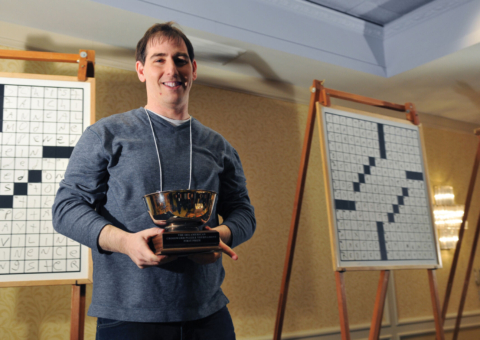
Barkin not only creates crossword puzzles that are solved, or attempted to be solved, by millions, he also places in national tournaments and in 2016 won the prestigious American Crossword Puzzle Tournament (ACPT). All this while working full time in computer processes for a Route 1 firm. And, let us not forget, being a totally dedicated family man. However, there is no dog to walk; there are limits.
The crossword puzzle, as it is known in this country, is said to have originated right before Christmas, 1913, in a New York newspaper. It was another 29 years before the New York Times (NYT) deemed such an inclusion worthy of its newspaper. And with that, the paper became the source of the crème-de-la-crème of puzzles. Creating for that paper is among the highest honors in the vast crossword puzzle world.
As a child, Barkin’s adored uncle gave him his first exposure to crossword puzzles. “He loved the Sunday New York Times puzzle,” Barkin says, “and I’m very grateful for the time with him and the introduction to this activity.” Nevertheless, the goal of creating puzzles — 11 at last count —for the NYT, let alone winning a national tournament was not part of his formative years.
A born and bred New Jersey guy, Barkin hails from Bergen County and moved south to receive a computer science degree from Rowan University in Glassboro. “I had a great time there,” he remembers. Work the following years was not always so great (he has since switched from being a programmer to managing computer software engineering processes; this is known as quality assurance). To fill in boring lunch breaks while working as a programmer, he returned to solving crossword puzzles. “I solved any sort of a puzzle for as long as I remember,” Barkin notes, “but crosswords weren’t a preference until about 18 years ago.”
And at first it was a hobby. “Generally, I enjoy a calm, relaxed solving over coffee,” he says. Occasionally, the phrase “a glass of wine” will slip into various published descriptions of how he solves a puzzle. And then, though “I didn’t plan for this to happen,” his competitive juices kicked in, he says. Puzzle tournaments, which feature competitive speed solving “just came with the hobby,” he explains.
Barkin further explains that “having a simple, everyday hobby that’s developed into a larger interest gave me the confidence to realize that if you can put your mind and effort into something, you can accomplish things you never imagined.”
Indeed, the first time he entered the national tournament was in 2006 — “has it been that long?” he wondered — and he placed in the top three C level competitors. “There are skill divisions from A to E,” he explains, “and everyone starts at C, moving up or down after that based on previous performances.” With that first-time performance, Barkin was on his way up.
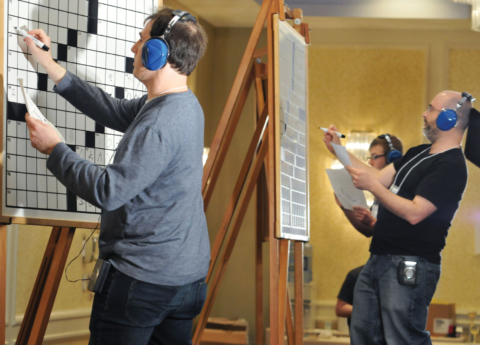
Way, way up, actually, as it was just a few years later that he was a finalist in the top A category. This is where the action gets tense. There are three grand finalists, and they solve the last puzzle on stage with their backs to the audience and wearing ear plugs so that no one can call out an answer.
It was the year 2016. Barkin had been on the final stage four times before over a 10-year period. “The stress level was high,” he readily admits. “Most people aren’t used to solving a crossword with a timer counting down in a room full of 500 people.” Not only that, reigning six-time champion Dan Feyer was one of the other finalists.
In this kind of timed competition, there is no chance to look at the two other finalists because time would be lost. “I was so relieved to finish, it took me a few seconds to realize that Feyer was still solving. Once that hit me, I realized I had won and was just thrilled.”
Barkin had broadened his crossword palette earlier by constructing crossword puzzles. Not surprisingly, he had several rejections before his first sale. “Most puzzles submitted by anyone are rejected, due to the large number of submissions received,” he notes. “So any rejection is a learning experience. Like publishing, if you can’t handle some rejection, this isn’t the pastime for you.”
He became more serious in 2013, “where I slowly learned the finer points of construction and style.” He was an excellent self-taught student, having sold his first puzzle to the Los Angles Times that year and in another 12 months his first to the New York Times.
“I tend to construct from my comfort zones,” he says. “My first puzzle centered around baby items in a crib, after my first daughter was born. I like fun, little wordplay themes, where letters are in a pattern or changed, something light.”
What may not be widely known is that there are computer programs designed to help with puzzle construction. Barkin freely admits using programs such as Crossword Compiler and XWordInfo for matching specific patterns. “However,” he makes abundantly clear, “there is no substitute for your own brain.” And then adds, “Only humans have a sense of humor, wordplay, and the ability to create a theme to build a puzzle around.”
While creating puzzles during COVID restrictions was not a problem, attending any sort of public gathering was. For the first time since its founding in 1978, the ACPT was held online this year (the 2020 tournament had been cancelled). It is hoped by crossword puzzlers across the country that it will be held next April at its usual Stamford, Connecticut, location.
Barkin will definitely be there. “The tournament is always full of friendly, open-minded, fun people who all share the common hobby of word games. They transcend age, gender, and any other differences. And all are very welcoming, even to the most introverted or shy newcomers.”
After all, if you place as a finalist your back is to the audience and you wear earphones so that you can’t hear anything or see anybody. That’s a perfect location for anyone who is introverted or shy, and it’s also great — though perhaps a wee bit nerve wracking — for sociable people who are truly competitive and really enjoy the challenge of solving crossword puzzles.
The American Crossword Puzzle Tournament website is at www.crosswordtournament.com. Information on where it will be held in April, 2022, as well as how to enter will be posted by the beginning of next year. Of the 741 competitors in the 2019 tournament, more than 200 were rookies.
For more information visit www.crosswordtournament.com.
Princeton’s Puzzler
Alison Peebles of Princeton never won an ACPT national championship, but she did come home with three Winged Victories, prizes for placing in various tournament categories.
“The tournaments are awesome,” she says. “There are hundreds of people solving puzzles at tables with cardboard dividers. And,” she adds, “you get see people once a year and have fun.”
Peebles found it easy to get to the tournament because she could take a train to Stamford, Connecticut, and then walk two blocks to the hotel where it was held. There are now more than 20 categories in which to compete.
Peebles wound up as a finalist in the B category. “That,” she admits, “was nerve wracking with my back to the audience and wearing ear plugs.” She has also placed in two other categories, but standing on stage is not required to win trophies in those events.
Peebles feels she has been solving crossword puzzles “forever.” Her mother introduced her to them and, as the saying goes, once bitten, totally smitten. Even though she has failing eyesight due to macular degeneration, the Sunday New York Times crossword puzzle is one of the first things she looks for on weekends. Magnifiers help her tackle that puzzle, but her diminished eyesight precludes her participation in the tournament.
Indeed, she and her husband, Nobel Prize-winning astrophysicist Jim, are in the process of cleaning out their house in preparation for a move to Stonebridge at Montgomery. Will the trophies go with her? Well, maybe just one. After all it is special to bring back a winged victory from a national tournament, and the memories associated with it are grand.