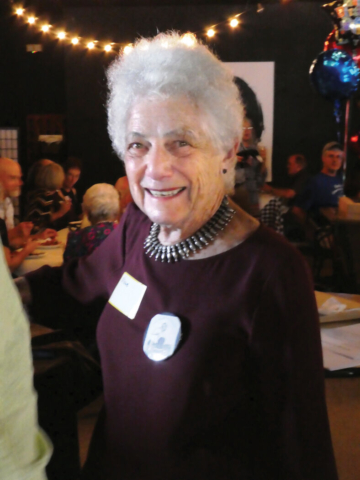
Editor’s note: U.S. 1 staff past and present were saddened to learn of the death on April 22 of Elaine Strauss, who spent more than 25 years as a freelance writer for U.S. 1 covering primarily classical music. She spent her final years in California, a move she chronicled in a November 21, 2018, story “Facing a Landmark Age? Trust Yourself” that captured the then-90-year-old’s enduring youthful spirit and taste for adventure.
Her daughter, Evelyn Strauss, wrote the following obituary.
Elaine Strauss died peacefully at home in Santa Cruz, California, with family members by her side. She was 95 years old.
Since her youth, Elaine engaged 200 percent with the world and its inhabitants. Her relentless energy, resourcefulness, and adventurous spirit inspired those whose orbit intersected hers. Elaine was interested in everything and everyone. She never wanted to miss out and was always game to try something new. She was a dynamo who sought ways to connect people with one another and with activities and experiences that she thought they’d relish.
Elaine was born in New York City to Sylvia and Herman Greenbaum, Polish immigrants. She grew up in Elizabeth, NJ, with her parents and younger siblings, Joan and Harold. From the start, her imagination and intelligence shone. Little Elaine walked around rooms, pretending that the ceiling was the floor; head tilted backward, she circumnavigated light fixtures and stepped over door lintels. Every morning while her dad shaved, he quizzed her on addition facts; she quickly deduced that, if the numbers increased by one, their sum increased by two.
Elaine taught Joan about opera, and the two girls took turns going to the library each Saturday to pick up the libretto for that afternoon’s Metropolitan Opera performance. At 2 p.m., they draped themselves over the radio, tuned in to WQXR, and followed along. The sisters frequently took the train or bus into Manhattan to see shows of various types.
Music floated through the Greenbaum household. Pop hits emanated from the radio and Sylvia’s vocal chords. When Elaine was about seven years old, her aunt gave her a toy trumpet with a single-octave range. She picked out tunes on it, and her parents suspected that she might be musical. They acquired a piano and started her on lessons, but the Great Depression was in full force, and they wanted to ensure that the expenditure was worthwhile. They had Elaine play for a musical expert in New York City; he deemed her talented and suggested that she switch to a better teacher. She began working with the conductor of the Elizabeth Philharmonic Orchestra.
By the end of high school, Elaine dreamed of becoming a foreign correspondent. She set her sights on the University of Missouri’s renowned journalism program, but she won a state scholarship that kept her close to home. At Douglass college (called New Jersey College for Women at the time), she thrived. Among her many academic and extracurricular activities, she wrote a senior honors’ thesis about Soviet poetry and the party line in literature, and she was editor-in-chief of Caellian, the weekly newspaper.
Elaine graduated in 1950, and the following summer, she met Ulli Strauss at a party, while stopping by to pick up a friend. Zing went the strings of her heart. She got the sense that the feeling had been mutual, so she did not understand why he failed to track her down instantly. Fortunately, she had mentioned that she worked on the first floor of Gimbels department store in New York, selling novelty items such as small plastic Christmas trees on which gumdrops could be impaled. Ulli showed up about three weeks after the party and leaned on her counter. “I’ve come to buy err…ahh… BLANKETS,” he said.
“Blankets?” she replied. “Sixth floor.”
Their first date ended with four-handed piano at the apartment of his parents, who were away on vacation. Elaine and Ulli married several months hence. Elaine adopted his two young children, Dotty and David, from his previous marriage to Esther Lipetz, who had died in a car accident. Elizabeth was born two years later.
Elaine read Greek myths as bedtime stories and arranged the kids’ glasses in equilateral triangles so that no one got the best (or worst) milk. From Ulli, Elaine learned about the importance of mountain vacations. Early in the family’s existence, they hiked near the northern end of the Appalachian Trail, then Aspen, and eventually, the Swiss Alps.
Elaine continued her education, taking one graduate class each term at Rutgers University. In 1955, she earned her master’s degree in political science. The following year, the family moved to Highland Park, NJ, where Elaine lived for most of her adult life. From their home on Lawrence Avenue, she dove into myriad activities. She became president of the League of Women Voters, played tennis, alternated with Ulli as pianist for the New Brunswick Chamber Orchestra, and danced—modern in the ‘60s, folk in the ‘90s, and baroque somewhere in between. She took up cello, hosted dinner parties for Ulli’s Rutgers chemistry department colleagues, and taught piano. She polished her French and German, and learned some Slovenian. In the ‘80s, Elaine’s piano playing made a leap when she began attending Dorothy Taubman’s workshops in Amherst, Massachusetts, and studying regularly with Taubman-trained teachers. She became an accomplished pianist and performed at various venues in the Princeton area. In 1982, Elaine joined Travelers’ Club, an organization founded in 1890 when 30 women in long skirts came together to study the world and foster camaraderie; her annual 10-page papers gleamed with well-researched information, creativity, and sometimes her own piano accompaniment. In everything she did and discovered, she recruited others to share her fun.
During the early Highland Park period, Elaine continued her studies, aiming for a Ph.D. In 1961, she performed spectacularly on her oral exams and was shocked to learn that she had flunked the written portion. When she asked the chairman of her committee what she had done wrong, he explained that the department referred each question to the expert in that field. She inquired further, as the comparative government expert had given her an A; the chair said that the comparative government expert had been wrong. The encounter ended when he told her that she couldn’t just come in, take the exams, expect to pass, and then leave for France. The family had planned to spend a year in Strasbourg, where Ulli would be doing a sabbatical. Elaine had intended to conduct her thesis research there after giving birth to Evi, with whom she was pregnant. She concluded that she would never pass the exam and ended her formal schooling.
Elaine cherished the three stints that she spent in Europe — Strasbourg (1961-1962), Oxford (1971-1972), and Basel (1980-1981). She soaked up the culture and the customs. In France, she learned from Evi’s Alsatian nanny that milk was for thirst and wine was for nourishment. In England, she watched BBC historical specials. In Switzerland, she marveled that concert tickets arrived before she paid for them.
At age 67, Elaine launched the journalism career that she had always desired. Over the ensuing 25 years, she wrote hundreds of articles, mostly about music, for U.S. 1, Clavier Magazine, and other publications.
Elaine’s sense of humor combined with her moxie in amusing and sometimes exasperating ways. She had an extraordinary ability to rationalize anything—ice cream for breakfast, for instance (it contains milk). One time she was playing a game in which competitors race to come up with words in given categories that begin with a certain letter. For “something cold that starts with U,” Elaine wrote “underwear.” When challenged, she proclaimed that underwear chills when kept in a humid yet cool locker room.
Elaine and Ulli frequently visited Manhattan, where they savored its restaurants, concerts, plays, museums, and street happenings. On each visit, Elaine tried to pack in as much as she could. Ulli died in 2015, but Elaine continued noticing things to tell him about.
She moved to Santa Cruz in 2018 and, true to character, enjoyed embarking on a fresh chapter even at age 90. She joined the Dominican Oaks retirement community with gusto. Within weeks, she was reveling in dining-room conversations, reading Shakespeare with new friends, and planning a piano concert. She chose an apartment that was as far as possible from the facility’s center to ensure that she’d stay fit and, several times a week, she Ubered to the nearby pool to swim laps.
Typically feisty, Elaine recently rallied against medical odds. At age 93, she suffered a serious femur fracture and her surgeon said that she would never again walk unassisted; five months later, she strode down his office hallway swinging her cane. A year ago, a COVID infection temporarily felled her, and in mid March, she endured a nasty RSV infection; she was recovering, but about ten days before her death, her body began to slide. She repeatedly summoned energy for spurts of favorite activities; two nights before she died, she won the last Rummikub game that she played, and 16 hours before she took her last breath, she insisted on going to dinner. After arriving, she realized that she needed to nap. Until the very end, she embraced life, but finally, her lungs gave out; her inspirations could no longer support her aspirations.
Elaine is mourned by her children David Strauss (Julie Smith), Elizabeth Strauss, and Evelyn Strauss (Karen Ottemann). She leaves six grandchildren: Deborah Politziner Afir (Adam Afir), Amanda Politziner Manning (Kevin Manning), Michael Decuir (Cami Decuir), Matthew Decuir (Marijke Decuir), Mia Strauss, and Olin Ottemann-Strauss; as well as four great grandchildren, Ethan, Meghan, Adelaide, and Simon.