
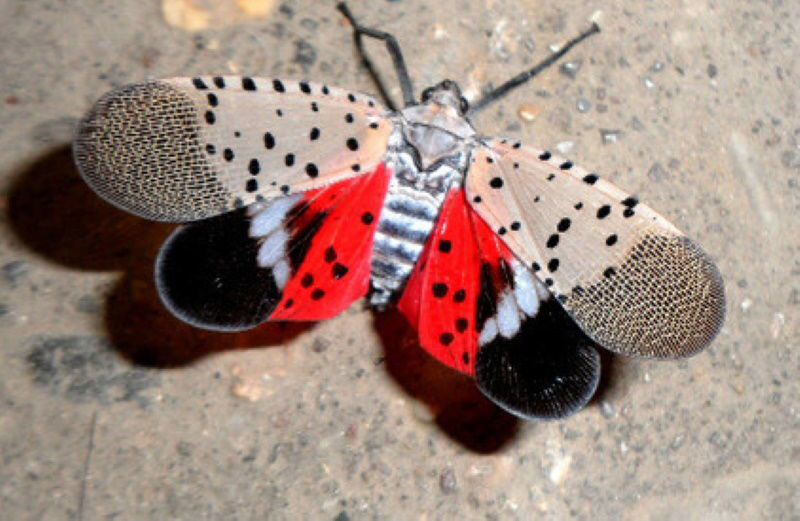
The New Jersey Department of Agriculture (NJDA) informed residents last week that sightings of the spotted lanternfly no longer need to be reported to the agency, as the invasive insect has become so widespread across the state.
Previously, residents were asked to report sightings to the agency so that it could help control and prevent the spread, as well as coordinate treatment resources. New Jersey populations were first detected in 2018 and have been detected in every county since, although populations remain most troublesome in the counties bordering Pennsylvania, including Mercer County.
While not a threat to humans or animals, spotted lanternflies can be a nuisance and have the potential to impact agricultural crops and hardwood trees. In addition to the Tree of Heaven, which is common in Princeton, attractive tree hosts include black walnut, red maple, river birch, willow, and agricultural crops such as grapes, apples, and peaches.
“Princeton is particularly susceptible due to its high density of trees relative to surrounding areas,” said Municipal Arborist Taylor Sapudar. “The spotted lanternfly isn’t going away anytime soon, but there are steps residents can take to help manage the spread of the insect.”
Spotted lanternflies mature into adults in late July-August and are easily recognizable with large spotted red wings. Because mating and egg laying takes place in October, this could be a critical time for management, according to the New Jersey Agricultural Experiment Station (NJAES) at Rutgers University.
Homeowners and business owners are encouraged to destroy as many spotted lanternflies and egg masses as possible. For more information including clear guidance on how to identify and remove spotted lanternfly eggs, visit princetonnj.gov/616/Spotted-Lantern-Fly.
In addition, badbug.nj.gov is updated by NJDA as a resource for people to learn more about the spotted lanternfly. The webpage includes a timeline for the stages of growth for the insect as well as treatment options.
