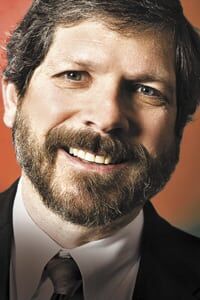
There are as many good approaches to running a tech company as there are recipes for chili. Everyone has a favorite that’s the best. And everyone’s right. The thing is, the aggressive-growth approach that works so well for Microsoft or Google, doesn’t necessarily work for a small enterprise like, say, Universal Display Corp.
Whereas some tech concerns like to keep growing, keep innovating, and keep diversifying, UDC sticks to what it started with almost 20 years ago. From its nondescript red brick headquarters on Phillips Boulevard in Ewing, UDC researches and develops organic light-emitting diodes (OLED), technology with such patience and modesty that many of us may not have realized we have been holding it in our hands for years.
“We develop our technology on an appropriate time horizon,” says Steve Abramson, president and CEO of Universal Display. “Our progress is not measured in years, but in multiples of years.”
Abramson will speak at the New Jersey Technology Council’s 2014 Technology Forecast on Friday, January 24, beginning at 8 a.m. at the Westin, Princeton Forrestal Village. Abramson will join David Chanley of Stifel Investment Banking; accountant Philip Politziner; Thomas Catanese of Power Survey Company; Jim Gunton of the NJTC Venture Fund; Chris Kuenne of Rosemark Capital Group; Flint Lane of Billtrust; Andrew Malik of Needham & Company; Simon Nynens of Wayside Technology Group; Chris Sugden of Edison Ventures; and Jeremey Donovan of Gartner Inc. to discuss key trends in technology development and marketing in the year ahead. Cost: $250. Visit www.NJTC.org/events.
What Abramson means by measuring multiples of years is that the time needed to bring OLED to full fruition will take decades. UDC began in the 1990s as little more than an idea with the financial backing of Princeton University. In 1996 the company went public (with some initial public investment by Princeton) with a grand total of zero full-time employees. Pretty much all it had going for it was its faith in OLED as an energy-efficient means of displaying readouts for MP3 players and cell phones.
In the early to mid-1990s, cell phones were roughly the size of Manhattan and festooned with big buttons and antennae. The sleeker models that showed up by 1996 or so had tiny, 8-bit gray screens that displayed block numbers when you dialed. Texting, as we know it now, was still a few years from catching on and the idea of watching movies or sharing full-color selfies on a device that fit into your jeans pocket was still the stuff of “someday.”
But the folks at Universal Display, perhaps because their job was to develop clearer imaging technology, saw the future and set to being there when the world caught up to the company’s grand vision. Today UDC does business with all the major cell phone/smartphone/computer companies Asia has to offer, as well as with European giants like Philips.
Energy efficiency, says Abramson, was an early concern when it came to advancing digital technology. On top of that, he says, phone manufacturers even 20 years ago knew the future would require bright, beautiful displays. “The convergence of these technologies,” he says, “was OLED.”
Indeed, OLED is vastly more energy efficient than traditional, backlit displays. And indeed, OLED is vastly clearer. In fact, it’s so superior and so much the way of the future that there’s a problem. “There’s so much potential [with OLED] that the industry is its own worst enemy,” Abramson says.
A complicated ecosystem. Talk to Steve Abramson about OLED for a few minutes and you will almost certainly hear him say “the technology has a lot of legs.” What he means is, OLED has the potential to be the way of the future, for computers, phones, televisions — whatever requires a screen display. But because OLED has shown up in the marketplace and because people are aware of its potential, they expect the technology to be perfect already. “Products need to be perfect in this day and age,” he says. It’s a hard world in which to show marginal success, on the promise that things will get awesome someday soon.
Evidence to back up Abramson’s assessment comes from a recent announcement by Sony and Panasonic to cease research on OLED television. A year or so ago, geeks were abuzz over the idea of OLED TV, but the disintegration of the Sony/Panasonic partnership caused even the usually techie-optimistic Businessweek to question whether OLED television is dead before it even got out of the gate.
Abramson essentially finds the question Businessweek asks to be balderdash. “It’s a complicated ecosystem,” Abramson says of the OLED sector. The partnership dissolution between Sony and Panasonic has much more to do with disparate corporate cultures than with the technology itself. “The technology is fine,” Abramson says. “The research is ongoing. OLED TVs will be on the market well before 10 years from now.”
Seeing the Light. Despite the pace of a world that demands its technology be perfect simply because we’re well into the 21st century, Abramson reminds that UDC was forged on patience and still operates that way. Patience is what grew the company from a tech dream with no full-timers to an industry player with 125 full-time workers 20 minutes south of Princeton University. Technology development, despite what people think or want, takes time.
Success in this complex ecosystem also requires being able to go with surprises. Like OLED lighting. In a world becoming more obsessed with energy efficiency, Abramson says, environmentally friendly lighting technology is more sought-after than ever. Unlike incandescent bulbs, which burn hot and burn out, or like fluorescent lamps, which contain mercury and generally are hated by everyone sane, OLED lighting sources emit light through diodes that lie evenly across a flat panel. The results are more even lighting and far less energy used.
No one who developed early OLED technology really thought about using it as a lighting source for homes and buildings and baseball games, but that’s part of the potential Abramson is talking about. The hangup is, despite that OLED is itself more efficient than current lighting technology, it is not efficient enough yet to work in the marketplace. For one thing, it’s too expensive for the average person to buy for his house, and for another, the technology is not yet at the “perfect” stage everyone will demand. Hence, Abramson encourages patience.
“A number of major corporations — KonicaMinolta, LG, Toshiba — are investigating OLED lighting,” he says. “They’re really trying to reduce costs, because people expect to not have to pay a lot of money.”
Other Developments. One thing Abramson has come to understand about his business is that surprises happen in good and bad ways. “Just when you think you have it set, something comes along and screws it up,” he says.
In the research and development cycle of a company within Abramson’s complicated ecosystem, promising futures can fall apart for any number of reasons. Maybe the business managers at the company you’ve worked with for years got replaced. Maybe your customer had a bad year. Maybe China’s growth rate is a few percentage points shy of what was expected. Maybe 9/11 happens. Or maybe, Abramson says, your competition — which in his case is LCD technology — makes an unforeseen leap so far past you that you barely have time to catch their tail lights. It hasn’t happened. But Abramson is very aware that it could.
Interesting things loom on the horizon — like OLED you can wear. Perhaps not OLED fabric, since organic light-emitting diodes need a super-flat surface on which to sit, rather than a porous surface like thread, but wearable pieces, such as belts or watches or glasses are real possibilities. Yes, Abramson acknowledges that Fergie from the Black Eyed Peas recently wore a full OLED dress, but such a specialty product is a ways away, he says.
Whatever comes, Abramson is well prepared to meet it and philosophical enough to dream exciting things about the future of OLED. A native of the Philadelphia area, Abramson’s first job as a kid was working at his father’s auto body shop, where a portentous conversation with a co-worker led him to pursue a life outside of manual labor. “A guy I worked with looked at me and said, ‘Stevie, thank God you’ve got a brain because if you had to make a living with your hands, you’d starve.’”
Abramson took his brain to Bucknell University, where he earned a general bachelor of arts degree in 1973. He then earned a master’s of philosophy and international relations from Ohio State in 1975. There his interests in law and science merged. A course on the philosophy of science outlined how science and the law both advance or fail based on evidence and proof. The idea so piqued his interest that he decided to go to law school. He earned his J.D. from Temple in 1979.
In the 1980s Abramson worked in general counsel and as the tech sector manager for International Mobile Machines — later Interdigital, which contributed to the development of cellular radio — in King of Prussia. In 1992 Abramson went to the environmental engineering firm of Roy F. Weston, where he served as general counsel and treasurer. In 1996, after a conversation with an old friend from IMM named Sherwin Seligsohn, Abramson decided that yes, it would be a great idea to invent screens for cell phones and joined the two-year-old UDC as COO. He became the president and CEO in 2007.
Comfortably at the helm, Abramson says UDC is working to increase its customer base and “grow in as many valuable directions as possible.” He expects to hire more people, which is something the company did even when the Great Recession gutted many companies. In fact, he says, UDC managed to land some extremely high-caliber talent thanks to other companies letting them go.
The moral, according to Abramson, then, is this: high-tech or not, the future for UDC will come from something decidedly old-fashioned. Patience. And a focus on what the company knows.