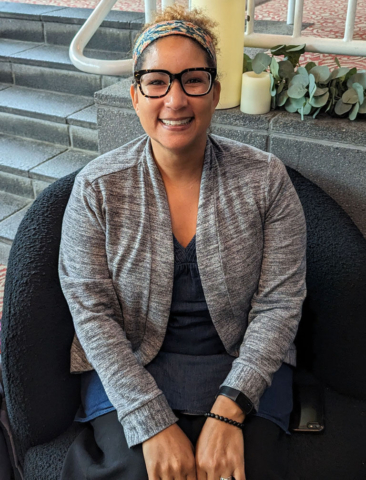
McCarter Theater is stepping out with post-pandemic strength with associate artistic director Nicole Watson’s staging of “Bulrusher” — running September 13 through October 7.
The 2006 play by the California-born, now Brooklyn-based, Eisa Davis takes its name from the central character: a young multi-racial woman with clairvoyant powers who arrived in a California redwood region town as a baby found in a basket among the reed-like bulrushes along a river.
The Pulitzer Prize-nominated play was one of the streaming successes of the digital ‘Bard at the Gate’ series launched during the pandemic and co-curated by Watson and Pulitzer Prize-winning playwright Paula Vogel.
Another digital project overseen by Watson was a four-week festival of the prolific yet underproduced contemporary American playwright Adrienne Kennedy with whom Davis studied.
Watson also directed McCarter’s well received “Blues for an Alabama Sky” in May 2023.
“It is a thing of beauty,” says Watson about “Bulrusher” during a recent interview at McCarter Theater. “It is a beautiful play about the life of a young black woman in 1955. It is a play that invites us to learn about a place in America that we didn’t know about — a place in the U.S. that created its own language.”
She also says the play fits her aesthetic sensibilities as a director, works that “simultaneously feel familiar and real” yet “invite me to find a story to tell and tell it in an interesting and imaginative way.”
Prior to arriving at McCarter in 2022, Watson served as associate artistic director at the Round House theater in Washington, D.C.
Other credits include directing at the New Black Fest, the Women’s Project Theater, Washington National Opera, Baltimore Center Stage, Geva Theater, Asolo Repertory Theater, Playmakers Rep, A.C.T.’s Conservatory, North Carolina School of the Arts, New Dramatists, and The 52nd Street Project.
She is also a member of the New Georges Jam and has worked with New Dramatists, Lark Play Development Center, Fire this Time Festival, New Black Fest, Women’s Project Theater, 52nd Street Project, Signature Theater, and Working Theater.
Interestingly, she began her career as a history teacher.
Born in Kingston, Jamaica, Watson was 2 years old when her family moved to White Plains, New York, and she went to public school.
About her parents, she says, “My mom was a school librarian at a special ed school and my dad was an emergency room doctor.”
Although she played bass clarinet and participated in theater in high school, Watson went to Yale University and focused on getting a degree in history.
“My parents said Yale was very expensive and ‘please don’t do music or theater.’ They hoped that I’d wake up and be a doctor or lawyer.”
While she later taught classes in ancient civilization and European history, she also concentrated on African and Caribbean history at Yale.
Watson says she “fell in love” with the storytelling aspect of history. “There is so much to discover … and I loved looking at primary sources and uncovering stories. There is an old book library at Yale, so you can’t help but fall in love with the past.”
Meanwhile, she had a summer love and did summer stock at the Berkshire theater festival.
After Yale, she got started in education by teaching part-time at a private school. It offered few benefits and got her to start thinking about the future.
Then there was an unexpected break. “I ended up directing their school play. I fell into directing because it was related to teaching.”
Watson says while she continued to teach for a few years and found it “extremely rewarding,” she was also auditioning for plays and frustrated when she could not leave school for call backs.
Meanwhile, she continued directing plays for schools and gaining more experience. “I aged up, first sixth graders, then high school, and then college.”
She also started to gain a fresh perspective on theater. “Working with young people keeps you honest and humble and keeps you clear. We have nothing on a 10-year-old’s imagination.”
Watson says that the process of academic research and work on plays are connected.
As an example, she brings up working with the New York Historical Society. “I was bound by fact. Theater has a different set of rules. So, if I go to the New York historical society and there is a photo of a Black man in the Civil War, and if they have no names, the joy of theater is to look at the photo, give them names, and restore their lives.”
“No history teacher can tell all the stories that could be told. That’s why there should be more plays. We need our schools and our arts spaces so they can work together. That’s how we learn.”
Watson says her move to Princeton was connected to McCarter Theater artistic director Sarah Rasmussen, whose tenure began in 2022.
The two knew each other through a female playwriting and producers organization.
When Rasmussen contacted Watson and asked if she would “figure out how to reopen a theater that had just closed because of COVID. I was really interested in McCarter as a performing arts center, so we moved.”
Watson and her playwright husband, Tim J. Lord, moved to work in a theater that was closed.
First living in the Mill Hill section of Trenton, they currently live in Hamilton.
“It was interesting to work for a place for a year before I came into the building,” says Watson. “When I started, we had Zoom links. It was a year before I could say hello to a person who came to McCarter.”
She also mentions “a particular type of heartbreak” for artists losing work during the pandemic and an unsettled aftermath — that includes existing problems art organizations faced or created before COVID changed everything.
The includes something more than audiences not coming back as they had in the past, the people who make theater and run organizations.
“The crisis isn’t over. Staffs are not coming back the same way,” she says, noting that the pandemic made professionals relook at how they worked long hours and what they missed.
“We have to figure out how to more humanely do what we’re doing. When I did shows I missed weddings and funerals. We can be human and do a show at the same time.
“We have to think about what growth means. In a capitalist country, everything has to be bigger and faster, but that may not be the case (in art).”
As for herself and her work in the theater and on stage, she says, “I hope that I bring a sense of rigor, joy, and relentless pursuit to figure things out. Those things are important. I want to tell the story, but I recognize I am not the person telling the story. I ask (others) to figure it out. It does take a group of people to do this. I want people to come into the process of telling the story. Feel like it is a worthwhile use of time.
“I love being a director, but I don’t want to be the only person who has the ideas. I’m the person who has to ask what is possible.”
‘Bulrusher,’ McCarter Theater Center, 91 University Place, Princeton. September 13 through October 7. $25 to $60. 609-258-2787 or www.mccarter.org.