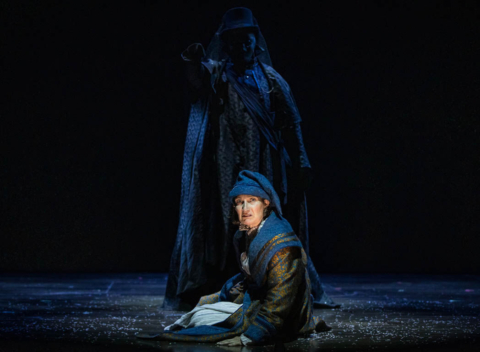
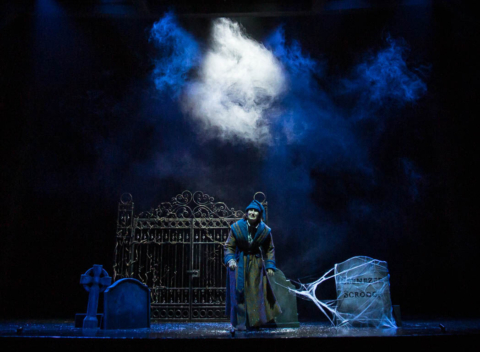
McCarter Theatre’s current production of “A Christmas Carol” continues a long tradition of mounting a live presentation of Charles Dickens’ 1843 novella about a miserable man transformed by ghostly visitors on Christmas Eve.
That the book was immediately turned into a successful stage production weeks after publication in London’s pre-copyright era speaks volumes. So too that Dickens himself turned his work into a popular one-person show he presented until his death in 1880.
Obviously, between then and now the story hasn’t given up the ghost — supported by several other area productions.
Yet, the ghosts in “A Christmas Carol” have good company. There are a good number of ghosts conjured up by writers contributing to the annual Christmas magazines that Dickens and other magazine editors sold for the holidays.
And while ghost tales were also being published in the United States by authors such as Washington Irving, literary historians argue that Dickens was the writer who made the ghostly connection hold.
As a Smithsonian Magazine article on Christmas ghosts tales notes, “Dickens’ genius was to wed the gothic with the sentimental, using stories of ghosts and goblins to reaffirm basic bourgeois values; as the tradition evolved, however, other writers were less wedded to this social vision, preferring the simply scary.”
The reality is that ghost tales at Christmas had become so familiar that it seems natural that Henry James, an American-born author writing in England, opens his famous 1889 ghost story “The Turn of the Screw” with the bewitching line, “The story had held us, round the fire, sufficiently breathless, but except the obvious remark that it was gruesome, as, on Christmas Eve in an old house, a strange tale should essentially be.”
Meanwhile, around the same time, another James, the 31-year-old writer and Medieval scholar Montague Rhodes James (aka M.R. James), presented his first live Christmas Eve ghost story account to an audience at Kings College. It was a practice he continued throughout his career as provost at Kings College and Eton and then serving as vice-chancellor at the University of Cambridge until his death in 1931, creating a body of work that became a collection of highly regarded ghost tales.
But while all this spirited activity continues to go during this time of the year, there is one haunting question: How did ghost get added to the heavenly hosts that welcomed the birth of the Messiah on Christmas?
As the previously mentioned Smithsonian article notes, “Telling ghost stories during winter is a hallowed tradition, a folk custom that stretches back centuries, when families would while away the winter nights with tales of spooks and monsters.”
Others writing about ghost and horror stories point out that cold, snowy, and barren landscapes seem ideal for stories. It is, after all, exactly the type of place where Mary Shelley’s novel “Frankenstein” opens and closes.
And while literary critics point to Shakespeare’s line, “A sad tale’s bets for winter, I have one of sprites and goblins,” from “The Winter’s Tale,” it reinforces the life and death motif suggested by the season and expressed in mythology.
That Christmas isn’t mentioned is a significant omission.
However, another line in another play by Shakespeare holds a clue to the ghostly holiday connection.
The play is “Hamlet,” whose plot is set forth by the wanderings of a ghost.
As the play opens, several guards encounter the spirit of Hamlet’s father walking along the fortress’s ramparts. When the ghost fades away at dawn, the guard officer Marcellus talks about it and the time of the year, “Some say that ever, ‘gainst that season comes Wherein our Saviour’s birth is celebrated, The bird of dawning singeth all night long; And then, they say, no spirit dare stir abroad, The nights are wholesome, then no planets strike, No fairy takes, nor witch hath power to charm, So hallow’d and so gracious is the time.”
Catherine Belsey, author of the 2019 book “Tales of the Troubled Dead: Ghost Stories in Cultural History,” writes that with that line “Shakespeare seems to have invented this belief: in the fireside tradition ghosts were particularly active at Christmas — and would remain so once Dickens had re-energize the convention in ‘A Christmas Carol.’”
Belsey adds that Shakespeare’s ghostly introduction was accepted by audiences for both its symbolism — the ghost represented the “rotten” something at the heart of the story — and its connection to a 17th century Anglican belief that the church could banish ghosts during the Advent.
Nevertheless without any Biblical mention or Medieval legends supporting them, stories of active ghosts on Christmas Eve became a reality and could possibly be connected to the ancient Celtic traditions that bookend the seasons of life and death — Samhain and Beltane.
The first is celebrated at the start of November when the realm of the dead meshes with the living, when light diminishes and spirits appear. We know it now as Halloween.
The second occurs at the first of May when struggling life returns and the sun and daylight grow longer. The day is still celebrated as May Day.
That Dickens’ “A Christmas Carol” is about death and rebirth — although spiritual — easily allows one to connect it to the above mythic struggle where light and life eventually triumphs over darkness and death. That Christmas is the day where the “light of the world” was born ups the impact of the tale.
While all of the above is interesting to consider, the reason for telling ghosts stories at Christmas time could be something more basic. Ghosts and evil make a story about good tidings and personal redemption a hell of a lot more interesting than moralizing.
It also makes it a lot easier for a story teller to say, to borrow another line from Shakespeare, “lend me your ears,” and keep them listening.