Dudgeon can be tricky.
It has to be pitched to the right degree, or the best instinct can play as overdone or lame.
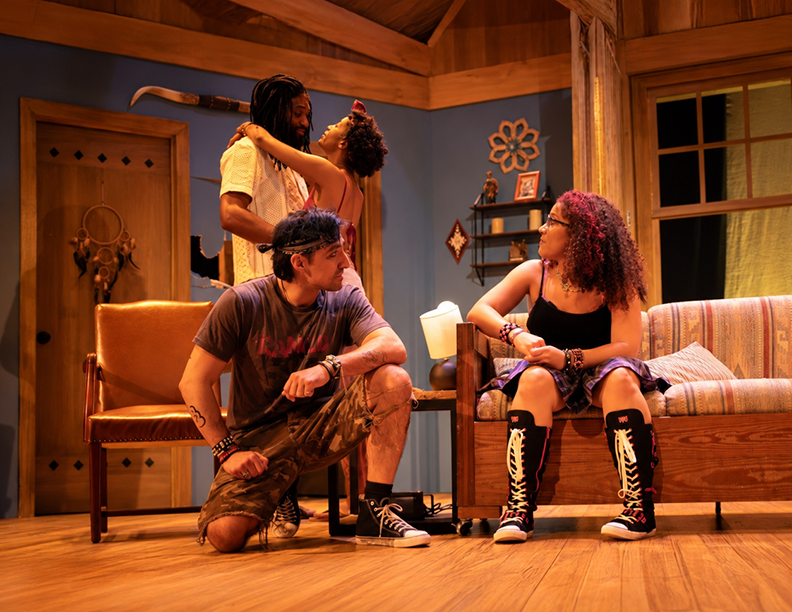
“Teen Dad,” an Adrienne Dawes play at Passage Theatre’s Mill Hill Playhouse through Oct. 11, is ripe with dudgeon. It practically thrives on it.
The upshot is some of it registers beautifully, conveying a deep emotion or large personality that has room to blossom. Much of it is too much, with anger, crudeness, raunch, disgust and opposition expressed so large that it’s out of proportion to “Teen Dad’s” dramatic needs and seems more unnatural than heartfelt.
The overkill at times becomes annoying and harmful to C. Ryan Domingues and Richard Bradford’s production of “Teen Dad” for Passage.
Ironically, Dawes’ play, which revolves around quickly triggered conflict and confrontation, works better in its more peaceful moments, when two characters sit and offer thoughtful, confessional conversations about who they are, what they want and how one person can disrupt the life of another.
It’s a good play, but it could use being turned down a notch. Dawes’ characters enjoy acting out and claiming attention — well, three of the five do — but Domingues and Bradford’s production could stand a few fewer instances of characters making distorted faces through glass doors, screaming as though they’re rock stars coming to a vocal climax, grunge or Goth mannerisms, and generally communicating in a high-pitched, frustrated yell.
Schtick like this begins to look self-conscious. It might be meant to define a character or show how close they are to spontaneously acting out at any opportunity, but it distracts and distorts because it looks like a bit, something to rattle the audience rather than entertain or inform. Dawes’ characters are neurotic and edgy enough. They don’t have to resort to excess or bizarre acting out.
I’m happy to report that exaggerated levels of dudgeon fade as Passage’s “Teen Dad” proceeds. Later fights and conflicts seem more naturalistic and less out of the blue. Because of the more intimate, personal scenes I mention earlier, characters seem to settle into understanding each other or hearing something that makes a difference in how they regard another’s behavior.
This improves the production because it reveals facets of “Teen Dad” that were camouflaged by all the noise and commotion.
“Teen Dad” doesn’t need to be blatant or super-intense to succeed. Dawes has put a lot in the play, some serious, some satirical, most coming from the way an individual character sees him- or herself in immediate and overall situations. Her points and ideas hit home more solidly when they have a chance to breathe, when you become interested in a cobbled family that has a lot to deal with instead of feeling you’re trapped watching an especially chaotic and irritating version of “The Jerry Springer Show.”
To move into understatement, all of “Teen Dad’s” characters have issues, several of them, most neglected or unresolved.
Tom (Zachary Valdez), the title character, is seen in flashback as a teenager about to enjoy the act that will make him a father at age 14, but in all other scenes he is a 29-year-old living an itinerant rock musician’s lifestyle. Tom may live in Chicago, but his existence is “Have Guitar, Will Travel,” with all the rootlessness and insecurity that comes with it.
Tom liked the idea of being a dad to Abby (Jade Cox), who is 15 when we meet her, but that idea extended to being the sporadically seen fun parent while heaping all the responsibility for nurture, education and a stable life on Tanya (Morgan Cheréce Hall), who had her fill of Tom’s act from the minute she learned she was pregnant, at 18, and saw he was not partner material.
At 29, Tom remains a “teen dad.” He hasn’t grown up. He goes beyond Peter Pan in leading a life that can mean rocking in gigs one minute while collecting tattoos, scuffling on the road, serving occasional jail time and never losing that modicum of charm that attracts women to him.
Abby wants more. When Tanya’s fiancé, John (best of cast Walter J. DeShields Sr.), is offered his boss’ beachfront house for a weekend, partially as a test to see how well he might manage property, Abby invites Tom to join them, unbeknownst to a less-than-thrilled John and an absolutely apoplectic Tanya.
Putting her own variation on a tale as old as time, Dawes has intelligent but adolescent Abby hoping her parents, now in or approaching their 30s, will rekindle the spark that conceived her and reunite. (John even cites Hayley Mills and “The Parent Trap.”)
Tom doesn’t know his daughter’s aim, and he wouldn’t be ready for it if he did. He may talk about wanting to be a better father to an imagined child in his future, not Abby, but he hasn’t matured much since the cute, sexy waif who lured Tanya into flagrante delicto 15 years before.
Tom makes matters worse. He doesn’t arrive at John’s borrowed Galveston, Texas, digs alone. He brings a woman, 22-year-old Alisha (Victoria Wallace), who pronounces her name Al-oo-sha, a whim of the late woman who adopted her, a circumstance that makes the quick-fused Tanya even angrier and more resentful.
Dawes explores a lot of dynamics. In addition to all of the relationships, parental and otherwise, she has all of her characters be mixed-race in some way. Individual identity becomes as significant to each character as his or her place or status among the beach house denizens.
Once Domingues and Bradford even out the emotional level, “Teen Dad’s” texture comes through, and sequences that were blowing up via overexpressive acting begin taking on some meaning and turning things from comic claptrap to interesting, mainly because each character reveals something that makes him or her more universally human as opposed to some overwrought piece on a theatrical game board.
Walter J. DeShields Sr. anchors the beginning moments of Passage’s production by being calm when Tanya is panicking beyond reason and Abby seems comatose.
He continues to be the reasonable voice in “Teen Dad,” even when he loses control and has to explode or crumble.
John is a mediator. He works with juvenile offenders to resolve their emotional issues and make them consider alternatives. He does this by asking probing questions that make one explain what they may not be saying clearly. As such, he can wring information from Tanya, Alisha and even Tom that they could never think of, let alone articulate, on their own.
Dawes and DeShields are canny in their use of John’s character. Dawes is making fun of John’s process while having it work in most instances. DeShields is so sincere and productive in using the technique, you begin thanking whoever thought of it while seeing Dawes’ joke.
Passage’s “Teen Dad” needs the stability and grounding DeShields gives it. He is the antidote to Hall and Cox overplaying the opening scene, which would work better if the characters took on a more pointedly humorous tone instead of acting like frightened hotheads.
He is also the antidote to Tom’s need to be naughty and disruptive.
Zachary Valdez gets away with Tom’s irrepressible, intentional mischief because he embodies the cuteness and spontaneity Tom is intended to convey.
If John represents logic, order and arrival at a conclusion, Tom is pure, unadulterated (and unadult) chaos, something Valdez, with his boyishness and bedroom eyes, has the charm to pull off.
Valdez makes you happy to see him enter a scene even though Tom is bound to annoy with his penchant for purposely making matters worse.
Victoria Wallace has the most challenging role as Alisha, committed to being Al-oo-sha. She is the stranger in the midst, the unwanted guest who never realized she’d be in a position to be unwanted.
Wallace handles it all well, especially in her quieter scenes, when you hear about her tough life and simple ambitions.
Jade Cox improves markedly when she sheds Abby’s Goth traits and allegedly cantankerous behavior to show the A-student she is.
Abby wants a cohesive family and wants it to include her father, even if Tanya and John have a better chance of providing such a family with Tom as a distant memory. She is also the most poised of the characters to succeed at life in general.
It is as the thoughtful, needy teenager that Cox shines brightly.
Morgan Cheréce Hall shows a lot of range as an actress, but she often loses aspects of Tanya in her intense expressions of anger and appearance of being constantly en route to a nervous breakdown.
Hall is too fine an actress not to claim her own in scenes where Tanya has to face down Tom and even John and Abby, but it is her dudgeon in general that needs some regulating.
Dirk Durosette’s set design is portable when necessary but needs some tonier appointments for a successful executive’s beach house.
Yes, Tanya and John make fun of the owner’s taste, but the place looks so run-down and put together via thrift shop finds that the kitschy knickknacks they deride are no better than the rest of the place.
Ilya Boatwright Buffaloe’s costumes show the characters’ quirks, especially Abby’s.
“Teen Dad” runs through Sunday, Oct. 11, at Passage Theatre in the Mill Hill Playhouse, 205 E. Front St., Trenton. Showtimes are 7 p.m. Friday and Saturday, 2 p.m. Wednesday, Thursday and Sunday, and 10 a.m. Wednesday, Sept. 30. Tickets are $48, with various discount plans available. They can be obtained by visiting passagetheatre.org or calling 609-372-0766.