The National Guard Militia Museum of New Jersey, with divisions in Lawrenceville and Sea Girt, features objects and information chronicling the state’s militia activities from the colonial period to the present.
It is also home to an important online presence: The Center for U.S. War Veterans’ Oral Histories.
That collection includes more than 600 veteran interviews that capture experiences of those who served in World War II, Korea, Vietnam, Desert Storm, Operation Iraqi Freedom, and other American military campaigns.
While the recorded interviews are housed at the museum’s Sea Girt location, where they are accessible to researchers and scholars, more than 300 interviews are available in online archives.
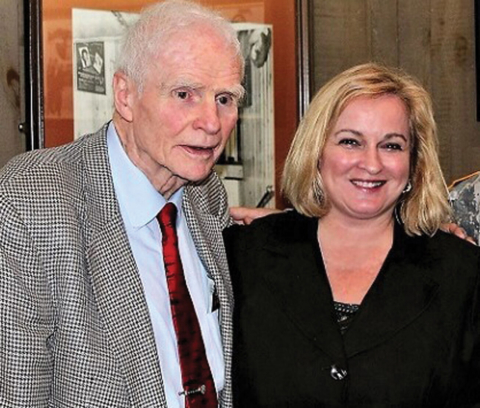
What follows are excerpts of several regionally significant stories prepared by Carol Fowler, the museum’s director of oral history.
In addition to providing a fitting Veterans Day tribute, the stories also show the importance of such a resource.
Brendan Thomas Byrne was born in West Orange, New Jersey, in 1924. He is known both as a former governor of the state.
When WWII broke out with the Japanese attack on Pearl Harbor, Byrne was a student at West Orange High School.
Byrne was a student at Seton Hall University in 1943 when he decided to join the military. He wanted to be an officer and thought his best chance at that would be in the Army Air Corps.
Byrne recalled that he was “scared to death” on his first combat mission, not so much of the enemy, but of the possibility that he would screw up. He said, however, that he became ‘a rather good navigator” as time went on. Byrne eventually became the lead navigator, in the first of 36 planes in the formation.
A typical mission would involve getting up early and going for a briefing, then boarding a B-17 to fly to a target and drop bombs. A mission would last for six to seven hours in the air, usually flying at 20,000 feet and occasionally at 30,000 feet. The bomb run at the climax of the mission took about six minutes. There was no threat from German fighter aircraft, but large numbers of anti-aircraft guns were deployed to protect targets, which include oil refineries, railroad yards and factories.
On one mission to Athens, Greece, Byrne’s plane was separated from the remaining aircraft on the mission and began to run out of fuel. They barely made it back; he remarked that he had his “hand on the door” ready to bail out. Byrne recalled that as his “closest call” during his service
Byrne was discharged in September 1945. He died January 4, 2018.
Howard Hoagland was born in Hopewell in February 1911, and grew up in both Hopewell and Belmar, New Jersey.
In 1938 Hoagland joined the New Jersey National Guard’s 119th Quartermaster Regiment “for the extra money.” In his interview he recalled that “we had no basic training, but we drilled once a month at Sea Girt and went to camp for two weeks every fall. It was a two week paid vacation.”
By September 1940 Hoagland was a corporal, and in that month his unit, the 119th’s third battalion headquarters detachment, was federalized along with the rest of the New York and New Jersey National Guard’s Forty-fourth Division.
He later became a motor pool sergeant and taught new recruits how to drive the diverse array of military motor vehicles on the base.
The Forty-fourth Division was ordered into federal service for eighteen months, but the duration of that duty changed after the December 7, 1941 Japanese attack on Pearl Harbor.
When he and his fellow soldiers heard the news that “the Japs had bombed Pearl Harbor. When we got back to Fort Dix, they tore up our discharge papers in front of us, [and] we were in for the duration,” he recalled
The division landed at Cherbourg, France, on the Normandy coast. Hoagland recalled that “we were the first full division to go directly from the United States to France,” adding that “we rode on cattle cars from Cherbourg to Luneville, France and went on line on October 18, 1944 when we relieved the Seventy-ninth Division.”
Hoagland recalled that on “the 23rd of December [1944]… my C.O., commanding officer, told me to take my fifteen men and hold the line near a [frozen] canal. All of the bridges were blown, and that night some of my men reported that they saw movement across the canal. I told them to hold their fire until the Germans were on the ice, then open up with their weapons and grenades. But I found out that another division had come in to fill the gap. They were our own men on the other side of the canal.”
When prompted by the interviewer on the subject, Hoagland said that “…during combat you think of your wife and children back home, but unfortunately I never heard from my wife back home. She thought it best not to write, so we never did. But it was heartbreaking to see other guys get mail, and I didn’t get any.
After the war Hoagland returned to New Jersey. He passed away on January 18, 2006 at the age of 94.
Kenneth E. Williamson was born in New Hope, Pennsylvania in June, 1928.
Williamson paid little attention to the progress of the Korean War after it began in June, 1950. He believed he might be drafted, however, and he was on October 10 of that year.
Following basic combat and advanced infantry, Williamson shipped out on an overcrowded troopship on a twenty-eight day voyage to Japan.
After stopping briefly in Japan, his ship docked at Pusan and then Inchon, Korea, where he went ashore in March, 1951.
When a South Korean unit was pushed back by the enemy, American infantry and armor soldiers from the 24th, including Williamson’s unit, were sent to restore the line and rescue the South Koreans. Throughout the remainder of March, Williamson remained on the front line, living in foxholes and eating K-Rations before pulling back three miles for a break.
On the night of April 26, 1951, an intensive Chinese attack, part of the enemy’s “Fifth Phase Offensive.” The Chinese infiltrated and surrounded the American position, then launched an overwhelming attack, with an intensive mortar barrage followed by a human wave infantry assault, featuring blaring bugles and intensive small arms fire, which overran the position held by Williamson’s 150 man company.
Williamson, who recalled that only thirty Americans survived the attack, was hit with something on the head, temporarily knocked unconscious and awoke with a rifle muzzle stuck in his face.
The survivors of Company E were marched north with other prisoners. Early on in the march, one man tried to escape and was shot dead. After a trek of eighty days, covering some 600 miles, wandering in seemingly different directions and paraded through villages in front of North Korean peasants as war trophies, the prisoners were loaded onto a railroad boxcar on which they traveled north all night.
For food they were issued a powdered dry ration of soybeans, peanuts and sorghum, which Williamson mixed with some hot water he managed to acquire. Upon leaving the boxcar in the morning, the POWs resumed walking, traveling into a valley with a stream running through it where they given a brief opportunity to bathe for the first time since they were captured.
Shortly afterward, Williamson and his comrades arrived at POW Camp Number 3, on the Chinese border at Changsong, where he would remain incarcerated until the end of the war.
Leonard Pope (Trenton) was working as a garage attendant for the Trenton Police Department in April 1967, when he was drafted into the United States Army.
On arrival in Vietnam, he was assigned to C Battery of the 2nd Battalion of the 13th Field Artillery and stationed at Bien Hoa Air Force base near Saigon, where the battery was tasked with the indirect fire defense of the base.
Pope encountered several dead Viet Cong outside Bien Hoa on his second day there; he recalled that the enemy was a dedicated fighting force.
Pope said that the Viet Cong actually feared his artillery unit; a captured communist confessed they called his battery the “Dragon Unit” due to the unit’s symbol.
Pope was in Saigon when the Tet Offensive occurred in February 1968 (and) got serious about his service in Vietnam, as he was fighting for his life day in and day out. He was a forward observer radio operator during Tet, and was promoted to private first class during the offensive. The iconic photo of the police chief shooting the Viet Cong guerilla happened only a block away from where Pope was at the time.
Following Tet, Pope’s battery was sent to Loc Ninh, near the Cambodian border. This was around the time when Jane Fonda visited North Vietnam, and her famous photo op angered him. .
While stationed at Loc Ninh, Pope finally received orders to go home (and) remembered handing his rifle to his replacement and wishing him good luck, before he boarded the helicopter.
He remembered his return to civilian life as being a culture shock; because, he went from the jungle to civilization literally overnight. In later years it became harder for Pope to be patriotic, after discovering that the White House knew that Vietnam was unwinnable. He also developed diabetes from his exposure to Agent Orange in Vietnam. Leonard Pope earned the Good Conduct Medal, the Vietnamese Gallantry Cross, and the Vietnamese Service Medal for his service.
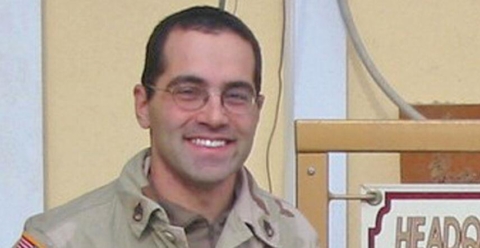
Sergeant First Class Dean Baratta was born in Trenton in September 1968. When he joined the army on October 15, 1986, Baratta selected the intelligence branch, a choice that reflected his high school love of historical research and military affairs.
Baratta was stationed in Metz, Germany, as a junior intelligence analyst for an infantry brigade. The American mission was to deter the Soviets from occupying West Berlin and invading Western Europe.
It was his job to analyze potential Soviet tactics should an invasion actually occur. The Berlin wall came down six months after he left Germany, and the Soviet empire began to unravel, leading to an end to the Cold War.
He returned to New Jersey and went on to receive a BA degree in Political Science from Rutgers University, but he eventually discovered that he actually missed being in the military.
In January 1995 Baratta joined the Pennsylvania National Guard’s 213th Area Support Group in Allentown, Pennsylvania.
Baratta was in Allentown, working with the Pennsylvania Attorney General’s office, at the time of the 9/11 attacks.
In the immediate aftermath of 9/11, Guardsmen were ordered to provide extra security at airports.
Following airport duty, Baratta was assigned to help start an operations center designed to collate and coordinate military and police intelligence gathering.
Baratta’s unit was notified in late February 2003 that it was going to be called to active duty and sent overseas .. many of the men thought the 213th (unit) was to be demobilized, but instead it was assigned to Afghanistan, apparently on the request of the commanding officer.
The 213th, as part of “Task Force Dragon,” was charged with running several bases in Afghanistan,
Baratta had moral issues about the war in Iraq, so he was glad his unit was sent to Afghanistan, where he hoped to make a difference — but when he left Afghanistan he could not see that anything significant had been achieved.
He recalled that his adjustment back to civilian life was difficult; he would often wake up in the middle of the night searching for his gun. When he returned home, he got a job with the New Jersey State Police as an intelligence analyst, and transferred his military duty to the New Jersey National Guard.
National Guard Militia Museum of New Jersey — Lawrenceville, 151 Eggert Crossing Road. Tuesday, Friday, and Saturday, 10 a.m. to 3 p.m. Free. 609-530-6802
National Guard Militia Museum of New Jersey – Sea Girt, 100 Camp Drive. Monday through Friday, 10 a.m. to 3 p.m. Closed state holidays. 732-974-4570
The Center for U. S. War Veterans’ Oral Histories is an official partner of the Library of Congress Veterans History Project in Washington, DC. For collection access or to participate in the project, call 732-974-4571 or email carol.fowler@dmava.nj.gov.
For more on the New Jersey Militia and National Guard Museum, visit www.njmilitiamuseum.org.