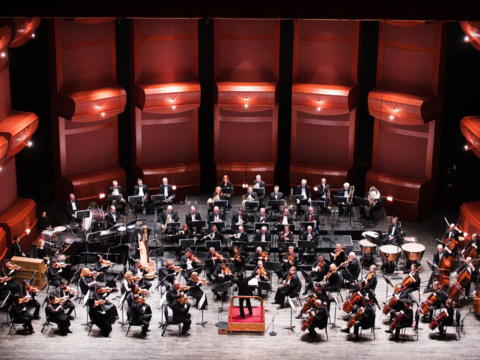
A venerable orchestra, celebrating 100 years this season, will strike a balance with some-things-old and something new, when the New Jersey Symphony returns to Princeton University’s Richardson Auditorium this Friday, April 21, at 8 p.m.
Established classics by Wolfgang Amadeus Mozart and Anton Bruckner will flank a world premiere by Princeton composer Steven Mackey.
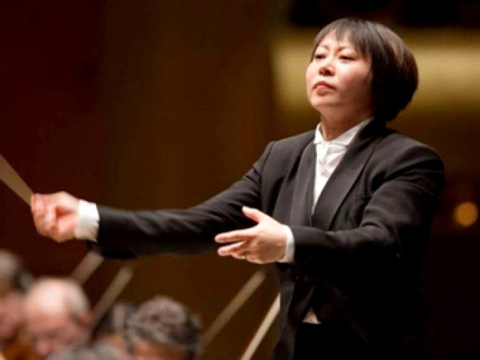
New Jersey Symphony music director Xian Zhang will conduct Mozart’s overture to “Don Giovanni” and Symphony No. 25. The evening with conclude with Bruckner’s “Te Deum” for vocal soloists, chorus, and orchestra.
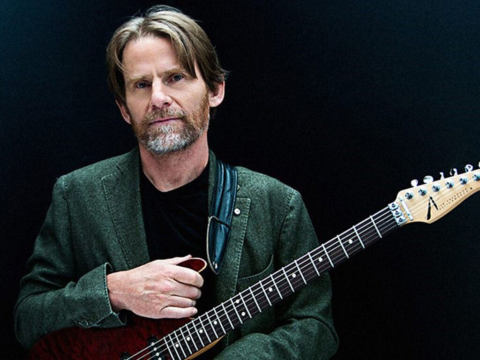
In between, Mackey, a longtime professor at Princeton University (and former chair of its music department), will take the stage with his electric guitar to mark the orchestra’s centenary with “RIOT,” a New Jersey Symphony commission incorporating original texts by Tracy K. Smith. Smith served as U.S. Poet Laureate from 2017 to 2019.
Mackey observes, “My daydreams about what I might do for such an auspicious occasion were grand: my friends in the New Jersey Symphony joined on a packed stage by a vocal soloist, a chorus, and myself on guitar, all singing and playing with abandon.”
The Princeton Glee Club will participate in both “RIOT” and “Te Deum.” Vocal soloists for the evening will include mezzo-soprano Alicia Olatuja (in RIOT), and soprano Meigui Zhang, mezzo-soprano Jennifer Johnson Cano, tenor Sean Panikkar, and bass-baritone Nathan Berg (in “Te Deum”).
The program will be repeated at the New Jersey Performing Arts Center (NJPAC) in Newark on Saturday at 8 p.m. and at the State Theatre New Brunswick on Sunday, April 23, at 3 p.m.
What had been approached as a celebratory work when Mackey and Smith began to discuss the piece in the summer of 2020 took on a more complex character following the death of George Floyd. Suddenly it was impossible for the artists not to address what was dominating the national psyche. “RIOT” coalesced from meditations on race and resilience.
The first line Smith wrote is a dark, personal statement that, according to Mackey, sets up “the interplay between personal and communal, the soloist and the chorus.” It begins “Sometimes I feel / the Black in my heart / like a map / made of tar. You need / only part your lips / to mar what isn’t yours.”
What follows is a series of six texts that “trace a trajectory that culminates in positive affirmation and a celebration of hope, perseverance, commitment, and community. The music aspires to honor that trajectory.”
Mackey says of Smith, a former colleague at Princeton University, “She knows how to make words sing.”
Born in 1956 to American parents stationed in Frankfurt, Germany, Mackey developed an early passion for blues-rock guitar that had him playing in northern California bands during his youth. The experience carried over into a number of his concert pieces, including two electric guitar concertos and numerous solo and chamber works. He continues to perform with his own band, Big Farm.
He now lives in Princeton with his family. His wife is composer Sarah Kirkland Snider. Mackey has been a professor of music at the university since 1985. In 2022, he also joined the faculty of the Curtis Institute of Music in Philadelphia.
Mackey’s orchestral music has been performed by the Boston Symphony, the Chicago Symphony, the Los Angeles Philharmonic, the San Francisco Symphony, the BBC Philharmonic, the Royal Concertgebouw Orchestra, the Sydney Symphony, the Tokyo Philharmonic, and the Chamber Orchestra of Philadelphia.
His album “Lonely Motel: Music from Slide,” featuring the ensemble eighth blackbird (all lower-case), vocalist Rinde Eckert, and Mackey himself on guitar, was nominated for four Grammy Awards, including that for Best Contemporary Composition. It was honored with a statuette in the category of Best Small Ensemble Performance.
Mackey has enjoyed a close relationship with the New Jersey Symphony, which over the years has commissioned or played a number of his works.
In addition, every summer, he serves as director of the orchestra’s Edward T. Cone Composition Institute, a program for which he mentors four emerging young composers (selected by application in February) for an intensive week that culminates in a public concert of their music, with the New Jersey Symphony performing under the baton of a recognized conductor. Past conductors have included JoAnn Falletta, Cristian Macelaru, and David Robertson. This year, Case Scaglione, chief conductor of the Wurttemberg Chamber Orchestra, will be on the podium, again at Richardson Auditorium, on July 15.
A world-class orchestra with local roots, the New Jersey Symphony Orchestra sprang from an ensemble of 19 string players performing under the direction of Philip James at the Montclair Art Museum in 1922.
In its early decades, the orchestra expanded its core repertoire, and its standards were such that it began to attract major instrumental soloists, including Pablo Casals, Percy Grainger, Mieczyslaw Horszowski, José Iturbi, Artur Schnabel, Joseph Szigeti, and Efrem Zimbalist. It also embraced music education and community engagement as essential components of its mission.
For much of its existence, the New Jersey Symphony led something of a nomadic existence, performing subscription concert series in venues across the state — currently in Newark, Red Bank, Morristown, New Brunswick, Princeton, and Englewood. Previously, the group also presented concert series at the War Memorial in Trenton and at the Paper Mill Playhouse in Millburn.
With the opening of Newark’s New Jersey Performing Arts Center in 1997, the orchestra established its current base of operations. An earlier home was Newark Symphony Hall.
In 2021, the orchestra rebranded so that it is now known, simply, as the New Jersey Symphony.
Any organization that’s been around for 100 years can be expected to have a rich and varied history. In 2003, there was some notoriety surrounding the orchestra’s purchase of some “Golden Age” string instruments from one Herbert R. Axelrod that turned out to be less than he purported them to be. Axelrod would have his share of unrelated legal difficulties, but throughout this particular controversy, the orchestra maintained its high artistic standards.
Surely a high-water mark was the orchestra’s appointment of Henry Lewis. Lewis, who served as music director from 1967 to 1976, is credited with having been the first African American conductor to lead a major symphony orchestra. In fact, it was Lewis, perhaps more than anyone, who raised the orchestra’s profile to the level it has maintained to this day.
He transformed the group from a community ensemble of largely part-time instrumentalists into an internationally recognized symphony orchestra. He increased its performances from 22 to 100 concerts a season. He attracted top-tier soloists (including his wife, mezzo-soprano Marilyn Horne). He took the orchestra to Carnegie Hall and the Kennedy Center. It was under Lewis’ watch that mega-tenor Luciano Pavarotti made his U.S. orchestral debut.
In the meantime, Lewis did his best to make concerts less forbidding and more welcoming to new audiences, performing at outdoor venues and high school auditoriums and increasing outreach into New Jersey’s underprivileged neighborhoods. Tickets to Symphony Hall were offered for the price of a dollar.
Other music directors of note include Kenneth Schermerhorn (1962-67), Max Rudolf (artistic advisor in 1976-77), Hugh Wolff (1985-92), Zdenek Macal (1992-2003), and Neeme Jarvi (2003-09). Jacques Lacombe led the orchestra from 2010-’16. The New Jersey Symphony’s current music director, Xian Zhang (2016-present), is the first woman to hold the title.
Zhang is in her seventh season with the orchestra. She is in demand as a guest conductor all over the world. Her U.S. engagements alone this season include appearances with the Chicago Symphony Orchestra, Los Angeles Philharmonic, San Francisco Symphony, St. Louis Symphony Orchestra, Seattle Symphony, Boston Symphony Orchestra’s Tanglewood Festival, and the Philadelphia Orchestra.
Her recording of Pulitzer Prize winner Kevin Puts’ triple concerto, “Contact,” on the Deutsche Grammophon label, with the Philadelphia Orchestra and genre-defying trio Time for Three (made up of violinists Nicolas “Nick” Kendall and Charles Yang and double-bassist Ranaan Meyer), won 2023 Grammy Awards for both Best Contemporary Classical Composition and Best Classical Instrumental Solo.
Regarding the music on this weekend’s program, Mozart’s Symphony No. 25 gained wider popularity in the 1980s when it was used in the opening credits of the film “Amadeus.” The composer was only 17 in 1773, the year of the work’s completion, but clearly he was already hitting his stride.
“Don Giovanni,” a dark comedy about notorious libertine Don Juan, is often cited as one of greatest operas ever written. Composed in 1787, the overture conveys an unexpected emotional intensity, reflecting both the exuberance of the seemingly indomitable Don, but also the story’s eerier, supernatural elements.
The heaven-storming “Te Deum” is of an entirely different character. Bruckner described it as the pride of his life. Gustav Mahler, on his copy of the score, slashed out “for Chorus, Soloists, and Orchestra” and scribbled in “for tongues of angels, seekers of God, chastened hearts, and souls purified in the fire!” Bruckner’s blaze of glory is a fitting conclusion for this series of concerts celebrating 100 years of the New Jersey Symphony.
New Jersey Symphony, Richardson Auditorium, Princeton University, Friday, April 21, 8 p.m. State Theater of New Jersey, 15 Livingston Avenue, New Brunswick, Sunday, April 23, 3 p.m. $25 to $92. www.njsymphony.org.