Full disclosure: I am a lifelong Korngold fan.
Before I knew a thing about music, I knew Errol Flynn and “The Adventures of Robin Hood.”
The film would be shown on television, on a weekend afternoon, and my best friend and I would take down his mother’s curtain rods and start dueling all over the house.
The jaunty battle music we sang, in unison, was by Erich Wolfgang Korngold, who received an Academy Award for Best Original Score for his work on “Robin Hood” in 1939.
You might say, I loved Korngold’s music before it was cool to do so. At the time I started collecting recordings of his music, there were only a handful of albums available on vinyl.
Of the concert works, there was a Symphony in F-sharp that I found, eventually, in a remainder bin for 99 cents. And before that, a recording of the Violin Concerto in D major, with none other than Jascha Heifetz.
Even radio broadcasts were rare. I would never have dreamed at the time that Korngold’s concerto would experience such a remarkable resurgence. The work is now in the repertoire of many of the world’s major violinists.
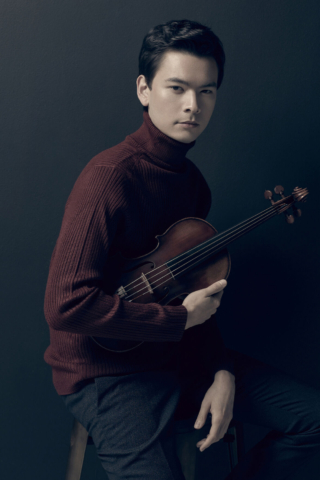
Audiences will have two chances to hear it performed live in Princeton, on Saturday and Sunday, May 7 and 8, at Richardson Auditorium, with Stefan Jackiw the soloist, and the Princeton Symphony Orchestra conducted by Rossen Milanov. The program will also include Gabriela Lena Frank’s “Elegia Andina” (“Andean Elegy”) and Felix Mendelssohn’s Symphony No. 3 “Scottish.”
When the above mentioned Heifetz introduced the concerto in St. Louis in 1947, the audience lapped it up. But a second performance in New York was savaged by the critics. Most notorious was Irving Kolodin’s withering put-down, “more corn than gold,” an unfortunate aphorism not easily shaken.
It was quite the reversal of fortune. Korngold, born in 1897, was once the toast of Vienna. A child prodigy who composed works of astonishing maturity, he was by the 1920s regarded as one of the world’s leading opera composers.
In the 1930s he accompanied impresario Max Reinhardt to Hollywood to provide music for a film adaptation of “A Midsummer Night’s Dream” (Recently used by the American Repertory Ballet’s for its “A Midsummer Night’s Dream” premiere). This began an association with Warner Bros. films that lasted until 1946.
With the outbreak of war in Europe, half in protest (he vowed not to “compose” as long as Hitler was in power) and half out of necessity (he was cut off from home), Korngold abandoned the concert hall for the movies, providing scores for Flynn swashbucklers like “Captain Blood” and “The Sea Hawk.” He credited “The Adventures of Robin Hood” with having saved his life, since he happened to be in America when the Nazis annexed Austria.
After the war, he attempted to pick up where he had left off, but the world had passed him by. Central Europe was in ruins, and Korngold’s brand of romanticism seemed hopelessly old-fashioned. His Violin Concerto was dismissed as kitschy and cinematic.
The irony is that it wasn’t Korngold who sounded like movie music; it was the movies that sounded like Korngold. Both he and Max Steiner (composer of “King Kong” and “Gone with the Wind”) had been personally and artistically connected to Gustav Mahler and Richard Strauss, among others. As European musicians found employment in Hollywood, Old World opulence became the soundtrack for New World fantasy.
The Violin Concerto does indeed have ties to Korngold’s film work. However, as evidence of the work’s purely musical appeal, many violinists who have embraced the concerto in the 21st century no longer associate it with the movies from which its themes were lifted. To them, “Another Dawn,” “Devotion,” “Juarez,” and “The Prince and the Pauper” (another Flynn vehicle) are now little more than names.
“I’m not really familiar with the films that he quotes,” PSO violin soloist Stefan Jackiw admits, “but the concerto holds up. I’m really drawn to how expressive, how heart-on-its-sleeve it is. Also how playful it is. It’s almost like there are moments of slapstick comedy in the third movement. The real emotional heart, I think, is the middle movement, the slow movement. There’s real sadness and weeping in that movement that I really love. The first movement, I can’t think of a more evocative opening. That sunrise of the first ascending violin line, it gives me goosebumps every time I play it and every time I hear it.
“Also, he’s such an imaginative orchestrator. His use of the different instruments really captures the hilarity of the last movement, but also the kind of smoky mysterioso ‘jazz improv’ feeling of the middle movement. So even though we think of him as being primarily a film composer, he was really a virtuosic symphonic writer.”
Although the upcoming concerts will mark Jackiw’s first appearances with the Princeton Symphony Orchestra (which is not affiliated with the university), the violinist previously visited Richardson with pianist Jeremy Denk to perform an all-Charles Ives program presented by Princeton University Concerts in 2019.
Also, he and Milanov have collaborated before, in Beethoven’s “Triple Concerto,” with the Chautauqua Symphony Orchestra, in 2019, and Brahms’ Violin Concerto, with the Columbus Symphony Orchestra, last year. In addition to his leadership role in Princeton, Milanov serves as music director for both of those ensembles. In 2015, soloist and conductor presented Prokofiev’s Violin Concerto No. 2 in Detroit as guests of the Detroit Symphony Orchestra.
Jackiw was set for his Princeton Symphony debut in 2020, as soloist in the Mendelssohn concerto, but the concert had to be scrubbed because of the pandemic.
His current season includes several unusual and underplayed pieces. Aside from Max Bruch’s “Scottish Fantasy” — a concert favorite — he has been championing Robert Schumann’s neglected Violin Concerto, Witold Lutoslawski’s “Partita,” and a new concerto by his associate, pianist and composer Conrad Tao. With cellist Jay Campbell, Jackiw and Tao form the JCT Trio (“JCT,” from their surnames, pronounced “Junction”).
The last time the Princeton Symphony played the Korngold concerto was in 2011, when Lara St. John was the soloist.
Princeton Symphony Orchestra, Richardson Auditorium, Princeton University. Guest artist Stefan Jackiw performs Korngold Violin Concerto. Also on program, “Elegia Andina” and Mendelssohn’s Symphony No. 3 (“Scottish”). Saturday, May 7, 8 p.m., and Sunday, May 8, 4 p.m. $10 to $79.50. 609-497-0020 or www.princetonsymphony.org
Korngold may have lost his luster for a few decades in the concert world, but his influence on the movies has endured. For that, more than anyone else, we can thank his spiritual heir, John Williams.
Williams’ Korngoldian approach to film-scoring is evident in his music for “Star Wars” and every big budget adventure he has worked on since.
Williams will be celebrated by the Capital Philharmonic of New Jersey in a concert at Trenton’s Patriots Theater at the War Memorial on Saturday, April 23.
The composer’s heroic, leitmotif-driven style will be well-represented, as music director Daniel Spalding will conduct selections from two of his Academy Award winners, “Star Wars” and “E.T. The Extra-Terrestrial.” Unbelievably, June will mark the 40th anniversary of the latter’s release. Both films share the distinction of having been the highest-grossing movies of their day.
The “Olympic Fanfare and Theme” that will open the concert is equally inspiring, cut from the same cloth as Korngold’s fanfare for “The Sea Hawk.”
But to define Williams solely as a Korngold disciple would be unjust. Although he trained as a classical pianist at Juilliard with Rosina Lhevinne and studied composition while at UCLA with Mario Castelnuovo-Tedesco (another émigré who fled fascism in Europe), Williams’ early success was as a jazz pianist. His father was a drummer with the Raymond Scott Quintet.
Williams Jr. (then known as Johnny) was much in-demand as a session pianist in Hollywood, playing on the soundtracks of Henry Mancini (“Peter Gunn”), Jerome Moross (“The Big Country), and Elmer Bernstein (“To Kill a Mockingbird”). He also worked with legendary film composers Bernard Herrmann, Alfred Newman, and Franz Waxman. With that kind of pedigree, it’s hardly surprising that he would embark on writing film and television music of his own.
In the mid-1970s, “Jaws” and “Star Wars” may have made him a household name, but as is so often the case, his overnight success was 20 years in the making.
Williams’ music for Steven Spielberg’s “Catch Me If You Can” is a clear throwback to the era in which, for him, it all began. The 2002 film tells of Frank Abegnale Jr., who, as a teenager in the early ‘60s, is said to have pulled off a series of audacious con jobs worth millions of dollars.
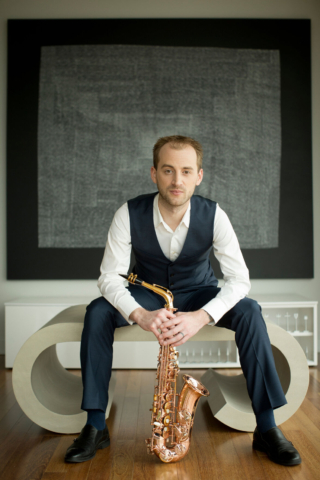
The composer arranged sections of his retro-tinged score into a concerto for saxophone, “Escapades,” which will form the centerpiece of the Capital Philharmonic concert. Saxophonist Jonathan Wintringham will be the soloist.
“The jazz influence is an important one, because he’s trying to capture that environment in his music,” says Wintringham. “One of the things I love about this score is that everything I feel like you experience in the film — the journey of the film — is kind of encapsulated in this work. With the third movement, ‘The Joy Ride,’ it ends on a lighter, happier note, in many ways, than the film itself. It’s definitely a lot less of the kind of epic statements of themes that you might expect. It’s a lot more subtle, a lot more mysterious, a lot more kind of ‘smoky jazz café,’ at times. That’s a language we may not associate with John Williams as much.”
In contrast to Jackiw’s approach to the Korngold concerto, Wintringham says rewatching “Catch Me If You Can” was helpful in shaping his interpretation of “Escapades.”
“At first, it was the excitement and recognition of hearing the parts that were in the film. But then it went deeper than that, in trying to associate the music with the sentiment, with the emotions that you feel in the music.
“I think the greatest challenge for me is probably wanting to contribute to the overall nostalgia that’s associated with the jazz saxophone of that time, while clearly being so removed from it as a player myself. As a 21st-century classical-contemporary saxophonist, my sound and the way I play and shape is very different from what is naturally called for in the music of this era. It’s about wrestling with the balance between trying to recreate the right atmosphere, while still representing myself as an artist, being true to my own identity.”
Williams has written concertos for virtually every instrument in the traditional orchestra. Few of them are tied to his work in film. Right now, at the age of 90, he is touring a new violin concerto with soloist Anne-Sophie Mutter.
Wintringham was originally scheduled to appear with the Capital Philharmonic in 2020, before the arrival of COVID necessitated a postponement. In the meantime, he has had the opportunity to collaborate with Spalding as a recording artist in Philadelphia, performing some of the conductor’s own music for future release.
A lifelong New Jerseyan, Wintringham has certainly had his share of exposure to high-level jazz saxophone playing. A graduate of the Eastman School of Music, he now serves on the faculty of the Rowan Community Music School of Rowan University. In addition, he is soprano saxophone chair of the award-winning East End Quartet, and he performs regularly with Kuninobu Bando, professor of saxophone at the Kunitachi College of Music in Tokyo, as part of the Bando/Wintringham Duo.
Even aside from his film work, Williams has been everywhere. He was music director of the Boston Pops. He wrote the theme for NBC News. He composed a fanfare for the Statue of Liberty for its centennial celebrations. He conducted an Independence Day concert in the nation’s capital. He was music director at the Academy Awards. He even provided a set of variations for the inauguration of President Barack Obama.
In a past generation, he would have been embraced as our John Philip Sousa. Like Korngold, in many respects, underappreciated, Williams has been America’s composer. Ever-present, if, outside films, seldom acknowledged.
It’s true that, with the rise of computers and electronics, film music no longer relies quite so heavily on the vocabulary of the 19th century orchestra. The economics of the film industry make lower costs and quicker turnaround appealing. A more modern, electronic approach, with characteristics shared with popular and video game music, has perhaps become more relatable to some. But arguably no other medium is as rich and full of expressive possibilities as the orchestra.
The Genius of John Williams, Capital Philharmonic, War Memorial Building, 1 Memorial Drive, Trenton. Featuring guest saxophonist Jonathan Wintringham. Saturday, April 23, 7:30 p.m. $35 to $65. www.capitalphilharmonic.org.
Williams’ scores remain popular with listeners of all ages. Performing arts organizations are coming to recognize what many of us have known all along: the artistry that goes into this kind of music and the wide appeal it holds for general audiences. As an upcoming example, the New Jersey Symphony will perform “Star Wars,” complete, with showings of the film Thursday through Saturday, May 12 through 14, at the State Theater in New Brunswick.
Full disclosure: Korngold may have been the composer who enlivened my childhood curtain-rod mayhem, but it was John Williams who really got me interested in the symphony orchestra. If not for “Star Wars,” I probably never would have been moved to explore Wagner, Tchaikovsky, and the rest, and to make music my life’s passion.
Thankfully, we seem to have moved beyond an era when “movie music” was used as a pejorative, to one in which music for film can serve as a gateway to a lifetime of enrichment. With traditional music education increasingly falling by the wayside, film remains accessible for the musically curious, who are left to catch as catch can.
Star Wars: A New Hope, New Jersey Symphony, State Theater, 15 Livingston Avenue, New Brunswick. Thursday, May 12, 8 p.m. $35 to $110. 732-246-7469 or www.statetheatrenj.org.