Those looking to cool off with some lively art can do so by making a stop to one of the several fine art fountains in the central New Jersey region.
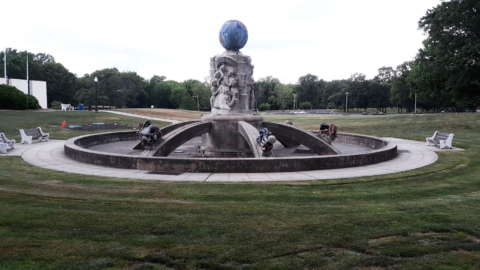
The oldest and arguably most intriguing is “Light Dispelling Darkness,” located in just off Route 1 in Roosevelt Park in Edison.
The monumental 1938 work by American ceramic sculptor Waylande Gregory is period piece that captures a moment in time — when the advances in modernism after World War I gave way to the grim uncertainties of the Great Depression.
The terra cotta fountain rises from a 40-foot-diameter basin. At its core is a 20-foot-tall pillar. Topped with the allegorical 10-foot terra cotta globe of light, the pillar bears three reliefs showing humans engaged in diplomacy, the arts and sciences, and harmonious labor relations.
Six arches form the trails of six allegorical figures of destruction rushing from the light and the light of reason. The figures include a skeleton on a horse representing Death; a Roman Warrior wearing a World War I gas mask, War; an emaciated woman, Famine; two octopi clutching one another, Greed; stock agents and tickertapes, Materialism; and a yellow spotted blue woman under a horse sporting a dollar bill, Pestilence.
“Light Dispelling Darkness” was created through the New Jersey Federal Arts Project under the Works Progress Administration (WPA). The then-32-year-old Gregory was also the director of New Jersey’s WPA chapter when he received the commission.
According to a New York Times article, “Gregory, who was born in Kansas in 1905, was a prolific sculptor of the 1930s, well known as an innovator in ceramics. An enthusiastic reader of the 16th-century prophet Nostradamus, and a stylist in the manner of the Social Realists, Mr. Gregory designed a hair-raising assemblage of good forces repelling evil to create a utopian new world order” — that included the prophet’s vision of a world peace conference.
The design also touched on two regional references: the terra cotta industry in nearby Woodbridge, Perth Amboy, and Sayreville during the late 19th and early 20th centuries, and the laboratory of an individual who actually dispelled darkness with electricity, Thomas Edison.
A brief biography of Gregory says as a “child, he made mud sculptures and glazed them with syrup.” He moved to Metuchen in 1933 and opened up his own terra cotta studio in Perth Amboy, allegedly operating the largest kiln in the world. A few years later he was commissioned to create another monumental work, the “Fountain of the Atom,” located at the entrance of the 1939 New York City World’s Fair.
By the 1940s Gregory realized that he would be unable to support his family by working in public art and began focusing on small ceramic work. He then saw his figurative work eclipsed by the abstract expressionist art movement and turned to teaching and creating works of metal. He died in Warren, New Jersey, in 1971.
“Light Dispelling Darkness” had its own trials over the years until the Middlesex County Freeholders, Cultural and Heritage Commission, and Parks Department and County Engineer generated funding from the Washington, D.C., based Save Outdoor Sculpture to save and maintain the work.
I visited the sculpture during times when the fountain was operating and when there was no water. While the former shows it off and can cool one off, a visit to the fountain is like a trip to another era and one of the most fantastic artistic visions one can find.
James FitzGerald’s “Fountain of Freedom” on the Princeton University campus is another very public, personally infused statement by another World’s Fair artist — this time the 1962 Seattle World’s Fair.
A handy description from the university says that “at 23 feet high, ‘Fountain of Freedom’ is one of the largest cast bronze sculptures in the U.S. Inspired by the rugged beauty of the artist’s native Pacific Northwest, the grooves, channels, and spires of the six-ton sculpture — reminiscent of naturally eroded forms — are meant to symbolize Woodrow Wilson’s aspirations and frustrations.”
Originally a painter from Seattle, Washington, FitzGerald studied with noted Mexican muralist José Clemente Orozco and American artist Thomas Hart Benton, participated in the WPA murals program, moved to New York (where he lived briefly with Jackson Pollock), then studied architecture at Yale.
During his time with the WPA, he was sent to do work in rural Idaho. Of that experience he says, “I spent all summer hiking in northern Idaho from one mountain fire lookout to another. This summer was valuable to me, and I imagine these early studies of nature have some bearing on the abstractions of our western landscape I am doing today in bronze.”
FitzGerald returned to Seattle, where he taught. He also married artist and teacher Margaret Tomkins, who partnered in his work.
Northwest art historian Fred Poyner notes, “In 1954, FitzGerald completed his first full-sized bronze sculpture, a fountain for the campus at Washington State College (soon to be renamed “University”) in Pullman. The work was an evolution of sorts for the artist, with his desire to take forms found in nature — rocks, trees, forests — and translate these into public artworks to be enjoyed as bronze and stone sculpture. A second fountain — Rain Forest — was designed in 1959 and cast into bronze for Western Washington College (later University) in Bellingham, and installed in 1960 as Western’s first acquisition for its new outdoor sculpture collection.”
In an archive document Tompkins explained that FitzGerald’s approach was to employ “hand-formed individual patterns cast in a sand mold. The original idea for the sculpture was not developed through drawings, but by making a small-scaled sculpture in wax which was cast by the lost wax method. This model indicated a general conception from which the sculpture later developed in its own way in relation to scale and inter-related forms.”
While FitzGerald experienced a series of successes, the one at Washington College brought him the World’s Fair project. The architect with whom he worked at the college had been commissioned to provide a work for the Century 21 exhibition and invited the sculptor to participate. He created two works.
The early successes led to continued opportunities, including a sculpture in a sunken plaza of the 1964 IBM Building in Seattle designed by fellow Seattle native Minour Yamasaki, who also designed the ill-fated World Trade Center in New York City and, in the mid-1960s, Princeton University’s School for Public and International Affairs (formerly the Woodrow Wilson School of Public and International Affairs).
FitzGerald’s last fountain was in 1970, and he died in Seattle in 1973.
While few visitors to the site know his name, his mountain forest-inspired fountain is a friendly and easy place to rest, meet friends, and unwittingly celebrate freedom.
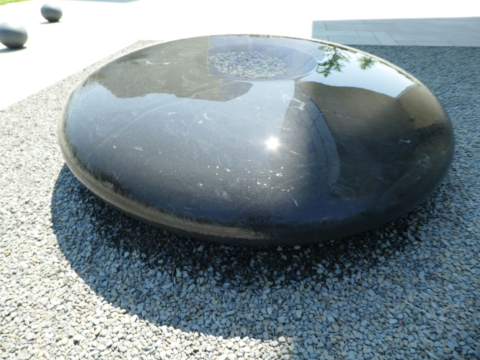
“Einstein’s Table” by celebrated contemporary designer Maya Lin is a smaller and more intimate fountain on the other side of the campus.
The Princeton University Art Museum, a major university collaborator on the project, describes the work installed in 2019 as an “11-foot diameter granite ‘water table’ whose elliptical shape recalls drawings of the Earth’s orbit around the sun. The table’s jet mist stone, sourced from a quarry in Culpeper, Virginia, was chosen for its subtle white striation, gently reminiscent of the appearance of the Milky Way in the night sky. The elliptical orb, along with the water weir and fountain at its center, were designed by Lin as an homage to onetime Princeton resident Albert Einstein and his theory on black holes. Like Lin’s earth drawing, this work also extends a series within Lin’s practice, in this case a series of site-responsive water tables that were initially inspired in the 1990s by another sculpture on Princeton’s campus, Scott Burton’s Public Table (1978-79). Both artists’ works in the form reflect an interest in activating communal spaces. Of Lin’s work to date in the water table form, examples of which can be found on the campuses of Yale and Brown universities, Einstein’s Table is the most abstract.”
Lin developed two projects for Princeton; the other is the environmental earth work “The Princeton Line.” She says both “tap into my dual interests in immersive and environmental earthworks, as well as my focus on a more object-oriented cartographic and science-based approach.”
“I’ve always been drawn to a very still use of water,” said Lin during a public discussion when her artworks were unveiled in 2019. “I’m in love with things that aren’t what you think they’re going to be. I want to ‘still’ the water down until it’s barely moving, and then you engage with the piece. Water has a propensity to be both very powerful and extremely calm.”
The PUAM says of the New York-based Lin that as a “designer whose creative practice extends from public art to sculptural objects to architecture, Lin first achieved international recognition as an undergraduate at Yale University, when her design for the Vietnam Veterans Memorial in Washington, D.C., was chosen in a national competition. During the course of her remarkable interdisciplinary career, Lin has created a lasting and highly influential body of work that includes residential and institutional architecture, a powerful range of memorials (including her most recent, a web-based project focused on species loss), and site-based outdoor work such as the Civil Rights Memorial in Montgomery, Alabama (1989); ‘Wave Field’ (2008) at Storm King Art Center in upstate New York; and ‘A Fold in the Field’ (2013) near Auckland, New Zealand.”
Lin’s Princeton works were part of a 10-year plan to add work to the university’s public art collection and to complement the opening of the Lewis Arts complex.
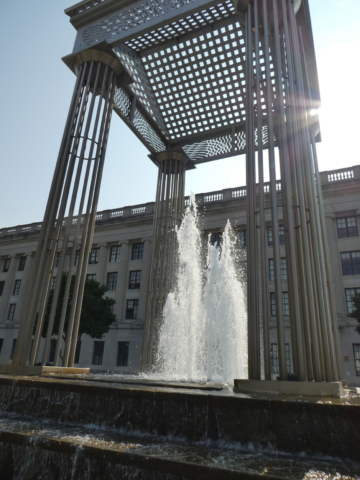
“Confluence” rises at the center of the New Jersey State House Plaza at the center of the New Jersey State House Complex on West State Street in Trenton. It was created in 2000 as one of the juried New Jersey State Council of the Arts’ Arts Inclusion Projects.
In a statement regarding the fountains, creator Clyde Lynds says, “The 35 foot high, stainless steel fountain pavilion, designed with classical form, represents the state while the waters symbolize the resources in the state’s care. A powerful, programmed water display erupts every 15 minutes.”
The design is also a confluence of styles. Its abstracted columns and Greek temple-inspired architecture reflect the architectural references to the American Renaissance and Neo-classical styles found in the nearby State Capitol buildings built in the 19th and early 20th centuries as well as the clean and unadorned facades of the international-styled architecture of the state structures built in the 1960s.
The statement notes that the design of the fountain “begins at the entrance to the plaza with a pair of sculptures engraved with figures from the state seal, Liberty and Prosperity. At night beacons on top of the sculptures illuminate the entrance, while changing fiber optic displays on the surface of the stone columns depict the sky over Trenton as it looked when it became the state capital.”
Surrounding the foundation there is a 500-foot granite seating wall that bears the name of every state municipality. And between the fountain and the end of the plaza, where one can gaze at the Delaware River, there is a 225-squre-foot granite-etched floor map of Trenton in 1790, when the city became the state capital.
In the catalog for the New Jersey State Museum’s 1993 exhibition of Lynd’s work, New York art critic Eleanor Heartney wrote that the artist “was trained as a painter and developed a style that explored ambiguous qualities of light on surfaces and objects. At the same time, he was always interested in the permanence of carved stone and fascinated with the work of the sculptors and architects of the stone relics he observed in his travels to Greece, Egypt, Mexico, and Japan.”
A resident of Wallington, New Jersey, Lynds has also mounted solo exhibitions in New York, Washington, Toronto, and Tokyo. His work is included in the collections of the National Museum of American Art of the Smithsonian Institution, the Wadsworth Athenaeum in Hartford, and the Butler Institute of American Art in Youngstown, Ohio.
In addition to completing large scale commissions for the Federal Office in Manhattan, he received commissions from the Federal Government’s General Services Administration and the states of New Jersey and Connecticut.
The seating wall around the fountain provides a quiet invitation for groups to rest and chat and enjoy the water show — and perhaps be refreshed on a hot late summer day by the fountain’s welcomed cool mist.