Classical solo saxophonists are a rare breed, and a true virtuoso is the rarest of the rare.
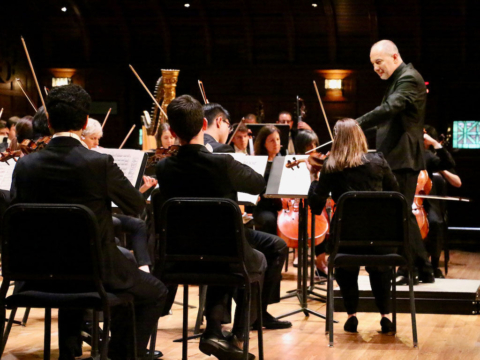
So, those of us in the audience last weekend when the Princeton Symphony Orchestra showcased the talents of saxophonist Steven Banks as part of its 2023-2024 season opening concert, should consider ourselves quite lucky. With Rossen Milanov conducting the PSO, the exceptionally talented Banks performed Henri Tomasi’s (1901-1971) Concerto for Alto Saxophone and Orchestra, just one of three singular pieces offered in the program.
The evening of music began with contemporary composer Sarah Kirkland Snider’s “Forward into Light (2020),” musings on American women suffragists who struggled in their crusade for women’s equality – particularly the right to vote.
The piece began with the flutes and piccolo, just barely audible wisps of haunting sound. We heard a lonely motif in the harp, then violins, then the bassoon interacting with the percussion — all of which evoked a sense of isolation and anxiety. Moments of brightness and a feeling of hope burst through in the winds, then the mood darkened as the full orchestra returned, then retreated, then swirled into a crescendo.
Toward the end, a quote from “March of the Women,” an early anthem of the women’s suffrage movement, was initiated by solo clarinet, then picked up by the rest of the wind section, as the composition closed on a note of positivity and inspiration.
Tomasi’s Concerto for Alto Saxophone followed, and soloist Banks “sang” through his instrument, with a simply beautiful tone to open the piece. The composer grew up in the port city of Marseille and his works often echo or evoke a watery feeling. We heard this undulating undercurrent in the lower brasses, as Banks deftly ran the range of the instrument, through passages of ethereal chords and chromatic runs.
As the lower brasses traipsed through one passage, Banks effortlessly executed little twists, turns and asides on the saxophone. Then, as the piece grew lyrical again, Banks reached for the uppermost range with ease and impeccable intonation. There was so much going on in the orchestra, as a storm-like sound in the brass and percussion roared and softened.
Then, a lengthy cadenza allowed Banks to really shine. Again, his performance was flawless, charismatic and mesmerizing.
The second movement lifted off energetically, with Banks and the first clarinet in a staccato dialogue interspersed with more of those dazzling runs up and down the saxophone.
The clarinet settled into the lower register and created a kind of continuo, a buzzing, fluid stubbornness while the saxophone soared above. The many moving parts of the PSO blended with Banks’ virtuosity, as the piece came to a crescendo.
The audience gave Banks a standing ovation, and so much love that he came back on stage to do an awe-inspiring a cappella version of The Lord’s Prayer, a setting by American composer Albert Hay Malotte. I’ll bet even non-believers teared up as Banks ascended to and reached the climactic high note.
The second half of the program featured William Dawson’s 1934 composition “Negro Folk Symphony.” The piece was revised in the early 1950s, after the Black composer toured Africa, bringing back with him joyful sounds, rhythms and tonalities from the continent.
Our journey began with a solo tuba carrying a jaunty folk melody, echoed by the English horn. The tempo picked up to a gallop, as the air worked its way through the strings. I enjoyed the composer’s vibrant colors and use of the whole orchestra, like a full-throated gospel choir.
In the second movement, Dawson wanted to reflect the despair and hope of a people removed from their homeland. A motif ran through it, at times somber and foreboding, at times heroic and spirited. Throughout, we heard a clank of percussion, evoking hard manual toil, or the jangle of chains. This heaviness was balanced by a playful interlude in the winds and a plaintive passage in the French Horns.
The mood lifted in the third movement, which signifies renewal and blends the themes of the previous movements. You could already feel a sense of invigoration, with a bright solo oboe, then bassoon, then clarinet. More lovely passages, particularly in the winds, and a jubilant percussion section brought the symphony to its rousing finale.
The Princeton Symphony Orchestra returns to Richardson Auditorium, Saturday, October 14 and Sunday, October 15. Assistant conductor Kenneth Bean will lead the PSO, performing works by Sibelius and Mendelssohn. Guest violinist Jennifer Koh performs Missy Mazzoli’s Violin Concerto. 609-497-0020. www.princetonsymphony.org.