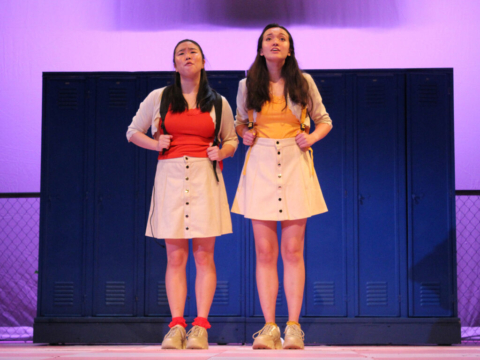
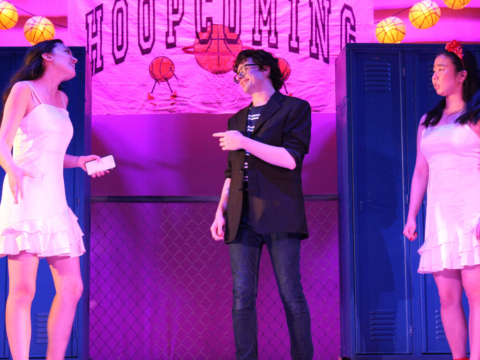
Survival of the fittest, or at least the most cunning, is the business of “Peerless,” Jiehae Park’s dark comedy about covetous competition at Princeton Summer Theater through Sunday, July 30.
Aggressively or passively, five students vie for a single spot at a prestigious university. The most overtly aggressive, M (Sydney Hwang), believes the golden spot is hers. She has worked hard. She had achieved the highest academic distinctions including 16 advanced placements, and she has done the legwork and roadwork necessary to impress.
Frankly, M is right in thinking she is the best and most deserving candidate for the sought-after berth. Her sterling credentials say so. Her identical twin sister, L (Gaea Lawton) assures her so, and a look at the others up for the prizes convinces anyone who judges objectively.
Hwang does not portray M as a nice or rounded person. In Eliyana Abraham’s sharp production, she is more ambitious than laudable, more governed by check-list and entitlement than joy of achievement.
Yet, Hwang, Park, and Abraham make you believe M should have her reward.
A package dropped in a loud plop from the stage flies indicates before “Peerless’s” action begins that some character we are about to meet was accepted. Then, we see M carrying a thin envelope and know it isn’t she.
Her rejection puts M into a rage encouraged by rapid contrapuntal assurances from L that M is justified is hating whoever “stole” her space, one L, according to the twins’ plot, is supposed to get the next semester. The sisters become more heated when they reveal the person who won M’s desired placement is someone they describe as a silly fat boy who happens to be two-percent Native American based on his great-great grandfather and wears a lanyard around his neck holding his tribal certification.
Park’s plot line looks as if it comes from today’s headlines. A controversial Supreme Court decision last month ruled in favor of plaintiffs, who happened to be Asian as M and L are, suing because quotas and other criteria were keeping them from receiving places in desired universities in spite of their higher achievement compared to the students being selected.
Such an expectation would be deceiving, possibly because Park wrote “Peerless” before the Supreme Court ruled. Smatterings of higher academic standing meriting higher rewards remain in Park’s script, but they are not the crux of it.
The outrage M and L express when M is passed over for D (Ed Horan), who has lost considerable weight when we meet him but flaunts his tribal identification, provides the motivation for Park’s characters.
Matters are exacerbated when M and L learn that others around them, including M’s boyfriend, who happens to be Black, have vied for and come closer than M to getting that placement she regards as only hers.
“Peerless” is not a play commenting on the times. Well, perhaps glancingly. It’s a good old-fashioned revenge play couched in a comic tone.
The point becomes less who deserves what. It centers on how the self-nominated deserving, M in particular, is going to claim her seemingly rightful place.
The revenge plot, though clever and with surprising twists, especially as regards M’s boyfriend, becomes unsavory. Once launched, it renders no character sympathetic, only ambitious and loaded with guile. It leads to an increasingly suspected ending that shows the power of the quiet and passive but unsatisfying because it is gained nefariously based on shrewdness rather than merit.
Unless you count better gamesmanship as deserving some reward.
Park’s play is not intended to please at the conclusion. Given its characters, it may have been impossible for one to be preferred over another considering how amoral they are. Rather than the ends justifying the means, the ending is a triumph of the slow and steady, the one person among the pack who is so bloodless and so willing to do the necessary without regard to conscience prevails.
Because of this, Park’s comedy, though frequently funny, becomes so dark you don’t feel like congratulating the author for wending her way to this ending as much as you’d have liked to see some semblance of humanity along the way.
The closest such humanity comes from the otherworldly. Park peppers her script with references to D’s Native American heritage. A black feather drops from the flies when the spirit of D’s great grandfather wants attention. You also hear characters seem to leave their own skins to yell, “Wake up!,” as the great grandfather pointedly does once to D.
Eliyana Abraham and an able cast work hard to elicit the texture within Park’s piece. Abraham understands the play’s various notes, including that is gives you no one to root for, and accentuates comic bits and nuances to keep “Peerless” entertaining and to provide some suspense about whether one character or another will have the nerve to carry out his or her reprehensible plan.
Abraham’s cast contributes gleefully to the entertainment —you can tell they’re having a good time on stage — and to “Peerless’s” mystery.
Sydney Hwang is forthright as M. She leaves no doubt M not only wants the university placement but believes she and she alone has earned it. Her anger and contempt for others, especially D, seems boundless and heading towards the desperate.
It comes as a surprise then, a good one, that Hwang is able at one critical point to relax M’s disdain and consider a bigger picture. This sequence doesn’t change a dreaded outcome, but it gives M dimension and depth she hadn’t displayed. Her smugness lessens. She can see another point of view, can question herself, and make a moral decision. Until L steps in and puts her back on course.
Hwangs handles this transition, momentary as it might be, beautifully. For once, she makes you like M and think she’s more rounded and less a vector aimed only at getting what she wants.
Gaea Lawton is perfectly sly as the cooler, less emotional L. She is the empathetic twin who supports her sister and keeps her on keel when she appears on be straying. L, agreeing to wait her turn, is the reasonable sister whose personal ambition is held in abeyance to M’s.
At various points in Abraham’s production, I took special measure of L and was always impressed with the way Lawton handled her through-line from “Peerless’s” open to its finish.
Ed Horan is ebullient enough to energize stages from the Hamilton Murray to the Old Globe in San Diego. His character, D, says he talks non-stop, and Horan makes that into a sport, sometimes losing some diction along the way. Obnoxious as D can seem, Horan makes him into the sweet, likeable nerd happy to have fallen into a bit of luck that earned a place at the university. Horan’s ingenuous spirit makes D likeable and makes M’s alternating attitudes towards him plausible. Horan also does well as D’s woefully asthmatic brother.
Christien Ayers represents normality as BF, the boyfriend, giving some solidity to Park’s fancy. By contrast, Nora Aguiar plays a strange Cassandra-like character who taunts M with information she seems to divine from the atmosphere. Aguiar is deft in making this character half-interesting, half-creepy.
Jeffrey Van Velsor’s set again served multiple purposes well. Clara Bloom’s costumes fit the occasion but were patently unattractive.
Peerless, Princeton Summer Theater, Hamilton Murray Theater, Princeton University. Through July 30, Thursday through Saturday, 8 p.m., and Saturday and Sunday, 2 p.m. $30 to $35. www.princetonsummertheater.org.