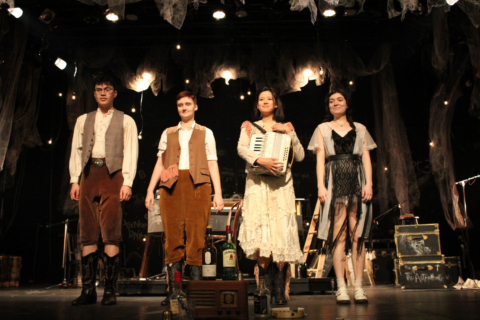
Frequent moments of excellence and performances of musical and vocal versatility abound in the Princeton Summer Theater production of Dave Malloy’s “Ghost Quartet.”
The song cycle weaves several stories, suggests several literary sources, and has to do with death luring sentimental people to their demise.
The superlatives BT Hayes’ staging rates are offset by the ponderousness of Malloy’s piece that is so in love with its allusions and variations, it darts off into myriad directions and dozens of plot twists that do not register clearly and, in time, become tedious. As good as Hayes’ company is, and it is uniformly terrific, and as clever as some of the director’s choices are, I found myself becoming tired of “Ghost Quartet” and wanting it to end.
The actual ending, in which cast members distribute percussion and string instruments to aisle-sitters and invite the audience to join them in a final tune that encapsulates the main tale in Malloy’s mélange, is lovely and rousing, the crowd really getting into to shaking their tambourines, striking a xylophone, and strumming an autoharp.
The love for the cast and the warm spirit of this last sequence cannot hide that while occasionally poignant, Summer Theater’s “Ghost Quartet” provides more admiration than entertainment or depth.
One long section, on “Side 3” of a format that announces each number as if they were cuts on a double record album, is particularly off-putting and distancing in a way that is more confusing than Brechtian.
Much of the pleasure in Hayes’ production comes from watching the cast’s expressions, basking in their universal ability to play a sundry and unrelated array of instruments, sometimes switching from one to another within one scene, and taking in the whirl of characters, and even performer Sam Melton’s piano, moving with choreographed abandon as individual numbers unfold.
In — on? — Side 3, the bulk of Malloy’s songs are presented in total, unrelenting darkness. Happening suddenly and lasting for what feels like an eternity, this plunge into the invisible robs the play and production of most of its virtues. Instead of making one listen more intently, as blackouts often do, and appreciate verbal nuances the visual tends to absorb, this extended sequence annoys and turns story lines that require concentration to track into gobbledygook. I, for one, stopped attending carefully to the songs and began wishing for the lights to return.
Never having read Malloy’s script, I remain unsure whether the darkness is mandated or Hayes’ idea. Whoever dictated or thought of it, and despite some intriguing sound design from Minjae Kim, this passage scuttles any good will one had towards Hayes’ production to the point that it becomes unrecoverable. You can feel the restlessness and tension in the audience while none, Kim’s efforts notwithstanding, resonated from the stage. The inert superseded the interesting.
The shame is if Malloy’s songs at times wore out their welcome as pieces to hear, Hayes and her cast also gave the audience something worthwhile to see.
Rather than being tied to their instruments or serving as narrators to Malloy’s convoluted yarns, Grace Zhao, Radon Belarmino, Kate Short, and the above-mentioned Melton endow numbers with personality and earn high praise for the wit and thought they put into their phrasings and expressions. As much as they can, they flesh out Malloy’s lyrics that often travel aimlessly and are more in love with sounds of words and imagery for imagery’s sake than they are with direct and gripping storytelling.
Whatever emotional reaction you have to the yarn being spun, it’s Hayes’ sterling cast that provides it. They, when they can, keep the piece from dissolving from overload and guide you through the four or more threads Malloy employs to embroider his tales of the dead, the frequent violence of their deaths, and the allure death has for survivors.
Zhao, Belarmino, Short, and Melton are as musically complete an ensemble as has ever been created. An accordion, cello, percussion, and piano may be their basic assignments, but each exchanges his or her primary instruments so you wonder, while hoping not, if there’s any end to their ability to make beautiful music.
This talent extends to the cast’s vocal performance. Its individual voices all have resonance and texture. In harmony, the group is superb. No matter the combination in which they sing, the sound they produce is lovely, a delight to hear and a blessing to behold. Zhao and Short, in particular, have moments that dazzle with the compatibility and complementary nature of their voices.
While all receive kudos for instrumentality, Belarmino’s cello is the star, almost an additional character that intensely and sonorously enhances all Malloy attempts to accomplish.
With all this talent, and all this goodness in presentation, why isn’t Malloy’s “Ghost Quartet” more moving and involving?
The answer is it goes too many places, gets enamored more with language than substance, and draws on too many references to be concise and engrossing.
The opening number (Side 1, Cut 1), “I Don’t Know” holds great promise. When I heard words akin to if not exactly, “I don’t know what I know or how I know it,” I thought, “We’re in for something interesting; that’s already a clever sentiment worth exploring.” Then came one of Malloy’s walls of imagery, and the cleverness became lost in self-consciousness. A couple of other tunes, “Any Kind of Dead Person” and one in which one is about to lose control to boozy badness, also work.
To be fair, maybe Malloy’s writing is too complex to be heard for a first time without knowing it. Perhaps it’s rich in a way that requires multiple experiences before it’s fully grasped. Yet, the point is Malloy works in the theater, so even if I give him the benefit of a doubt and castigate myself for not being attuned enough, his words do not register in a way that moves. Zhao’s expressions and readings help, but they are not enough to make up for the density of Malloy’s lyrics.
Malloy is also too in love with allusion. Snatches of Poe and “The Arabian Nights,” Scheherazade and all, blend with ideas familiar from other stories, primarily ghost tales, until the main plot involving a woman, Rose, and her sister, Pearl, who dies in childhood and a secondary thread, about Rose, a photographer loving an astronomer and feeling guilty about taking a picture instead of helping when someone is thrown in front of an oncoming train, until all caring or definition gets lost in a general stew of narratives.
Even Zhao’s inventiveness and Belarmino’s gorgeous cello cannot rescue “Ghost Quartet” from this overkill. (The cast indulges in some asides throughout the show. Upon one colleague telling Belarmino how beautifully he plays the cello, Belarmino comments drolly, “I practice a lot.”)
Zhao is a marvelous actress. She provided shrewd, knowing, enhancing commentary that gave texture to songs that otherwise would have been at sea. Radon Belarmino is another wonder, so subtle and ingenuous while being so proficient and versatile.
Short amplified the talents she displayed in PST’s “Pride and Prejudice,” adding clarity at some crucial points. Melton kept the music flowing and contributed well when asked to vacate the piano to take a character or in strengthening the harmony.
Jeffrey Van Velsor’s set, looking at first like the set-up for a band rehearsal, gives Hayes a chance to create constant swirl and movement, including a traveling piano that never seems cumbersome as it flits to various positions on the stage. Clara Bloom’s costumes are minimal but fun. Alex Slisher’s lighting design, the dark Cut 3 aside, is among the wittier parts of Hayes’ production.
Ghost Quartet, Princeton Summer Theater, Hamilton Murray Theater, Princeton University. Through Sunday, July 16, Thursday through Saturday, 8 p.m., and Saturday and Sunday, 2 p.m. $30 to $35. www.princetonsummertheater.org.