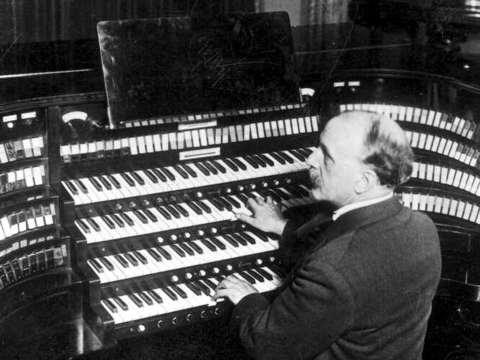
On June 2, 1937, French composer and organist Louis Vierne had just concluded his 1,750th organ recital, which eyewitnesses claimed had been as fine a concert as he had ever given.
He was just about to launch into two improvisations on submitted themes, and had already selected the stops, when all at once he pitched forward. As he collapsed, his foot hit the low E pedal, and the sustained note resounded throughout the vast cathedral.
Whether it was a heart attack or a stroke that ended his life is unclear. What matters is that Vierne went out the way he said he had always wanted: He died at the console of the great organ of Notre-Dame de Paris.
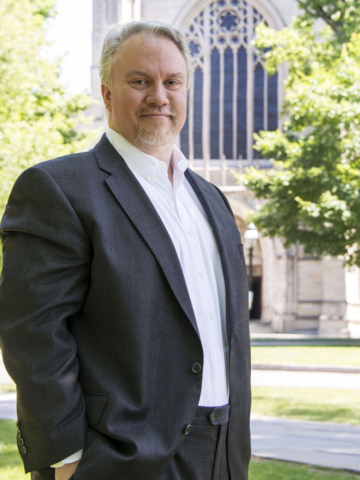
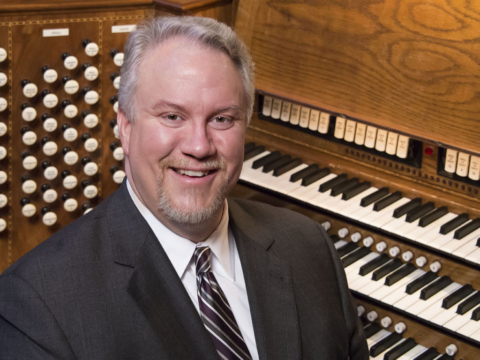
In a sense, Vierne continues to resound, as one of the greatest French composers for his instrument. One of his most recent champions is none other than Eric Plutz, whose new recording, “Vierne: The Complete Organ Symphonies,” has been released as a three-CD set on the Princeton-based Affetto Records label.
Plutz, of course, is a highly visible figure on the local music scene. Now in his 18th year as university organist at Princeton University, he shares musical duties at Princeton University Chapel with director of chapel music Nicole Aldrich. Aldrich directs the 65-voice Chapel Choir and oversees choral concerts, worship services, and other special musical events. Plutz oversees just about anything that involves the organ.
He coordinates the “After Noon Concert Series,” 30-minute free recitals given at the Chapel by a variety of organists on Thursday afternoons from 12:30 to 1 p.m.
He hosts full-length concerts by visiting organists, such as Scott Dettra, who recently performed 19th-century Belgian composer Cesar Franck’s complete works for the instrument, in honor of the composer’s bicentennial.
Plutz too has been working his way through Franck’s oeuvre, presenting the pieces as preludes or postludes to nondenominational services held at the Chapel on Sunday mornings at 11 a.m. The services are sponsored by the university’s Office of Religious Life. He anticipates the last of the works will be performed around the time of the composer’s actual birthday anniversary on December 10.
Plutz supplies all the organ music for the services themselves, playing voluntaries, supporting hymns, and accompanying the choir, as necessary. He also plays for weddings and funerals that are held at the Chapel.
He plays for the university’s academic services: the opening exercises for first-year students, the baccalaureate service for seniors, and a special service on Alumni Day to remember those who died over the past year.
He also performs three evening concerts a year, in November, February, and May — the latter on the Friday of Princeton Reunions.
The next of the concerts will take place on November 11, when the focus will be on contemporary composer Gerald Near. Plutz played Near’s Organ Sonata No. 2 as part of an all-American program he toured throughout Germany. In gratitude, the composer dedicated his Third Sonata to him. The Princeton performance of the new piece is believed to be the work’s world premiere.
In addition to his duties at the university, Plutz teaches the instrument at a private studio in his Princeton home (where he keeps an electronic organ) and is an instructor with the Princeton Music Department.
Plutz stays busy touring and working with other musicians and musical groups in the community, including the position of collaborative keyboardist with Princeton Pro Musica. Currently, he is accompanying the choir (on piano) in rehearsals for its upcoming performance of 19th century Romantic composer Johannes Brahms’ “Ein Deutsches Requiem,” which will be presented with orchestra at Princeton University’s Richardson Auditorium on Sunday, October 23, at 4 p.m.
On occasions when a pianist is required for a concert, Plutz will appear on the program, as he did when artistic director Ryan James Brandau conducted the original chamber orchestra version of American composer Aaron Copland’s “Appalachian Spring,” or when the choir performed the two-piano version of Carl Orff’s 1937 oratorio “Carmina Burana.”
Later this season, in the last of its four concerts, Plutz will accompany the choir on the organ in a program presented in honor of the 80th birthday of American composer Morten Lauridsen, to be held at Princeton University Chapel on May 6. He will support the choir in Lauridsen’s choral masterpiece “Lux Aeterna” and play a suite for organ by Florence Price.
Plutz grew up in western Illinois, along the Mississippi River. His father was a computer programmer for the U.S. government at the Rock Island Arsenal; but on the side, he played clarinet and sang in a barbershop quartet. His mother was a registered nurse who became a homemaker once she started to have kids. Eric was the middle of three children. His mother played the piano, and both parents sang and rang handbells in the church choirs. “Nothing professional,” Plutz says, “but they had a healthy love and respect for music.”
Summers were often spent with his mother’s family on the farm they owned in northeast Indiana.
“For three or four weeks, we would be gone to this area. To keep us entertained, one of my uncles, who lived outside of Indianapolis, took us to a place called the Paramount Music Palace. It was an old theater, with the theater organ, that had been completely renovated, and the organ was now tricked-out so that if the marimba stop played, little lights would shine on the various bars that were being used for the sound. There was an upright piano on the wall, and whenever that was played, a light would shine on the piano.
“So it was not just an aural experience, but a visual experience as well. Lights would shift, and lights were flashing. The swell shades were made out of plexiglass or plastic or something. You could see through them, into the pipes. And of course the console would come up, and it would turn this way, and then it would turn that way.
“To an 11 or 12-year-old boy, all the mechanics of this were really interesting. I wanted to do all that. I wanted to make all that happen. So it was a theater organ that started it all.”
At the time, Plutz had already been taking piano lessons (which he continued). His mother arranged his first organ lessons with the music director of their church in Rock Island. Her degrees were in voice, but she also played piano, and she knew her way around the pedals of the organ.
Once she felt she had taught him everything she knew, she encouraged him to find another teacher and to keep going. Plutz then studied with an organist in town, who prepared him for auditions at the Oberlin Conservatory and at Westminster Choir College in Princeton. He was accepted at both institutions.
He recalls, “Westminster gave my parents a better financial aid package, so they said ‘You’re going to Westminster.’ I had the best four years of my life there. It was great.”
He was a double major in piano and organ until the summer between his sophomore and junior years. That’s when it became clear to him that he preferred practicing the organ. He was also starting to think pragmatically about the future.
“Honestly, I thought I was a better organist than I was a pianist. I love the piano. I still play the piano all the time. But I think I excel at playing the organ. And I thought I would be able to make a living as an organist.”
He graduated from Westminster with an organ performance degree. Then he earned his master’s from the Eastman School.
He secured a full-time position as assistant organist at St. John’s Episcopal Cathedral in Denver, Colorado, which had an impressive music program. (It’s rare for an assistant organist to be employed full-time.) Gerald Near was artist-in-residence there.
After four-and-a-half years, Plutz moved to Washington, D.C., where he served as director of music at the Episcopal Church of the Epiphany. “It’s right downtown, three blocks east of the White House. Built in 1841, this proud old church is there, surrounded by these modern office buildings. I was there for 10 years. It was a great place to work. I enjoyed the fact that I had my own parking space in downtown Washington.”
He returned to Princeton in February, 2005.
Prior to his work on the Vierne project, Plutz recorded four CDs for the Pro Organa label.
When shopping around the idea for a Vierne cycle, he was told the CD format was dying. One company expressed interest in documenting the performances, but only as a video.
Plutz had known John C. Baker, a recording engineer and owner of Affetto Records, since he was a student at Westminster. Plutz was then assistant organist at Trinity Episcopal Church and Baker recorded the services there. In more recent years, Baker has recorded innumerable musical groups during Plutz’s tenure at Princeton University Chapel. In all, the two have known one another, on and off, over some 35 years. According to Plutz, when he called Baker to pitch the Vierne project, Baker said, “I’ve been waiting for this call.”
Unfortunately, right in the middle of the endeavor, COVID-19 broke out across New Jersey. While everyone was isolating, Plutz offered all six Vierne symphonies as a streamed marathon in honor of the composer’s sesquicentennial. (Vierne was born on October 8, 1870.) All were performed on the Mander-Skinner Organ at Princeton University Chapel.
For the CD collection, Plutz opted to use six different organs in six different venues across the U.S. “Each instrument is from a different builder, but all are in the French style. Except for one, which is a quintessential American classic instrument. I play the Sixth Symphony on that, because that’s the one he composed after he toured the United States. He called for all these American sounds that no French organ would have.”
This entailed a lot of travel, and a lot of intensive rehearsal and recording, often piggybacked onto live concerts. Plutz flew when he could (one exception was when he drove through the remnants of Hurricane Ida on the way to Louisiana), but Baker, with a van full of recording equipment, had to drive.
The manner of Vierne’s demise proved a fitting capstone to a turbulent life. Vierne served as organist of Notre Dame de Paris for roughly 37 years. The legendary instrument there had fallen into a sorry state, so he undertook a grand tour of the United States in order to raise funds for its restoration. Among his stops was the Wanamaker Department Store in center city Philadelphia.
Vierne was born nearly blind as a result of congenital cataracts. When he came to notate his music, he did so by using outsized manuscript paper. Later, as his eyesight continued to deteriorate, he employed Braille. He endured a painful divorce from his wife, who had left him for his best friend. He also lost a brother and a son during the First World War.
A street accident resulted in compound fractures to his left leg. The injuries were so bad that for a time it was thought that the limb would have to be amputated. But the leg healed, and Vierne began the arduous process of relearning his pedal technique.
At a point, he traveled to Switzerland in the hope of improving his eyesight. There, he underwent an advanced treatment that included living in a completely darkened room for six months. Alas, it proved to be unsuccessful.
He was also a three-pack-a-day smoker, addicted to tranquilizers and sleeping pills, and used ether as a sedative. But for all he went through, and for all he achieved, Vierne can be forgiven a few vices.
Heroically, he managed to ride out every adversity, and he continued to compose prolifically in nearly all forms. Of course, he is most renowned for his organ works, of which the symphonies serve as essential milestones.
“In the world of organ music, Vierne was important because, to my mind, it’s his music that’s gone the farthest without going over the cliff,” Plutz says. “His music is very chromatic. He gets pretty far from a key center, but he never breaks that final strand that connects him to tonality. His music speaks to me quite strongly about pain. His personal life was so difficult.
“But on the other hand, his professional life was one of great successes. He had this duality that comes through, I think, in his music. His music is challenging, substantial, satisfying, and full of all the various emotions: majesty, heavy sadness, and unbounded joy. All of this is apparent in the six symphonies that he wrote for the organ.
“That really speaks to me. I love his music.”
Vierne: The Complete Organ Symphonies. Eric Plutz, organist, recorded by Affetto Records, Princeton. Available on various online vendors, $24.99, CD, 29.99 MP3.
Brahms’ Ein Deutsches Requiem. Princeton Pro Musica, Richardson Auditorium, Princeton University. Sunday, October 23, 4 p.m. $10 to $60. princetonpromusica.org.
Eric Plutz performs at the following:
Lutheran Church of the Messiah’s 75th Anniversary Celebration, 407 Nassau Street, Princeton. Sunday, November 6, 2 to 3:30 p.m. Free. princetonlutheranchurch.org.
All Things Near: Organ Works of Gerald Near, Princeton University Chapel. Friday, November 11, 8 to 9:30 p.m. Free. chapel.princeton.edu.
Organ recitals at Princeton Chapel continue on November 3, with John Butt, University of Glasgow, Glasgow, Scotland; November 10, Don Carolina, organ, and Ming Wilson, piano, St. James Catholic Church, Falls Church, VA,, and University of Hong Kong, Hong Kong, China; November 17, Seung-Hee Cho, Christ Episcopal Church, New Brunswick, NJ; December 1, Mark Pacoe, East River Catholics, New York, NY; and December 8, James D. Hicks, Califon, NJ. 12:30 to 1 p.m. Free. chapel.princeton.edu.
For more information on Eric Plutz and classes, visit ericplutz.com.