We usually visit Philadelphia for its world-class museums, theaters, and restaurants, but the “Cradle of Liberty” is also known as the “Cradle of American Horticulture.”
Bartram’s Garden in western Philadelphia, the oldest botanic garden in North America, is where the roots of American gardens began. Unlike Longwood Gardens, to its south, or the Brooklyn Botanic Garden (in whose shadow I grew up), or the New York Botanical Gardens (where I was wed), Bartram’s does not have manicured beds or formal greenhouses. Instead it is rich with history and contains some of the oldest trees in the country.
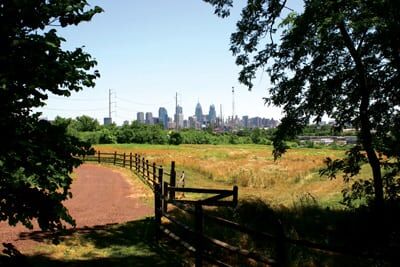
Those trees give off lots of shade, and with a breeze from the adjacent Schuylkill River, it is a cooling place to visit on a summer day. It also offers magnificent views of the Philadelphia skyline.
My interest in Bartram’s began 15 years ago, when writing about the Stony Brook-Millstone Watershed Association garden tour. Included was the Belle Mead garden of Sarah Roberts and Larry Koplik, in which grew a Franklinia tree.
The Franklinia, originally native to the Southeastern United States, is extinct in the wild. In 1765 Philadelphia botanist John Bartram and his son, William, first observed the tree growing in Georgia, along the Altamaha River. Besotted by its white flower with a puffball of yellow stamens, William collected the seeds and brought them to Philadelphia, where he cultivated the tree and named it for his father’s good friend, Benjamin Franklin.
In 1791, William wrote, “We never saw it grow in any other place, nor have I ever since seen it growing wild, in all my travels, from Pennsylvania to Point Coupe, on the banks of the Mississippi. At this place (on the Altamaha) there are two or three acres of ground where it grows plentifully.”
Believed to have become extinct by 1803, Franklinia only exists as a horticultural specimen today because the Bartrams collected plants and seeds and propagated them. All cultivated Franklinias descend from one or more of the Bartrams’ collected specimens.
A member of the tea family, the Franklinia is a relative of the camellia. It grows either as a shrub or a small tree, usually less than 20 feet tall. It rarely lives longer than 50 years, and often less.
We set off to Bartram’s Garden in search of the Franklinia. Its bloom period is July through September, so it was the perfect time to visit. Once in the parking lot, we were surprised to see very few visitors — on a magnificent Sunday afternoon we pretty much had paradise to ourselves.
While waiting for the tour to begin, we wandered on our own, and, in the garden behind John Bartram’s house, we spotted figs, anise, edamame, and, yes, the Franklinia in bloom. In fall, the foliage is said to turn a magnificent red, orange, and purple, though it is finicky to grow, partially due to its limited gene pool. It does not like compacted clay soils, preferring an acid soil. (In fact Roberts and Koplik have since given up on their Franklinia, having lost too many.)
Franklinia actually appears to be better adapted to northern climates than to the location where it was found in Georgia, according to some plant experts. The oldest documented specimens today are at Arnold Arboretum in Boston.
Several theories exist to explain its extinction in the wild. Climate change is one. Possibly after moving south during a previous ice age, the tree suffered from a hotter climate as the ice sheet receded. Another is that humans destroyed the trees’ habitat. An unlikely theory is that there was a tidal flood or fire. Yet another theory was that the Franklinia was not native at all, but an Asian camellia brought over by the British who highly valued tea. Yet another plant scientist hypothesized that an unknown cotton pathogen may have wiped out the Franklinia.
Besides the Franklinia, John Bartram (1699-1777) discovered and introduced a wide range of North American flowering trees and shrubs such as rhododendron, mountain laurel, and magnolia. He earned fame when interest in native colonial flora and fauna was at its peak. In 1765, King George III appointed him royal botanist for North America — allowing him to travel widely throughout the colonies to collect and preserve botanic specimens and seeds, both to transplant at home and send to collectors in Europe.
A third-generation Quaker, Bartram was a farmer with an unquenchable thirst for scientific exploration that led him to become the first significant botanist in the U.S. Bartram was educated at Darby (Friends) Meeting School and taught himself Latin to learn the plant classification system. In 1728 he purchased this land on the Schuylkill River that had been occupied by Native Americans as early as 3000 BCE.
Along with Franklin and others, Bartram established the American Philosophical Society “to cultivate the finer arts, and improve the common stock of knowledge.”
William Bartram (1739-1823), one of nine children, became an accomplished plantsman, artist, and writer, and recorded his southern explorations in “Travels Through North and South Carolina, Georgia, and Florida.” William added new plants, including oak leaf hydrangea, flame azalea, and bottlebrush buckeye, to the family collection. His drawings of North American flora and fauna were well regarded and collected by a host of patrons in England, thanks to his father’s connections. (Incidentally, the above-mentioned hydrangea quercifolia — or Snow Queen — was introduced by William Flemer III of Princeton Nurseries in 1979).
“The 18th-century aristocracy had to have American plants, and John Bartram Jr. (William’s brother) had the knowledge to ship them,” explained our tour guide, showing the Bartram’s boxes that were used to ship seeds, saplings, and root stock across the Atlantic. “He was more successful than anyone before him in doing this.”
The 1775 bank barn was built by John Bartram Jr. and is among the oldest stone barns in Pennsylvania. Behind it is a patch of prickly pear cactus, native to Pennsylvania, that blooms in June and is edible. During the 18th century, when many plants were cultivated for medicinal purposes, prickly pear was believed to lower cholesterol, according to our guide. Black and blue cohosh was grown as an emetic, and plantain — Native Americans called it “White Man’s Footprint” — was used as a cure for snakebite. Blood root was an antiseptic and antibacterial, and Great Blue Lobelia was used to treat syphilis (it did not work).
Bartram built the original house between 1728 and 1731, then expanded it, adding a kitchen and a Palladian-inspired, carved facade. There may have been 10 greenhouses at Bartram’s Garden in its heyday. The oldest, from 1760, still stands at the south end of the Seed House and bears stone carvings made by John Bartram. Bartram heated the building with a Franklin Stove.
He originally farmed 300 acres here along the Schuylkill. Today 46 acres remain, and a staff of four gardeners maintains it. We walk along Bartram’s original paths.
The oldest living gingko in North America is also located in Bartram’s. This male ginkgo is believed to be the last of three original ginkgoes introduced to the United States from China, via London, in 1785 — it was a gift from William Hamilton’s Woodlands Estate. “Hamilton gave a cutting of his tree,” says our guide. “Ginkgoes were around at the time of the dinosaur. At that time they were native to the Americas, but have not been since then.”
The largest tree in the garden is a London Plane tree planted in 1835. It is a hybrid of the American Sycamore and the Oriental Plane, and is often planted in cities, forming allees. The peeling bark helps filter toxins and pollution.
In the kitchen garden behind the house, we see evidence of deer browsing on the Edamame. Even in Philadelphia, deer are a menace. Edamame is actually the soybean plant. Ben Franklin, who believed a vegetarian diet was healthier and less expensive, discovered soy in London and sent a recipe to Bartram for soy cheese, or tofu.
In the beginning, the Bartrams collected and cultivated native plants, but when third generation Ann Bartram Carr inherited the garden, the plant business began to change and to compete she brought in exotic species — dwarf pomegranate, bay laurel, snail bean. She is credited with making the poinsettia popular.
Ultimately the nursery closed, and Carr had to sell the property. The nonprofit John Bartram Association operates the garden today, in cooperation with the Philadelphia Department of Parks & Recreation.
The garden is free to those who wish to explore on their own from dawn to dusk, with the exception of city observed holidays. Tours cost $10 to $12, and donations are welcome. In addition to driving to Bartram’s (parking is free), you can take a bike route from the Schuylkill or a Patriot Harbor Lines boat on Saturdays from the Walnut Street dock.
Bartram’s Garden, 54th Street and Lindbergh Boulevard, Philadelphia. 215-729-5281 or www.bartramsgarden.org.