A question I’ve pondered several times is whether Walt Disney would be able to purchase the necessary acreage and build Florida’s Disney World if he started now.
The question came to me again as I watched the world premiere of “The OK Trenton Project,” a pleasant and thought-provoking look at how varying views can affect the seemingly simplest of undertakings, especially if they involve the use of public grounds.
Welded together by David Lee White and Richard Bradford with input from the show’s ensemble and more than 30 members of the Trenton community, the play at Trenton’s Passage Theatre delves comfortably into the uncomfortable as it conveys how the intentions, interpretations, reactions, decisions, divisions, and final dispositions of many disparate constituencies impinge on just about any public endeavor today.
The main focus is a statue assembled by underprivileged children and teens at the direction of professional sculptor Eric Schultz.
The statue or sculpture depicts the common hand signal for “OK,” a palm forward with three fingers raised while the thumb and forefinger form a circle or “O.” The piece, called “OK Trenton,” was created from household items like pots and pans. The nails on the thumb and forefinger were painted bright red.
Schultz’s purpose, as the character representing him states in the play, was to teach the children attending Camp Mercer, a summer program of the city that invited the participation of several civic groups, how art is made and, more, how to use tools and familiar materials to produce your work.
“Most of the kids at the camp didn’t know how to work a drill before they got here,” Schultz says, He proudly demystified the construction and artistic process.
The “OK Trenton” sculpture was completed in a few weeks. It was mounted at the corner of Perry and Montgomery streets in Trenton on a Tuesday and was removed from its site by official decree — whose is not clear — on Thursday of the same week.
The reason was anonymous callers who said they were concerned police complained to a newspaper, The Trentonian, that the “OK” sign was a gang symbol used by local members of the Bloods and that people from the gang were taking selfies in front of it as if it acknowledged and celebrated their existence.
Others argued the “OK” sign has become a symbol of alt-right political adherents who used it to express white supremacy.
Some loved the work. Others hated it. The upshot was it was removed as dangerous before any real consensus could be reached. Looking at the piece in the lobby of the Passage Theatre, where “The OK Trenton Project” runs through Sunday, February 27, it appears like a squat slot machine with red fingernails. It also resembles a robot. The normal, uninterpreted “OK” finger sign is plainly seen and doesn’t overtly suggest any particular content or context beyond being a positive sign of agreement.
In other words, it’s relatively harmless and a little bit kicky as an art piece.
The tumult and controversy it engendered is another story, one told by White, Bradford, and company using interviews the Passage team conducted with various Trenton residents, some in authority, some involved with the sculpture, some street artists, some just folks on the street giving an opinion or expressing curiosity about why the sculpture was considered harmful or removed.
The discussion about the “OK Trenton” statue leads to other subjects such as the purpose of art, usually hashed over by the Passage ensemble; other public art including graffiti and commissioned murals; talk about other statues such as defaced likenesses of George Washington and Christopher Columbus. It also depicts a round-robin about who is responsible for permitting an artwork to be displayed on public ground and who has the authority to order it removed.
Depicted politicians, including two mayors, former and current, exercise plausible deniability in ways White, Bradford, and cohorts make quite funny. One lone official staunchly defends taking down “OK Trenton,” and in a way that earns her respect while a City Councilwoman, Marge Caldwell Wilson, is against the removal. Censorship is a major theme of the play, and “cancel culture” is also broached.
White, Bradford, and the Passage crew are to be congratulated for their creation. “The OK Trenton Project” sometimes winds in circles and repeats ideas and attitudes, but often with a fresh perspective provided by someone from a yet-unheard-from segment of the Trenton community.
While the play never grabs and has few sequences of intense drama or rollicking comedy, it proceeds smoothly and concentrates on clarity of ideas and the way different community factions will support and defend policies or ideas that are in diametric opposition to those of others. The play certainly illustrates Abraham Lincoln’s quip about how you can’t please all the people all the time.
A remarkable characteristic of the play is how many factions it shows wanting satisfaction for its point of view. Another is how people work to advance or squash something within their inner circles but speak as if they are above partisanship or special interest when interviewed.
C. Ryanne Domingues presents a production that keeps moving, keeping presenting yet one more aspect, even within repetition, and keeps people thinking. Through “The OK Trenton Project,” one understands the conundrum of trying to accomplish anything that will foster common agreement and support.
Each cast member, including co-author Bradford plays him, her, or themselves as well as an assortment of characters that contributed to mélange of material White, Bradford, and cohorts had to hammer, chisel, and mold into a text. Their show is more an ongoing parade of things to consider and think about than it is exciting, but those considerations keep a grip on you, and the overall work is eminently admirable.
Actors Richard Bradford, Kevin Bergen, Carmen Castillo, Molly Casey Chapman, and Wendi Smith all have strong moments of humor and pathos as they portray Trenton citizenry en masse. Bergen does a great take on Fox 29 reporter Hank Flynn, Castillo gives depth to the single city official who says “OK Trenton” had to be removed, Smith is winning as one of the teens who helped built the sculpture, Chapman turns Councilwoman Wilson into a real character, and Bradford has a nice gravelly snarl as he depicts one of the older Bloods. These highlights are among several each performer brings to his, her, or their characters.
Domingues magically brings all together in a watchable, engaging, but most of all, easy to follow way that at times makes you a participant in the action as you can’t help forming your own opinions or wanting to respond.
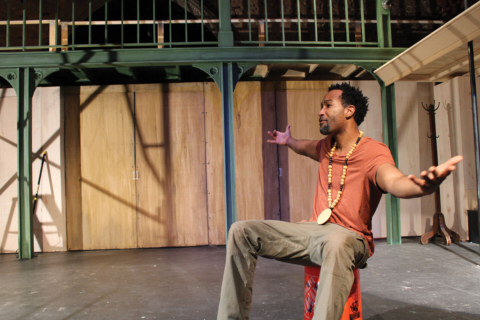
Yoshinori Tanokura creates a versatile open set that leaves room for telling projections by Damien Figueras. Robin I. Shane makes the cast into quick-change artists always finding the touch that turns one character into another on a dime. Jane Cox’s and Victoria Davidjohn’s lighting focuses on the important matter at hand.
The OK Trenton Project, Passage Theatre, Mill Hill Playhouse, 205 East Front Street, Trenton. Through February 27, Friday, 7:30 p.m.; Saturday, 3 and 7:30 p.m.; and Sunday, 3 p.m. $13 to $33. 609-392-0766 or www.passagetheatre.org.