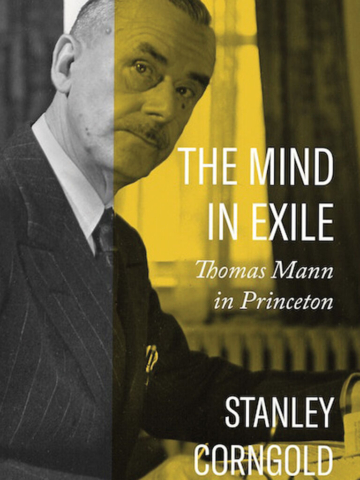
“The Mind in Exile: Thomas Mann in Princeton” is a new Princeton University Press book by emeritus professor of German and comparative literature Stanley Corngold.
The book focuses on the Nazi-exiled Nobel Prize-winning author’s work during the three years he spent teaching at the university and living in Princeton.
Corngold will talk about his book and Mann when the Friends of the Princeton University Library resumes its Small Talk series on Wednesday, September 7, at 4 p.m.
Mann (1875 to 1955) is the author of the noted novels “Death in Venice,” “The Magic Mountain,” and “Dr. Faustus.”
He won the Nobel Prize in 1929. The organization notes that the award was given “principally for his great (1901) novel, ‘Buddenbrooks,’ which has won steadily increased recognition as one of the classic works of contemporary literature.”
His work was also noted for its modern exploration of religious and philosophical concepts, clarity, and insight, especially in regard to the challenges encountered by the creative or truth searching personality.
When he arrived in Princeton in 1938, he was known as one of Western culture’s “greatest living men of letters.”
Mann’s move was orchestrated by Christian Gauss, the University’s dean of the college, through a mutual friend who lived in Princeton.
The catalyst was Gauss’s concern that the German writer then in Switzerland could be an easy assassination target by Nazis who resented Mann’s denouncement of them.
Gauss’s solution was to offer Mann the position of honorary professor from 1938 to 1941 and bring him to Princeton.
A recent Princeton Alumni Weekly article summed up Mann’s situation by noting that before his arrival at Princeton, Mann was perhaps the most famous living writer in the world.
“As his German cultural inheritance was the core of his artistic identity, he was a meaningful figure in the fight against Nazism and proof that a patriotic German could be an enemy of Hitler. With a refuge so close to Axis Europe, he was certainly in danger of assassination. Hitler’s spies hunted the Reich’s opponents using poison, bombs, knives, and sniper bullets. (Rumors went even further — saying, for instance, that German fighter pilots were flying close to passenger planes, peeping in the windows to see if they recognized some famous enemy they should shoot.)”
The reason, according to Corngold, was that “following the First World War, Mann presented several public speeches critical of fascist values. His proponents recalled his former support for a war in 1914 on behalf of a uniquely precious German Kultur; they could not tolerate his reversal, a defense of Anglo-Saxon and European values enshrined in a democratic Weimar Republic. His change of heart turned heads — hot heads.”
During the following years, Mann continued to address “so-called conservative-national idealogues” with addresses, including ‘An Appeal to Reason,’ which identified and repudiated the fanaticism of the movement. On February 13, 1933, barely two weeks after the Nazis’ seizure of power, at the admitted risk of being misunderstood, he discussed the work of the conservative cultural hero Richard Wagner as an ‘amalgam of dilettante accomplishments.’ Indeed, the caveat merely provoked an outraged Nazi press. With this intervention, he would become persona non grata with the Reich.
“In 1936, the Nazis stripped Mann of his German citizenship, condemning him to permanent exile (and probably with the risk of being murdered if he made a clandestine return).
“Soon afterwards, he received a letter from the dean of the Faculty of Philosophy at the University of Bonn, informing him that in light of his expulsion from Germany, his honorary doctorate from that university would also be revoked.”
The 61-year-old Mann reflected in writing that “I could never have dreamed, it could never have been prophesied of me at my cradle, that I should spend my later years an émigré — expropriated, outlawed, and committed to inevitable political protest. I was born to be a representative and not a martyr.”
The book then follows Mann’s physical journey to Princeton and then Los Angeles as well as his internal journey “from arch-European conservative to liberal conservative to ardent social democrat.”
According to Corngold, speaking in a book related interview, the book began in 2018 when he “was asked to lecture at the (Eidgenössische Technische Hochschule) ETH Zurich as a Thomas Mann lecturer on an aspect of his work that was alive today. I decided to explore Mann’s presence in Princeton more fully, aware, too, that he had become an articulate spokesman for the ideals of social democracy, a crucial matter today.
“The project changed as I discovered that during Mann’s stay in Princeton, after having fled Europe and the risk of being assassinated by the Nazis, Mann was ‘stupendously productive.’ I then felt obligated to summarize and comment on each of the major articles and book chapters he published during that period. As I also intended to include an account of his rich interaction with other émigrés in Princeton — above all, the historian Erich Kahler, the polymath novelist Hermann Broch, and (much less so) Einstein — I had burst the bounds of a single book. And so, I decided to publish a second shorter book titled ‘Weimar in Princeton,’ devoted exclusively to Mann’s association with his fellow émigrés, members of a burgeoning Kahler Circle.
“(The book) has sparked a longer project, one that would really need to be done by an entire cohort of intellectual historians, describing the productions of the members of what came to be called, decisively, The Kahler Circle.”
The circle included German-Jewish art historian Erwin Panofsky, American archaeologist Hetty Goldman, German medieval historian Ernst Kantorowicz, Austrian mathematician and philosopher Kurt Gödel, Russian-born American artist Ben Shahn, and the world famous German Nobel Prize-winning physicist Albert Einstein.
“I think readers of this book would be surprised, enjoyably, to learn of Mann’s three-year stay in Princeton and profit from the wisdom of his political writings and the infinite charm of the fiction he wrote while living here.”
“During that time in Princeton, Mann eschewed the label exile and insisted on continuing to be part of his homeland, ‘Where I am, there is Germany. I carry my German culture.”
The distinction he made to what was happening in Germany at the time was his thoughts on Hitler, who attacked the existing German culture by “incorporating it into his idea of a totalitarian state. You see, Hitler was a paperhanger. He sees himself as an artist. Therefore, all art must agree with his ideas.”
“The Mind in Exile” by Stanley Corngold, 280 pages, $35, Princeton University Press.
Stanley Corngold, Friends of the Princeton University Library’s Small Talk, live for members at the Princeton Senior Resource Center,101 Poor Farm Road, Building B, and on Zoom for nonmembers, Wednesday, September 7, 4 p.m. Free.