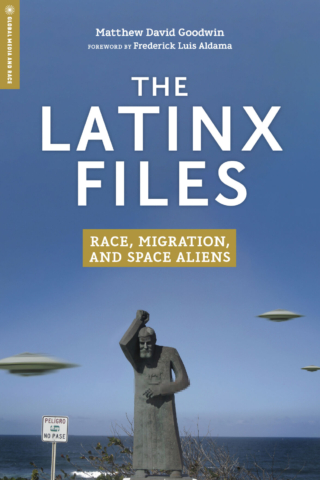
If the book title “The Latinx Files” conjures up any memory of the X-Files television and film series, it is no coincidence.
Matthew David Goodwin’s newly released Rutgers University Press book focuses on one of the X-Files’ popular subjects, aliens, but for a different reason.
Pointing to “The X-Files: Fight the Future” film, the Institute for Advanced Study visiting scholar writes that the fight is “a call to resist the alien invasion being ushered in by a rich and powerful cabal. The ‘future’ in this case is a future designed rather than unfolded, and it’s singular rather than multiple. The ways that ‘The X-Files’ envisions fighting the future, however, is also bound to the designed and singular science fiction legacy of the going alien narrative.”
That, he says, is founded on a reversal of colonization and, quoting another scholar, “represents a reversal of the power axis whereby Europeans and European-Americans are the primary potential victims of colonizing forces.”
He continues to note, “Rather than the White Americans and Europeans invading Native Americans lands, the space aliens are invading white America. The going alien narrative makes White America into the victim. And so the villains behind the scenes are the non-Whites. Like ‘The War of the Worlds,’ in the X-Files, the space aliens are overtly tied to hegemonic colonizers, but at the same time they are tied to people of color, Indigenous groups, and immigrants. The aliens of the X-Files make it clear that is a diverse future that is being fought.”
The book’s subtitle, “Race, Migration, and Space Aliens,” focuses the attention on the book’s exploration of how space aliens in contemporary Latinx literature can communicate experiences of another usage of the word alien, someone new to or outside of a dominant culture. In this case, people whose ethnic or cultural background is not Euro-American.
As Goodwin writes, “The space alien is a particularly powerful figure because of its ability to range across different groups. Precisely because the alien has no nation, no race, no immigration status, and, yet at the same time is able to express these issues because of its being a distinct life form from somewhere else in the universe, it can represent any and all of the diversity within these categories. In that way the space alien is significant for expressing Latinx solidarity, a third space that allows for non-nationalists yet unifying dialogue. But equally important, the space alien is not a utopian figure beyond race and nation — it can just as easily express the tensions and conflicts among Latinx communities through its capacity to express our fears about extraterrestrials.”
Early on in his 148-page book, Goodwin focuses the reader by noting, “It is important to get a sense of the general field of Latinx science fiction and the scope of this study. Latinx science fiction, for the purposes of this book, refers to science fiction written by Latinx living in the United States and should be distinguished from Latin American science fiction.”
That, he writes, “has a long tradition going back at least to the 18th century, has been well charted in the scholarship and there are various studies of the genre’s history, in addition to anthologies and bibliographies.”
Rather, he says, Latinx writing is connected “primarily to the author’s background, not a story’s themes,” and “not about representing ‘latinidad’ in some specific way, a stance that could have the effect of reducing the perception of what being Latinx in the United States means.”
However, “the representation of Latinx characters, cultures, and languages is responsible for much of the vitality of Latinx science fiction” and “although the inclusion of Latinx characters or cultures might not define the category, it does influence its reception, who is reading these works, and why. The authors bring the stories to the party, but the stories get the party going.”
Accordingly, Latinx writings come “from a variety of cultural national backgrounds. The largest groups represented is Chicanxs (Americans of Mexican heritage), but there are authors with ancestry in Cuba, Puerto Rico, Dominican Republic, Argentina, and Mexico.”
He continues to note that “Many of the works of Latinx science fiction examined in this book appear in traditional science fiction magazines and others in traditional anthologies of Latinx literature. In this way, Latinx science fiction is better thought of as a lens to see some particular grouping, which can be put on or taken off as needed. At the end of the day though . . . the goal of this study is to not separate out Latinx science fiction but to show how Latinx science fiction has been a vital part of both science fiction and Latinx literature all along.”
Then the writer provides a brief history of Latinx writing and a historical problem of documenting that history through the use of names. “One of the earliest Latinx science fiction authors is the Cuban American writer Luis Senarens, who wrote an influential series of steam-driven robot stories known as the ‘Frank Reade Library’ (1882-1898). Like many writers at the time, Senarens used a pseudonym, in his case ‘Noname’ and it was not until much later that the full extent of his involvement was documented.”
Additionally, he writes, “Because of the common usage of pseudonyms in early science fiction, it is worthwhile stating that there may be many more Latinx science fiction writers that we know. After Senarens, Latinx science fiction resurfaced in the 1960s. Luis Valdez’s short play ‘Los Vendidos’ (1967) is an early work of Latinx science fiction that depicts a group of young Chicanxs who use a robot to trick a representative of then-governor of California Ronald Reagan. Although it is rarely read as an example of science fiction, this play harkens back to the use of robots to represent class division in Karl Capek’s play ‘R.U.R.’ (1920) which coined the term ‘robot.’ Another early work is Isabella Rios’ ‘Victuum’ (1976), a novel written entirely through dialogue that recounts the childhood and marriage of Valentina Ballesternos, and her encounter with an enlightened extraterrestrial named Victuum.”
Goodwin says another challenge to the recovering of the history of Latinx science fiction “is that telling the history of Latinx science fiction is unlike telling the history of a movement, such as Romanticism, in that there are few definite lines of influences. Instead moments of inspiration are more common, as is the case with Cherrie Morgan’s play ‘The Hungry Woman: A Mexican Medea’ (1996), which is set in the ‘muy Blade Runner-esque’ city of Phoenix after an ethnic civil war has divided the United States into smaller nations.”
He says to evoke the 1982 film “Bladerunner” is significant because “it points to two key connections the film has to Chicanx culture. The ‘Bladerunner’ script was written by a Chicanx, Hampton Fancher, who added the character Gaff to the story. Gaff was then played by the Chicanx actor Edward James Olmos, who shortly before the filming of ‘Bladerunner’ had portrayed a classic pachuco (a stylishly dressed, street wise young Chicanx) in the film ‘Zoot Suit,’ and then developed a futuristic version of this role for ‘Bladerunner.’”
In a sense a companion piece to Goodwin’s anthology “Latinx Rising,” the book stands alone in exploring the works of active writers, and themes, and subjects — such as the legendary creature that emerged from Puerto Rico, the chupacabra.
Academic at times and broadly sweeping at others, Goodwin’s guiding star is to say that “Latinx science fiction writers are fighting the future on a different front, offering new futures that diverge from the going alien narrative so common in science fiction. The express variations … they depict complex yet powerful migrants, enlightened yet unbearable philosophies, and horrors that promise liberation. They depict aliens with a utopian sensibility as well as aliens who represent the violence and threats to Latinx communities. The multiplicity of the space aliens enables it to play a balancing function, point obliquely towards Latinx solidarity. Latinx science fiction writers give complex depictions of Latinidad as they embrace multiple futures through the Multitude of the space alien. To fight the singular future designed by racism and xenophobia, a diversity of future visions needs to be sustained, and we need to nurture in our youth the creativity needed to form those visions.”
The Latinx Files: Race, Migration, and Space Aliens by Matthew David Goodwin, 148 pages, $24.95, paperback, Rutgers University Press.
For more on Latinx Science Fiction and Fantasy and Matthew David Goodwin, visit www.latinxarchive.com.