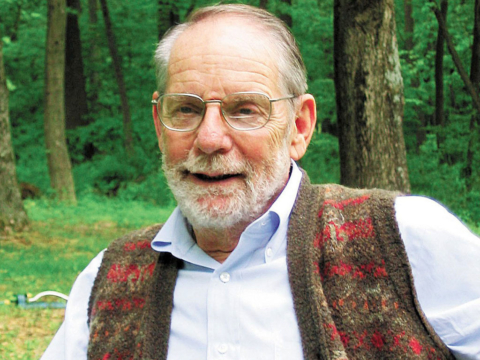
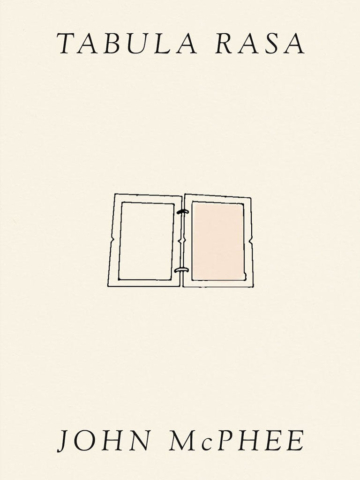
The publication of acclaimed Princeton writer John McPhee’s new book “Tabula Rasa” is a literary and community event.
When he was awarded the 1999 Pulitzer Prize for “a distinguished book of non-fiction by an American author,” “The Annals of the Former World,” McPhee was cited for creating a book that was “as clearly and succinctly written as it is profoundly informed.”
The award committee notes on its website that McPhee’s “writing career began at Time Magazine and led to his long association with The New Yorker, where he has been a staff writer since 1965. The same year he published his first book, ‘A Sense of Where You Are,’ with Farrar, Straus and Giroux, and soon followed with ‘The Headmaster’ (1966), ‘Oranges’(1967),’The Pine Barrens’(1968), ‘A Roomful of Hovings and Other Profiles’ (collection, 1969),’The Crofter and the Laird’ (1969), ‘Levels of the Game’ (1970), ‘Encounters with the Archdruid’(1972),’The Deltoid Pumpkin Seed’(1973), ‘The Curve of Binding Energy’(1974),’Pieces of the Frame’ (collection, 1975), and ‘The Survival of the Bark Canoe’ (1975). Both ‘Encounters with the Archdruid’ and ‘The Curve of Binding Energy’ were nominated for National Book Awards in the category of science.”
The citation continues with numerous other books including “The John McPhee Reader” and “The Second John McPhee Reader.” But it stops at 1997 — way before he added to his yield of 44 books. That includes “The First Fish” (2002), “Uncommon Carriers” (2006), and “Silk Parachute” (2010). Over the past several years, he has released a series of books that feature thoughts on writing, “Draft No. 4: On the Writing Process” (2017), or essays, “The Patch” (2018).
With a title elastic enough to suggest both a clean page and a fresh look, “Tabula Rasa” (scraped tablet) is a collection of 50 short works where the writer uses his well-honed craft to examine our shared world – and to relook at his own efforts.
That McPhee has deep Princeton connections is evident in the following short bio that Princeton-area writer and U.S. 1 contributor Richard D. Smith wrote for his 2014 book, “Legendary Locals of Princeton”:
“McPhee, born in 1931, is a Princeton native who ‘grew up right in the middle of town’ and, from kindergarten through eighth grade, attended public grammar school at 185 Nassau Street.
“His Ohio-born physician father, Harry, was an early specialist in what is now called sports medicine. In 1928, he came from lowa State to Princeton University, where he worked with athletes and trainers and later, served as an Olympic and Pan American Games team doctor.
“Perhaps not surprisingly, John developed an international outlook and became an active basketball and tennis player at Princeton High School. As an adult, he became an avid cyclist and fly-fisher. He caddied locally at the Springdale Golf Course. An after-school job working with Princeton University biological specimens boosted his interest in natural history.
“Matriculating from Princeton High School in 1948, he studied for a year at Deerfield Academy and then graduated from Princeton in 1953.
“The university’s capacious Firestone Library eventually decided him on establishing a professional base in his hometown. He says, ‘I knew if I ever got to do the work I wanted, this would be the resource.’ Skilled at making even arcane subjects accessible, McPhee often unfolds his topics through the engaging stories of their central participants, with a renowned ability to organize a chaos of information and anecdotes into a flowing narrative. He credits this skill to the late Olive McKee, a legendary Princeton High School English teacher who staunchly schooled her students in sentence and story outlining.”
When McPhee’s “Draft No. 4” appeared, U.S. 1 founder and then-editor, Rich Rein, a Princeton University graduate and now author of the critically acclaimed “American Urbanist,” noted, “For as long as I have lived in Princeton John McPhee has been the leading literary lion in town. When I returned to Princeton to live, not study, in 1972, the town was crowded with big-time writers — they had their own table at the Annex restaurant, in the basement space at Tulane and Nassau streets. There were people like Fletcher Knebel, co-author of the bestselling book (and later movie) ‘Seven Days in May’; Jerry Goodman, who wrote the big books on finance under the pseudonym Adam Smith; and Brock Brower, novelist and a prolific writer for Esquire, Life, Harper’s, and the New York Times magazine, among others. There was even a big-time editor in town, Alan Williams of Viking, who had just discovered ‘The Day of the Jackal’ by Frederick Forsyth.
“In this crowded field McPhee stood out. I was never a writer substantial enough to earn a place at the writers’ table at the Annex, but McPhee certainly was. Even though his office at the time was just a staircase or two away from the Annex, he rarely hung out there.”
That may be because McPhee was either too busy writing, teaching, fishing, or he preferred to be alone and reflect.
For myself, I know that McPhee has been a steady shadow on writing in the region.
I figuratively met him around 1970, when I was working at a summer camp in the New Jersey Pinelands and read his “The Pine Barrens.” Since then he and his succession of works have become part of my personal landscape.
And since most of his thoughts on what mattered to me and readers — writing and explorations or the world — were easily found on a page or reveled during his public talks, I saw no reason to interview him. However, I would be interested in finding out what fishing on the Delaware River has taught him and how it may have affected his writing.
Otherwise, I am content to read his work in which I sometimes found some small connection, like the following example from “Tabula Rasa,” “Thornton Wilder at the Century.”
While McPhee describes meeting the celebrated author who taught and lived at the Lawrenceville School and saw his landmark American play “Our Town” premiere at McCarter Theater in Princeton, he also shows his imperfection by sharing something that all writers who conduct interviews will do at some point: make a blunder.
“At Time: The Weekly Newsmagazine, my editor’s name was Alfred Thornton Baker, and he was related in some way to the playwright and novelist Thornton Wilder. Spontaneously, one morning at the office, Baker appeared at the edge of my cubicle, and said, “You need a little glamour in your life — come have lunch with Thornton Wilder.” We walked seven blocks south and one over to the Century Association, where Wilder had arrived before us. Baker may have been counting on me to be some sort of buffer. I was about thirty but I felt thirteen, and I was moon-, star-, and awestruck in the presence of the author of ‘Our Town,’ ‘The Skin of Our Teeth,’ and ‘The Bridge of San Luis Rey.’ I had read and seen those and more, and had watched my older brother as Doc Gibbs in a Princeton High School production of ‘Our Town.’ I knew stories of Wilder as a young teacher at the Lawrenceville School, five miles from Princeton, pacing in the dead of night on the third floor of Davis House above students quartered below.
“What is that?”
“Mr. Wilder. He’s writing something.”
About halfway through the Century lunch, Baker asked Wilder the question writers hear four million times in a lifespan if they die young: “What are you working on?”
Wilder said he was not actually writing a new play or novel but was fully engaged in a related project. He was cataloguing the plays of Lope de Vega.
Lope de Vega wrote some eighteen hundred full-length plays. Four hundred and thirty-one survive. How long would it take to read four hundred and thirty-one plays? How long would it take to summarize each in descriptive detail and fulfill the additional requirements of cataloguing? So far having said nothing, I was thinking these things. How long would it take the Jet Propulsion Lab to get something crawling on a moon of Neptune? Wilder was sixty-six, but to me he appeared and sounded geriatric. He was an old man with a cataloguing project that would take him at least a dozen years. Callowly, I asked him, “Why would anyone want to do that?”
Wilder’s eyes seemed to condense. Burn. His face turned furious. He said, “Young man, do not ever question the purpose of scholarship.” I went catatonic for the duration. To the end, Wilder remained cold. My blunder was as naïve as it was irreparable. Nonetheless, at that time in my life I thought the question deserved an answer.
And I couldn’t imagine what it might be.
I can now. I am eighty-eight years old at this writing and I know that those four hundred and thirty-one plays were serving to extend Thornton Wilder’s life. Reading them and cataloguing them was something to do, and do, and do. It beat dying. It was a project meant not to end.
I could use one of my own. And why not? With the same ulterior motive, I could undertake to describe in capsule form the many writing projects that I have conceived and seriously planned across the years but have never written.
By the way, did you ever write about Extremadura?
No, but I’m thinking about it.
At current velocities, it takes twelve years to get to the moons of Neptune. On that day at the Century Association, Thornton Wilder had twelve years to live.”
Tabula Rasa, John McPhee, 184 pages, $28, Farrar, Straus and Giroux. Please note that the book is also going by the name “Tabula Rasa, Volume I,” so, stay tuned.