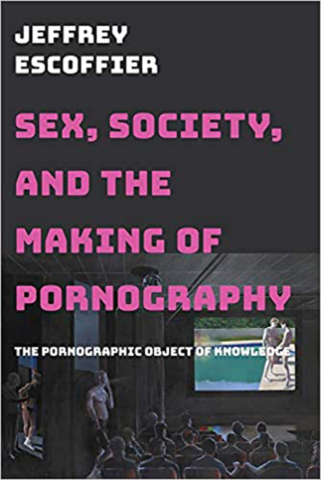
Rutgers University Press’s just released “Sex, Society, and the Making of Pornography” is an eye opening looking into a cultural presence that started mostly as a subculture but grew into a major enterprise — and social conundrum.
The book is the latest in a series of books on the history of sexuality by Brooklyn Institute for Social Research associate Jeffrey Escoffier, who also served as the director of media and marketing for the New York City Department of Health and Mental Hygiene and an instructor for Rutgers University.
With chapters reflecting themes from his other titles — “American Homo: Community and Perversity,” “Sexual Revolution,” and “Bigger than Life: The History of Gay Porn Cinema from Beefcake to Hardcore” — Escoffier does not shy away from exploring the hard core facts and human figures in chapters focusing on sex, identity, and everyday life; sexual dynamics in sex work careers; and “gay for pay” filmmaking.
One chapter also contains a rhetorical question that teases some generally accepted idea: “Do Female performers in the adult film industry earn more than male performers?”
In the following excerpts, Escoffier puts pornography in a historic context, takes the reader behind the scenes of a porno film, and makes a revealing observation.
In June 2017, New York Magazine published an article about Pornhub, a website that is the largest distributor of porn in the world. The author argued that Pornhub was “the Kinsey Report of our time” and that it “may have done more to expand the sexual dreamscape than Helen Gurley Brown, Masters and Johnson or Sigmund Freud.” Such a claim implies that video pornography on the Internet is not only a hugely popular form of entertainment, but also a body of knowledge about sex that is both a form of sex education as well as a self-help guide.
Erotic visual representations have existed for hundreds, if not thousands, of years — from cave paintings to Greek vase paintings and murals in Pompeii, up to World War II pin-ups, Francis Bacon’s paintings, and Hustler magazine. Up until the invention of photography, visual representations of sexuality were more fully mediated by fantasy and the human imagination. Photography introduced a realism certified by a degree of “automatism,” based upon the chemical relationship between light and the film medium.
And hardcore moving-image photography enabled the recording and presentation of live sexual encounters narratively organized by fantasy scenarios and accompanied with visible demonstrations of “real sex” — that is, “reality effects” such as erections, penetration, and ejaculations. The enhanced power of pornographic movies was due to its ability to blend fantasy and the “realism” of the photographic medium.
Yet hardcore pornographic film media also produce misrepresentations of sex that demonstrate the indeterminacy of pornographic media. The indeterminacy reveals a gap between pornography as photographic representation of sex and the human experience of sex. The photographic representation of sex captures only the visible record of the physical activity of a sexual encounter; it isn’t able to capture heart rates, feelings, or psychological self representations. The indeterminacy of the representation of sex in pornographic movies raises many challenging questions about the medium. . .
Pornographic cinema emerged almost simultaneously with motion pictures themselves. Motion pictures were invented by Thomas Edison sometime around 1889. Les Culs d’Or (“Golden Asses”), probably the oldest hardcore movie known to exist, was made in France in 1908. The earliest extant American hardcore film is “A Free Ride” (also known as “The Grass Sandwich”), made sometime between 1919 and the mid-1920s (going by the model of the automobile used in it) . . .
The making of pornographic films invokes “sexual scripts” in two distinctly different ways. On the one hand, there is the literal script or narrative action of the film itself. On the other hand, there are the sexual scripts of the participants: the director, various performers, and other participants in the process such as the script writer, the film editor, the lighting person, and even the marketing people.
However, sexual scripts in pornographic movies operate on many different levels. To some degree, directors, editors, and performers are guided by their own daydreams, fantasies, and personal scripts. And there is also the fantasy script of the person who watches the video.
The scripts in most porn movies or videos are more like storyboards, which may specify the setting (bedroom, gym, or outdoors) or costumes (lingerie, jock strap). They are fictitious aspects of scenarios of sexual fantasies. However, there are important nonfictional elements in pornographic movies — erections (even Viagra requires sexual attraction/stimulation) and orgasms. Thus, for the performers in a pornographic video production, sexual scripts exist as a practical necessity in order to produce credible sexual performances.
The production process of pornography creates the social conditions that enable performers to engage in credible sexual performances. The producers (1) supply the social and physical space where these sexual activities can take place, (2) provide actors who expect to engage in sexual activities with one another, and (3) develop narratives of sexual activities that invoke culturally available sexual scripts that elicit and activate the sexual activities to be performed.
Porn movie production organizes the space (both physical and social) where sex will take place. It is a social space dense with sexual cues. But the making of pornography necessarily requires drawing on the culture’s generic sexual scenarios — the sex/gender scripts; racial, class, and ethnic stereotypes; the dynamics of domination and submission; and the reversals and transgressions of these codes. These culturally significant symbolic codes help to mobilize the actors’ private desires and fantasy lives in the service of the video’s sexual narrative.
The production process is also a highly organized commercial space that supplies sex partners, symbolic resources, and other erotic stimulants, and a video production technology that can produce coherent and credible sexual narratives and images.
Performing in cinematic pornography is a form of sex work and, like all sex work, requires the performance of sex acts according to the direction of the paying party. While porn actors, like other sex workers, may exclude certain activities from their repertoire, their sexual behavior is governed by the demands and constraints of the video production process. The repertoire of a performer’s sex acts is very much a part of the actor’s porn persona and depends upon the sexual scripts that exist in the culture at large, their own sexual fantasies, as well as those they can imagine in their everyday lives.
The making of a porn video requires not only the performance of real sexual acts but also the simulation of a coherent sexual “narrative.” Real sex acts are usually performed, but the video representation of them is more coherent than the actual sexual activity recorded. The shooting of any sexual scene is made up of an apparently simple sex act photographed from several different perspectives . . . A 15- to 20-minute sexual scene may take six or seven hours to film. The short scene that the video viewer sees has been edited and patched together, with a soundtrack added, from the footage shot over many hours.
The video’s director choreographs the sexual combinations and the action, working from a script that is more like a storyboard or a “treatment” than a script in the conventional sense. In most videos, casting the performers and teaming them up, planning their sequence of sex acts, and coaching them in their performances form the director’s main job. Porn scripts frequently elaborate on or incorporate the culturally available sexual scenarios. The director fashions the sex scene by deploying material drawn from “cultural scenarios” (men dominate the object of desire, are active, etc.; men are sexual, but not emotional), from everyday interpersonal social dynamics, as well as from the actors’ “intrapsychic” or personal identity scripts. The director shapes the video’s script by exploiting and integrating these cultural resources.
While sexual excitement is a matter of a person’s physiological state and relies to some degree on the stimulation of erogenous zones, fantasy plays a central role in producing sexual excitement. Psychoanalysts Robert Stoller, Jean Laplanche, and Jean-Bernard Pontalis postulated that frustrations, injuries, conflicts, and other interactions during infancy were encoded as perverse fantasies. Stoller, like Freud, believed that the dividing line between what might be normal and what might be perverse was difficult to identify. The perverse mechanisms that generated sexual excitement did not seem restricted to people who were clinically perverse. Stoller believed that “perversions” or “perverse fantasies” were part of the human condition — that, in fact, we are all “perverts.”
Sex, Society, and the Making of Pornography by Jeffrey Escoffier, 238 pages, $27.96 (paperback), Rutgers University Press.