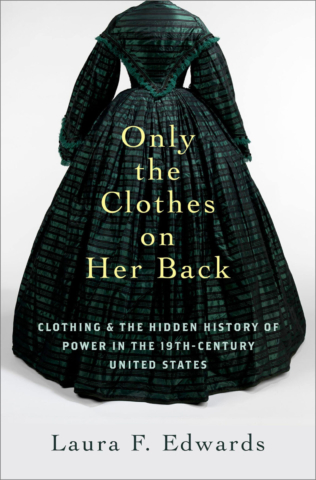
“I began writing this book before I knew I was writing it,” writes Laura F. Edwards at the start of the newly released Oxford University Press book “Only the Clothes on Her Back: Clothing and the Hidden History of Power in the Nineteenth-Century United States” — the subject of the author’s presentation at Labyrinth Books in Princeton on Tuesday, April 12, at 6 p.m.
A legal historian and member of Princeton University’s history department, Edwards says textiles have always attracted her, even while she was researching other topics.
“I took notes on all matter related to cloth, clothing, and related accessories, sometimes wondering why and sometimes not noticing at all,” she writes.
Eventually the information accumulated and ultimately came together to create the outline of a book that “found me.”
It also gave her joy in sharing “what textiles reveal about the history of the long 19th century: beauty, joy, wisdom, humor, and the creativity and resilience of people who clung to the fine filaments of hope at a difficult juncture in our nation’s past.”
Edwards argues that contemporary society has “largely forgotten the legal principles formerly associated with textiles and how they were a continuum of principles established in American colonies in the 18th century.”
While textiles and the wearing of garments to indicate social status have been an element in early civilizations and manifest themselves in various ways in various contemporary cultures, Edwards’ expertise focuses on the 19th century — one where dramatic social changes, including a brutal Civil War, give credence to the author’s claim that the 19th century was “long.”
Edwards opens her book with the story of a late 18th century attempt by a South Carolinian slave to flee her situation by disguising herself in her mistress’s clothing.
By attempting to hide behind the status and privilege afforded to the wearer of such garments, the slave was living out the sales adage that clothes make the person.
While the escape was a failure — partially because the escapee had concocted and executed the scheme under the influence of too much gin — it successfully provides an engaging opening to an engaging subject.
Edward unravels various legal threads involving ownership of both individuals and properties, with the emphasis on how owning textile objects constituted and expressed social meaning, especially in the era between the Revolution and the Civil War.
To Edwards, textiles were and continue to be “evocative objects” that function as an outer skin that “mediates between their wearer and the world around them.”
Additionally, she notes, the effort to create the fabrics and invent and design garments underscores their social importance. “Beauty mattered,” she writes, “as did the sound of rustling silk or the feel of soft, warm wool.”
Accordingly, Edwards says the people of that era would make an effort to put their hands on “particular colors, textures, and patterns, not only to mark their status or fulfill external standards of fashion but also as a means of self-expression and personal fulfilment.”
That legal considerations were advanced is connected with growing use and availability of garments that were less something “necessary and desirable,” and more a valuable object, a piece of property.
“Textiles were relatively durable and very much in demand. The material qualities of textiles combined with the legal principles attached to them to enable their use as a currency, credit, and capital, all crucial components of the developing economy.”
In other words, some textiles and garments were lawfully backed economic assets that were part of a well-diversified financial portfolio. And people acquired and stored fabric and cloths and awaited the right moment to leverage their value.
The result was that the accumulation of textiles was a component of the creation of new economy in a new nation. And many in the newly minted United Sates — including some slaves — made use of such new opportunities to participate in the new economy with new exchanges.
However, Edwards notes, at the same time, when the new nation’s extension of rights seemed to be opening up the legal system and other governing institutions to broad segments of the population, social and legal practices related to the new economic use of textiles challenged and stressed established relationships.
“As textiles show,” she writes, “the everyday actions of ordinary people had profound legal implications in the decades between the Revolution and Civil War.”
But, as Edward suggests, it was part of a pre-existing pattern and that national excitement towards textiles was shaped by the long history of international fabric trading — including Europeans securing silks and cottons from India, China, and the Middle East.
In fact, Edwards notes, the financial obsession with textiles in Europe and the American colonies fueled other forms of trade, including slavery.
“Textiles underwrote the slave trade,” writes Edwards. “Europeans used brightly colored Indian cottons, commonly called calicos, which had long been staples in African markets, to pay for captive people whose forced labor enabled the exploitation of resources in other parts of the Americans.”
The establishment of American plantations, mines, and farms, and their people in need of garments, and their ability to produce trade goods, including fabric materials, were a boon for European merchants.
To prove the point as well as to show her researching skills, Edwards reports that between 1785 and 1789, Spanish merchants exported 4,704,948 yards of calicos to the Americas. Enough, she says, that would “stretch from present-day New York City to San Francisco.” And enough to tempt readers to find out more.
“Only the Clothes on Her Back: Clothing and the Hidden History of Power in the Nineteenth-Century United States” by Laura F. Edwards, $34.95, 456 pages, Oxford University Press.
Author Laura Edwards discusses the book with Princeton professor of history Margot Canaday, Labyrinth Books, 122 Nassau Street, Princeton. Tuesday, April 12, 6 p.m. Free. Livestream available. www.labyrinthbooks.com.