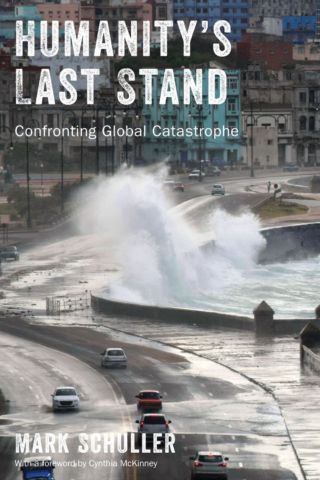
“Humanity’s Last Stand: Confronting Global Catastrophe,” the 2021 Rutgers University Press book by Mark Schuller, offers a type of a road map through some of the difficult terrain recently experienced in our culture.
A professor of anthropology at Northern Illinois University, Schuller is the co-writer of two Rutgers University Press books, “Humanitarian Aftershocks in Haiti” and “Killing with Kindness,” about the failure of non-government organizations to support Haitians.
The following excerpted and arranged statements from his introduction allow the author to focus in our current situation and to argue a way forward:
Every day it seems another crisis is coming to light, each more urgent than the next. It is easy to feel overwhelmed. Within a generation, getting news went from having daily broadcasts and newspapers to being subjected to a literally constant barrage of information. The “news cycle” is rapidly losing its meaning. In addition to several twenty-four-hour news stations with constantly scrolling headlines, news websites now employ clickbait, sensationalized content to entice readers to click on a link to a particular website, sponsored by paid advertisers. Social media platforms track — and predict — our every move, eerily foretold by the movie Minority Report. How can one possibly keep track of what’s actually going on or tease apart fact from “fake news” or “alternative facts”?
Many people I know have become overwhelmed, traumatized, hopeless. Speaking to these real and imminent fears, Toni Morrison said, moments of crisis are “precisely the time when artists go to work.” These times have also energized writers of all sorts: activists and scholars as well as artists. The current moment calls for bold thinking and fresh analysis that doesn’t shy away from asking the big questions. I’m writing this book because I believe that humanity is better than this, or can be. That we don’t have to give in to our fears. It’s now or never for us to act. The earth is sending loud and violent warnings that the current capitalist system is unsustainable.
It is also precisely during periods of “crisis” like these that the fog of ideology is easier to lift. Activist movements now are already adopting an intersectional approach, leading the way. But people who are going to one march this week against gun violence, another next week against family separation, or climate change, or women’s rights to safety, or transgender people’s right to exist, or science itself, risk reproducing a defensive, single-issue individualism, atomization, and compartmentalization — a “whack-a-mole” approach to resistance.
After World War II, within the United States in particular, a white “middle class” was created and sold the belief of endless growth. That growth has reached its natural limits. And the engines of growth are belching greenhouse gases, choking out other life.
At some point this endless growth machine was going to come back and bite us. That time is now.
Rather than the endless whack-a-mole process of resisting, which is exhausting and burning people out, this moment calls upon us to see how we are not only connected by these particular issues but also connected to communities that are differently situated along global capitalism’s process of accumulation by appropriation. Folks whose bodies, families, languages, and religions have been targeted by this system built on inhumanity are building specific networks of solidarity. People who until now have been spared the brunt of the colonialist, white supremacist, cis-heteropatriarchal accumulation machine’s violence need to put our own bodies on the line.
Not just by carrying signs and chanting, but by educating ourselves about the ways in which these issues that appear on the surface to be particular local struggles are already interwoven together globally. If we — and by “we” I do mean everyone — are serious about our struggle to defend humanity against the worldwide systems of dehumanization, in all its specific local faces, we need to see the system for what it is. To do this requires what could be called an anthropological imagination.
Seeing how these global issues are lived and confronted by real, living human beings and how they are connected to other issues and people can be called an “anthropological imagination.” An anthropological imagination also underscores that these issues are products of human action, and therefore changeable: they are particular local manifestations of the inhumanity of our global political and economic system based on inequality and private profit seeking at the expense of the collective good.
But more than anything, an anthropological imagination helps inspire, reminding us, in the words of the World Social Forum, that “another world is possible.”
I define the anthropological imagination as the ability of people to see as connected species-level phenomena to individual lived experiences, understanding particular local injustices as manifestations of global capitalism, built on the theft of Indigenous lands and plantation slavery, buttressed by patriarchy, and hence connected to one another.
Anthropological ideas have found their way into popular discussion. For example, social Darwinism, sometimes called survival of the fittest, is used to justify inequality, with the argument that the current social system is a result of genetic or reproductive fitness. However, a nuanced understanding of evolution argues just the opposite. Just like the moths studied by Charles Darwin at the dawn of the Industrial Revolution, we too as a species are finding ourselves at a similar precipice. White moths had more easily hidden from prey before the soot from London factories turned buildings black and gray. Following, black moths had better cover and thus were more likely to survive. But of course, unlike the moths, the changing conditions that humans have to adapt to are largely of our own making. Foregrounding the role of humans in shaping the environment, some scientists call our geological epoch the “Anthropocene.”
If anything, “evolution” teaches us that diversity, flexibility, and adaptiveness to change are keys to our survival. While certain classes, races, and genders of people have decidedly been favored in the global capitalist economic system, it is increasingly evident that our planet is sending loud and violent warnings that this system must change. If humans are to survive, we need to embrace our differences and adapt to the new conditions that we created, to welcome change.
How can we learn to live on this planet we are rapidly using up? In other words, how can we live within our means — our “carrying capacity”? While human beings have demonstrated our capacity for destruction, violence, aggression, marking territory, and massive systems of enslavement, inequality, and ideology justifying the plunder of the world’s resources, we have also demonstrated in key moments that we have the capacity for collective solidarity, cooperation, and love — the love of Gandhi, Martin Luther King Jr., Che Guevara, Dean Spade, Stephanie Mott, bell hooks, James Baldwin, Valarie Kaur, and Patrick Cheng, not to mention Jesus. As Cornel West and Michael Eric Dyson said, justice is what love looks like in public. Or as Chela Sandoval has argued, love is the methodology of liberation. It is the core of empathy, without which transforming the world will not be possible.
“Humanity’s Last Stand: Confronting Global Catastrophe” by Mark Schuller, 272 pages, $24.95, Rutgers University Press.