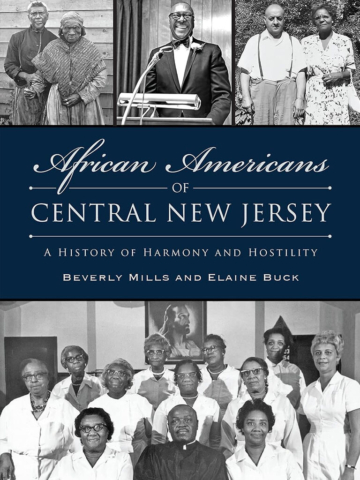
Regional authors Beverly Mills, Pennington, and Elaine Buck, Hopewell, have continued their investigation and reporting on the history of African Americans and slavery in Central New Jersey that began with their 2018 Wild River Press publication “If These Stones Could Talk: African American Presence in the Hopewell Valley, Sourland Mountain, an Surrounding regions of New Jersey.”
Their new book, “African Americans of Central New Jersey: A History of Harmony and Hostility,” continues their exploration of how Americans of African ancestry established homes, churches, and community in central New Jersey, despite social hostilities and prejudice.
As noted in promotional materials, Mills and Buck are the founders of the Stoutsburg Sourland African American Museum and recipients of the Kirkus Book Review in October 2018 and in 2019 the New Jersey Author’s Award Non-Fiction Popular Works Category.
In 2020 they partnered with the Museum of the American Revolution for an exhibition titled “When Women Lost the Vote.” In 2021 they received the Doris C. Carpenter Award on behalf of Preservation New Jersey for their work on the March of America’s Diverse Army through New Jersey and the Solomon Northup Family Award for uplifting the memory of enslaved people.
In 2022 they appeared in the New Jersey PBS special “The Price of Silence, The Forgotten Story of New Jersey’s Enslaved People,” produced by Truehart Productions.
Buck and Mills will talk about their newest work as part of the Pennington Library’s Conversation with Authors program via Zoom on Tuesday, October 24, at 7 p.m.
The following sample is from the new book’s first chapter, “White and Black Communities Grow Side by Side but not Together”:
In 1824, after touring for seven weeks, Peter Chandler, a White Connecticut businessman, traveled through New Jersey. After crossing the Delaware River into Pennsylvania, he described what he had seen: “Today left the land of slavery, New Jersey. The blacks are permitted to be held in bondage. Almost every farmer has from one to half a dozen slaves.”
In A Study of Slavery in New Jersey (1896), Henry Scofield Cooley, a late nineteenth-century historian, also remarked on the pervasiveness of slavery in the state: “The maximum slave population in New Jersey given by the U.S. Census Reports is 12,422 in the year 1800.” And although the slave population showed a decrease after the passage of New Jersey’s Gradual Abolition Act of 1804, “at the beginning of the present [i.e. nineteenth] century, Cooley noted, New Jersey had a larger slave population than any other State north of Maryland, except New York.” Indeed, two full decades after the passing of the Gradual Abolition Act, New Jersey remained a society with a system where, as Cooley described it, “whites and blacks struggled to define slavery’s end.”
Among the early nineteenth-century Black New Jersey residents Cooley described were a number of Hunterdon County families who shared surnames with the White families that had held them in bondage. Thus, the Black families whose lives we will highlight include families who have made their homes and lives in Hunterdon County for more than two centuries. A 1984 study listed more than 130 surnames of pre-nineteenth-century Sourland Mountain settlers and their descendants who lived in portions of Hunterdon County which includes present-day Mercer County and Somerset County.,
similar surnames could be traced through manumission papers filed by Hunterdon and Somerset County slave owners as early as 1788 sixteen years prior to New Jersey’s Gradual Abolition Act passed in 1804. What can we learn about the communities of the region by digging into the stories of these shared surnames and the early manumissions, in some cases, as well as cases of slavery and bondage enduring well into the mid-nineteenth century? In what ways were the lives of Black Hunterdon County residents intertwined with their neighbors of “other race”?
Cooley reported that though it took two legislative sessions, the manumission bill was eventually passed:
Every child born of a slave after the fourth of July of that year [1804] was to be free, but should remain the servant of the owner of the mother, as if bound out by the overseers of the poor, until the age of twenty-five, if a male, and twenty-one years, if a female. The right to the services of such negro child was perfectly clear and free. It was assignable or transferable. One person might be the owner of the mother and another have gained the right to the services of the child. Masters were compelled to file with the county clerk a certificate of the birth of every child of a slave. This certificate was kept for future evidence of the age of the child. The owner of the mother must maintain the child for one year; after that period he might, by giving due notice, abandon it. Every negro child thus abandoned, like other poor children, was to be regarded as a pauper of the township or county, and be bound out to services by overseers of the poor. This provision, allowing masters to refuse to maintain children born to their slaves, was the source of considerable fraud upon the treasury, and was the cause of many supplements and amendments to the law of 1804 in succeeding years.
Bondage, Freedom and the Building of Early White and Black Communities
The transition from slavery to abolition was clearly a contentious one. Nevertheless, between 1787 and 1856, more than five hundred manumissions were recorded in Hunterdon County, listing the name of the slaveholder, the enslaved person and the location of the slave owner’s home. These lists of slave owners’ surnames have proven to be a key resource for Black descendants’ efforts to trace their ancestors’ history through court manumission and census records. For many African Americans, however, manumission and abolition left them only a broken trail to pursue questions such as who were our people our ancestors and where did we come from? Could such questions be answered beyond oral histories and anecdotes passed down throughout theenerations? How to locate clues to centuries-old questions, questions that started with over twelve million bodies plucked like ripe berries from the African continent? How would it be possible to identify forebearers who were shackled and packed into the holds of disease-ridden slave ships that were riddled with despair? How does one identify which floating vessel of horror carried their ancestors to the unspeakable fate that awaited them?
William Blake’s The History of Slavery and the Slave Trade, published in 1861, is one place to start. In this narrative, Blake recorded firsthand accounts of seamen, captains, businessmen and doctors who described what they witnessed on various slave ships during the Middle Passage. One alleged eyewitness, Dr. Trotter, recounted,
They had not so much room as a man in his coffin, either in length or breadth. It was impossible for them to turn or shift with any degree of ease. In the interval of being upon deck they are fed twice. They also have a pint of water allowed to each of them a day, which being divided is served out of them at two different times, namely, after their meals. The meals consist of rice, yams, and horse-beans, with now and then a little beef and bread. After meals they are made to jump in their irons. This is called dancing by the slave-dealers. In every ship he (the ship Captain) has been desired to flog such as would not jump. He had generally a cat-of-nine-tails in his hand among the women, and the chief mate, he believes, another among the men. When the scuttles are obliged to be shut, the gratings are not sufficient for airing the rooms. He never himself could breathe freely, unless immediately under the hatchway.”
American history-telling has not included much about the Middle Passage and its unspeakable horrors. Difficult discussions involving the Middle Passage and the African American story are relatively new additions to twenty-first-century school curricula, but as of the early twenty-first century, this narrative is under threat of being suppressed or removed from the “American” story. For over four hundred years, this story has remained in shadow, muted and now poised to be erased completely from the American history narrative in several states.
African Americans of Central New Jersey, Beverly Mills and Elaine Buck, 160 pages, $23.99, The History Press.
Conversation with authors Beverly Mills and Elaine Buck, Tuesday, October 24, 7 p.m. Via Zoom. Register at us02web.zoom.us/webinar/register/WN_5tRIgDNbQcmF_iM2B1g9Jg.