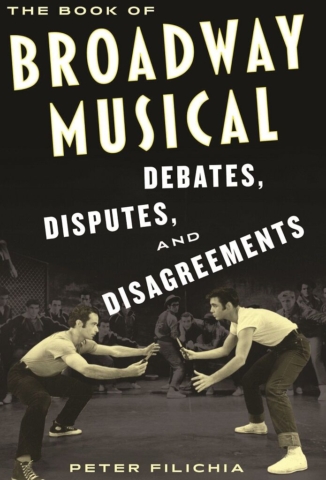
“The Book of Broadway Musical Debates, Disputes, and Disagreements” is the newest of a half-dozen books on theater by former Star Ledger theater critic Peter Filichia.
A writer and active reviewer for Broadway who claims to have seen more than 11,000 shows, Filichia, born in 1946, began reviewing shows as a young writer in Boston before landing in New York City.
Eventually he was working for a variety of print and digital publications and covering a territory that included on and off-Broadway, the New York Metropolitan region, and even the wilds of New Jersey, where he reviewed several plays I produced or/and wrote.
In a previously printed interview, Filichia provided the following insight into his approach: “I say critics should let people know what they’d enjoy. I endeavor to be an audience matchmaker. Most of my reviews are positive because I specifically slant them to the people who will enjoy a certain show.”
That’s pretty much how I recall the man driving around in all seasons at all hours in the late 1990s and into the new century to make sure a theater was reviewed — even calling to apologize if he couldn’t get there.
That sense of enjoyment evident when he arrived at the theater still shows in his new book that opens up by orienting his reader with the directive, “This book is for completely dedicated musical theater fans.”
He then throws himself into his fast-paced and sometimes gushy or smartass style that could cause a reader to do everything from smirk, raise an eyebrow, call him out in print, or think.
You get the idea with the following where he describes the concept of a “fan” by making offbeat references and musical theater-related puns:
“You’re a completely dedicated musical theater fan if you can remember where you were standing and what you were doing when you heard that Patti LuPone was having her hips replaced.
“You’re also qualified if you believe that those who don’t like musicals are Children of a Lesser God.
“In addition, you hate at least one musical that most everyone else loves and you love at least one musical that most everyone else hates. You can also give scores of reasons why you don’t like certain scores.
“And just let anyone try to convince you otherwise. Musical theater enthusiasts learn early on that we can’t agree on everything. When a bunch of us get together and start trading opinions, if we occasionally see eye to eye, that counts as one of the hundred million miracles that happen every day.”
He then advises that what he has in mind is “a book to make your blood boil “or “on the other hand, maybe every now and then you’ll find yourself nodding your head in agreement when you see the conclusions that your author has reached.”
In other words, he’s going to be himself.
As he goes on, he says the book’s structure is based on how the Tony Awards are presented. For each year and decade, he lists his own nomination, tells why, and then gives his own winner.
Fittingly, the writer who has also written liner notes for recordings of musical comedies, also limits his references to works whose original soundtracks have been recorded or captured on video.
A good way to get the flavor and sense of Filichia’s style is his overview of his “Author’s Choice” for the year 1945, “Carousel,” where he immediately starts with one the show’s most disturbing moments:
“Yes, yes, we all hate that Billy Bigelow hits Julie Jordan and that striking a woman can never, ever be condoned on any level. On that plot point alone, many will understandably be aghast at this choice.
“That said, throughout the show when people accuse Billy of beating Julie, he hotly rebuts that he hit her.
“Again: Billy can’t be let off the hook for what he did. It’s horrible. But there is a profound difference between hitting and beating. Hitting implies once and ‘only’ once; beating means a continuous barrage of abuse.
“We get the impression that Billy stopped after that first blow, ashamed of what he did and will never forgive himself.
“Still, if you can temper your temper and forgive Carousel, you’ll find that it’s the best musical to warn of the dangers of so-called Love at First Sight. You may also be thrilled with Richard Rodgers’ music as he was; he named this his favorite score of the dozens he composed. As for Oscar Hammerstein, his conception and delivery of ‘Soliloquy’ remains the highest achievement in any musical.”
And while he doesn’t take the time to linger here and elaborate, probably because “Carousel” has a solid place in musical theater history, he does when he dives in and champions unsuccessful or, in his words, “underrated” musicals of the decade, as he does for the 2014 musical production of “Rocky,” based on the 1976 hit film.
Here Filichia begins by arguing that “Thomas Meehan, who co-wrote the book with original auteur Sylvester Stallone, and in conjunction with lyricist Lynn Ahrens, actually improved the Oscar-winning film.”
The musical still tells the story of “Rocky Balboa, the aging journeyman boxer struggling to get by. When he isn’t a sparring partner for up-and-coming boxers, he strong-arms for a loan shark.”
But, as Filichia says, the story of a guy looking to show he isn’t the loser people think he is takes on deeper emotions with music and staging.
For example, “Rocky risks losing his job before he experiences a genuine loss: Gym manager has given his locker to the new kid in the ring. ‘Learn yourself a useful trade,’ the man advises.
“Rocky doesn’t feel he’s all done, as he expresses in Ahrens’ fine lyric ‘My Nose Ain’t Broken.’ It’s part rationalization, part badge of honor, and part ray of hope. ‘Some guys get to be champs at 29,’ Rocky muses as he approaches 30 – the first round-numbered birthday most people aren’t happy to reach. He looks at the poster of Rocky Marciano he has prominently displayed on his wall. ‘He and I share a name,’ he says.”
Filichia puts the stage work in musical theater context by noting that “Rocky is its own ‘42nd Street.’ Here, instead of the understudy subbing for the injured star, a nobody gets the chance to fight champion Apollo Creed after his much-heralded challenger gets hurts.”
Filichia also compliments the production for enhancing the love story between the misfits Rocky and Adrian, the pet shop clerk who sells Rocky the food for his turtle.
“‘We’ve been told we’re nothing,’ Rocky and Adrian eventually sing, ‘but together maybe we can be something.’ This is the fight we want Rocky and Adrian to win.”
He also compliments the show for upping the emotional content by taking advantage of seasonal events. “The film set one scene at Thanksgiving, but then made little mention of Christmas and none of New Year’s. Meehan and Ahrens wisely made more of the holidays. Rocky and Adrian sang about ‘decorating the Christmas tree like we’re a real couple’ and experiencing ‘something like happiness’ which, by song’s end, turned into the admitting that they’d found actual happiness.’”
That moment becomes more poignant by rewriting the film scene where Adrian’s brother, Paulie, comes home to house they share. That’s when he learns Rocky didn’t recommend him for a loan shark job, gets angry, and smashes up the house with a baseball bat.
“As dramatic as that is, Meehan and Ahrens instead had Paulie come to Rocky’s apartment and swing that bat. Attacking someone else’s house is a far greater offense than destroying one’s own. To see the decimation of the tree that Rocky and Adrian had so lovingly decorated as the symbol of their love added to their devastation (and ours).”
Filichia follows with other examples before ending the section with, “As in the film, Rocky’s goal was modest. He doesn’t expect to win, but insists ‘I got go the distance.’ He achieves the victory. Would that “Rocky: The Musical” could have been seen as a winner.”
It’s the ending line that makes one realize how the writer could easily deliver his own kind of one-two punch and make one want to see such a show.
Just the thing one would expect from a critic who can sense what works and why on the stage – but is deep down a fan ready to chat with others about Patti LuPone’s surgery.
The Book of Broadway Musical Debates, Disputes, and Disagreements by Peter Filichia, 366 pages, $27.95, Applause.