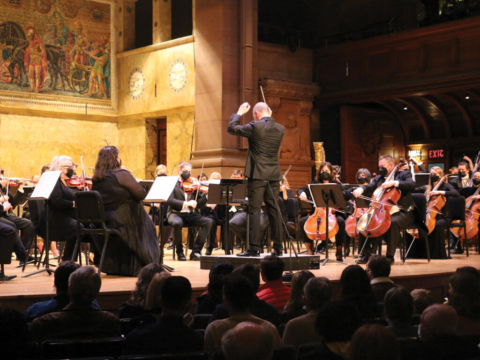
Something completely different happened at the Princeton Symphony Orchestra’s season opening concert Saturday night, September 10: we were all invited by PSO conductor Rossen Milanov to bounce in our seats.
Milanov added that he would probably be bouncing on the podium as well.
That was the joyful effect of the evening’s program, titled “Fandango” and dedicated to the sounds of Spain. Milanov mentioned that he had lived in Spain for many years, fell in love with the culture, and had been wanting to put together such a program for a while.
The night began with Joaquin Turin’s “Danzas fantasticas, Op. 22,” a haunting piece with obvious Spanish ancestry, but dreamlike harmonies more akin to Debussy. Led off by the English horn, the first movement’s main melody ambled through the orchestra, with lots of input from the winds, including a piccolo atop the orchestra, sounding like an exotic bird. The second movement was influenced by the Basque region’s sorrowful songs, while the third burst into the style of a masculine flamenco dance. The entire orchestra was engaged, from tuba to triangle, a rich, rousing sound.
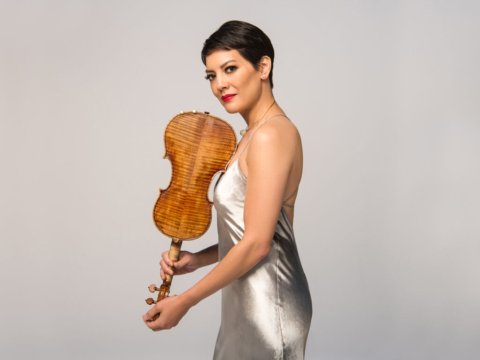
Then came guest violin soloist Anne Akiko Meyers to display her musical wizardry with Arturo Marquez’ “Fandango,” composed in 2020-2021 expressly for Meyers. In keeping with the Spanish flair of the evening, she wore a gorgeous strapless gown of garnet red. Noting that this was the Princeton premiere for “Fandango,” Milanov suggested we buckle up, and off we went.
The rhythms were contagious. This music was, indeed, in the body. The first movement, titled “Folia Tropical,” suggested ancient Iberian dances. However, the composer notes that, in French, the word “folie” means madness, and there was much controlled madness in Meyers’ swift, skilled playing.
Her bowing, along with the Latin percussion, brought to mind the clapping hands and stomping feet of a fandango dancer. The violin’s rollicking solo lines were contrasted by the robust lower brass, especially the tuba. The end of the first movement was met with enthusiastic applause.
For the contemplative second movement, Meyers explored her instrument’s overtones (the violin is a circa 1741 Guarneri del Gesu), with hushed, prayerful, solo passages, until the full orchestra came in like a gale force wind.
Composer Marquez writes that he wanted to honor his father, a famed mariachi violinist, and the third movement in particular was marked by those playful, syncopated rhythms. Meyers stayed focused on her virtuosic lines and feverish cadenzas, while the orchestra transported us with a fiery feast of sounds. Two curtain calls followed Meyers’ brilliant performance.
The second half of the concert at Richardson Auditorium offered two brief pieces. The first was the North American premiere of “America,” by Marcos Fernandez. Penned in 2017, Leonard Bernstein’s centennial year, the composition is an homage to “Lenny,” with nods to the Latin, jazz, and flamenco sounds weaving in and out of “West Side Story.” A busy percussion section worked out on snare drum, timpani, bongos, marimba, xylophone, wood blocks, cowbell, and gong, making the imaginary streets of noisy New York come alive.
Then, a bit of “zarzuela” or Spanish musical theater from the 1890s took us in a different direction. Ruperto Chapi’s “Prelude to ‘La Revoltosa’” ran the gamut from romantic and tender (with an especially lovely oboe solo), to swaggering and soaring, and was played to perfection by the PSO.
Finally, we were treated to Rimsky-Korsakov’s “Capriccio espagnol,” an 1887 work composed to highlight the colors of the orchestra. Many instruments were featured, with dazzling flute, clarinet, French horn, and English horn solos. Concertmaster Basia Danilow had several solo turns, which she played with delight and passion.
A snare drum introduced another movement and mood, the brass bringing to mind the revelry of a bullfight. I’ve never heard the PSO brass ring out with such power as Saturday night’s concert. But then the mood changed again, and we were transported from revelry to reverie with a dreamlike harp solo.
All the while, the orchestra gave a meticulous and impassioned performance. The musicians were working hard, but also appeared to be having fun. So did we.
The Princeton Symphony Orchestra’s 2022-2023 season continues Saturday and Sunday, October 15 and 16 with a program that includes the Benjamin Britten Violin Concerto, performed by Elina Vahata, as well as works by Edward Elgar and Jessie Montgomery. Tickets $30 to $112. Half price, ages 5 through 17. 609-497-0020. www.princetonsymphony.org