The current New Jersey Arts Annual at the New Jersey State Museum took on the big task of presenting 127 works by 95 artists recognized by the New Jersey State Council on the Arts by framing the exhibition with the idea of “Reemergence.”
The title is both a nod to the fact that it was the first such venture in two years and an opportunity for the participating artists to address their time during the pandemic and their subsequent return to “an altered landscape” caused by the “ongoing COVID-19 pandemic, political and ideological polarization, and a collective reckoning with systemic racism.”
The works selected by NJSM Assistant Curator of Fine Arts Sarah Vogelman are expert, cover a great variety approaches and mediums, and demonstrate the overall strength of the state’s artistry — an important visual statement for the NJSCA.
Yet important too is the recognition provided to the regional artists who are in the exhibition and whose work may be an introduction to area gallery viewers.
Princeton-based photographer Ricardo Barros is represented by two 360-degree digital composites. One features his interest in horses, “January Farm,” the other, “Heather,” is of his wife.
As Barros notes in a museum text, “COVID required that we isolate ourselves, allowing greater contemplation and purposeful work, and it pushed social activities outdoors. Other than that, the pandemic was background to my artistic concerns.”
After mentioning his process — letting the camera rotate and stitching the sections together — he creates a composition “reduced to the choice of a single point in space” to “tell a story with a nonlinear narrative.”
The works are visually engaging in themselves, yet for those who already know Barros’ work, it shows a new phase of exploration.
Gay Bitter is a Princeton artist who uses quilting as her medium as demonstrated with “There’s a Pandemic and the West is Burning.”
The artist says she uses “a modern, improvisational aesthetic” and that this mainly cotton and burnt orange hue work was a response to a time that “felt like Armageddon” and to “my rage and grief over all the human deaths and ecological destruction. The sparse black and gray quilting represents all the burned trees that I saw going up in flames on the nightly news. A turquoise strip of water represents the calm I hoped would come soon.”
Connie Bracci-McIndoe of Hopewell is represented with a fired stoneware clay on wood work titled “The Continent Rocked with Surprise.” The artist, who has been working with clay since 1974 and extols the use of rocks, says she faced the last two years by focusing on rocks, dried clay, and firing the works twice: first in a kiln and then in fire. “The playfulness of placing pieces of clay on a board for the creation of a small world has been a worthwhile experience.”
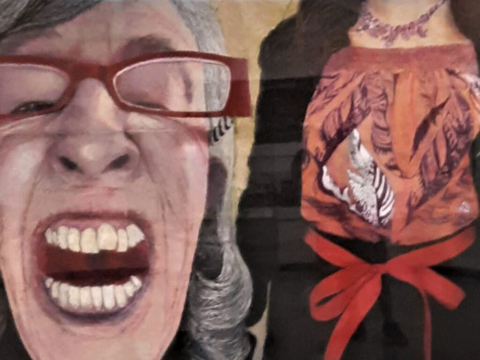
Noted Princeton artist and curator Judith K. Brodsky says her large oil pastel on paper, ‘Self Portrait 2,” marked a change in her long career. In response to being alone during the pandemic, she, like other artists, resorted to creating self-portraits but with a variation. “I had photographs from before the pandemic of Llana Cloud, then my studio assistant, who dressed in elaborate costumes. I was struck by the joyous energy expressed through her costumes in comparison with how I felt while in lock down. I paired them with photographs of myself screaming against the isolation and restrictions of the restrictions of the lockdown. I usually work in printmaking techniques, but because I could not access print facilities during the lockdown, I began to draw” — and captured the silent details of human pain.
Zenna Broomer, another Princeton artist, had an experience similar to Brodsky’s with the creation of her “Emerging #1” and “Emerging #2” on handmade transfer paper print and briefly notes, “The coronavirus pandemic compelled me to express my visceral emotions in a series of artworks” and to create works that reflect “the beginning of the end of the pandemic as we gingerly emerged.” The artist does so by offering faint images that on closer inspection reference or suggest symbols and language — perhaps reflecting a search to put meaning to the experience.
Princeton photographer Eileen Hohmuth-Lemonick has a different response with her image, “Aging.” She notes that “being 76 years old, body changes have been inevitable and evolving. Sadly, women are all too often culturally devalued and objectified after a certain age. There have been times when I have felt ashamed of how I look. Sometimes, I feel invisible. Amidst the forces of a patriarchal culture and the overwhelming emphasis on youth in our society, it is important to note that one in four 65-year-old women will live past the age of 90, and one in ten will live past 95. That’s a long time to be discounted.
“I want to document my aging with photographs that are authentic, confrontational, and free from vanity. These images are influenced by my dreams, personal experience, and an awareness of my own mortality. I want to look hard and accept who I am. The imperfections and injuries, as well as flesh, blood, and bones tell the story.” While the artist has demonstrated an ability to capture images rich with detail and color, the photographer uses a black and white to create a self-portrait of an artist in the flux of time.
Lawrenceville-based Barbara Klein is represented with her 2021 acrylic on paper, “A Kind of Devotion.” Regarding her five-piece panel using abstracted images on dark backgrounds, Klein prefers to focus on process and notes, “I work using either acrylic or oil paint as my primary medium. I find that acrylic allows me to paint as fast as I think, while oil forces me to slow down and be patient. I like the problems posed by both, and especially love the surface of oil paint and how it takes on a life of its own. I usually work with paper or canvas as a support surface. I’m fairly rough in my handling of paint so the surface needs to be somewhat sturdy. The images arise out of countless layers and corrections, often it is a very long time before I feel the work is done and needs nothing further from me.” It’s a quiet work that uses a limited number of dark hues, a rhythm of tones, and suggestive imagery to invite a dialogue.
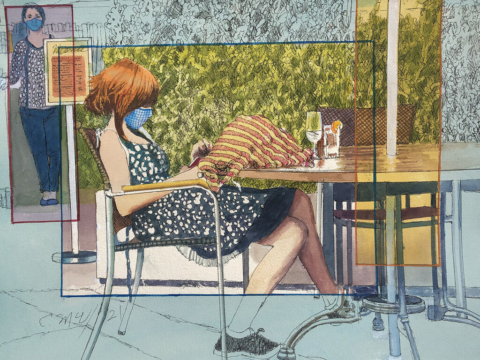
Princeton artist Charles McVicker’s “Social Distancing” is a simple figurative water color and acrylic painting on paper that the nonagenarian sums up equally simply, “The painting was done while watching a what a simple medical mask could do to the mores of society.” It also simply captures an era.
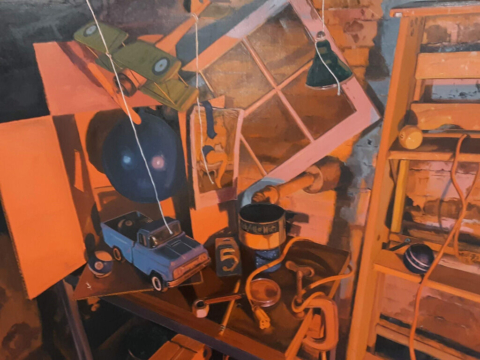
David Orban of Hamilton’s 2022 “The Work Party: Biplane and Blue Truck in Red” tells the viewer of a 40-year-career that has shifted from large paintings, sometimes with a narrative theme, to a series of smaller paintings using the “juxtaposition of playful objects, like antique toys collected over the years and colorful balloons, with utilitarian objects, such as machines and old hand tools. The entire composition is typically lit using one or more colored lights, throwing intense, high chroma color against deep shadows. I try to find a balance between achieving a ‘realist” rendering and allowing the physicality of the paint — and the ‘process’ of painting — to remain clearly visible. There’s no deliberate, implied narrative in these works, leaving them completely open to each viewer’s individual interpretation.” It also shows the artist’s mastery of approach.
Leni Paquet-Morante, also of Hamilton, is represented with her ink on paper “Constructed Shallow.” The work is “informed by the shallow wetlands near my home, and the exploration of the structures within these environments has led me through an ongoing series of paintings, drawings, and sculpture in which I explore subject and composition through a constructive lens and an intuitive approach. In the ‘Constructed Shallow’ ink on paper series, I have continued to look to the smallest elements of the wide landscape to drive a new approach to seeing rings of melting ice, and pollen swirling on water become the muse. These works occupy a space somewhere between figuration and landscape, standing as metaphors for the human experience, at once isolated and part of a shifting construct.” The work is simply an example of the artist’s prodigious effort and artistic exploration.
Since the exhibition provides a flash-like introduction to each of the all of the artists, those unfamiliar with them can find more on the artists through their websites or keep an eye out for these currently active regional artists. But those already familiar with the above will get a chance to see new approaches and work as the artists and arts viewers began to re-emerge in a COVID changed world.
Reemergence, The New Jersey Arts Annual, New Jersey State Museum, 205 West State Street, Trenton. Through April 30, 2023, Tuesday through Sunday, 9 a.m. to 4:45 p.m. Free. 609-292-6300 or www.statemuseum.nj.gov.