Historian Hannah Arendt coined the phrase, “the banality of evil.”
Among ways she illustrated it was the workmanlike way Third Reich leaders went about their business, even if it was to devise, perfect, and execute ways to kill millions of fellow humans as political policy.
The catalyst for Moisés Kaufman and Amanda Gronich’s thought-provoking “Here There Are Blueberries,” at Princeton’s McCarter Theatre through Sunday, February 9, is about a photo album an American investigating officer found discarded in a Frankfurt basement in 1946 and kept to himself until near his death decades later.
Before he passed, he loaned the album and the more than 100 pictures it contained to the United States National Holocaust Memorial Museum for inspection, to determine if it had any significance, and to see if expert scholars and researchers there could tell him more about it.
In “Here There Are Blueberries,” the junior researcher who receives the officer’s call, Rebecca (Delia Cunningham), agrees to give the album a look, although she has little expectation it will be significant or different from most documents people send the museum.
When it arrives, she realizes its worth. It is one man’s collection of photos from the time he spent on the administrative staff at the best known Nazi death camp, Auschwitz, in Poland.
Rebecca is stricken immediately by two aspects of the snapshots. One is that they are identifiably taken at Auschwitz while it was in full operation during World War II and not by Americans or allies following the camp’s liberation. Rebecca tells us the Germans were careful not to allow photography at Auschwitz because, contrary to their usual penchant for record-keeping, they wanted no visual evidence of what was being done there. (The term today is “plausible deniability.”) Rebecca also found it remarkable that the pictures do not depict one prisoner and little of the terrain of the camp.
Rather, they are pictures of officers having conversations, participating in social events, having meals, and enjoying the luxuries of a resort set up on Auschwitz’s most distant perimeter as a place where officers and their families could find respite and recreation from the duties at the camp.
In essence, the photos depict the everyday life of people working at the camp. In addition to Karl Höcker (Scott Barrow), the album’s owner and an adjutant who became the last Kommandant at Auschwitz, Rebecca could identify some of the most nefarious Nazi leaders, such as Josef Mengele, a doctor who conducted inhumane medical experiments, and Rudolf Höss, Auschwitz’s first Kommandant and chief designer.
The album the officer hoarded was a breakthrough. Like Martin Amis’ 2014 novel, “The Zone of Interest,” and last year’s movie of it by Jonathan Glazer, it depicted high-ranking Reich officials and some young women from Auschwitz’s telegraph office going through their daily routines and sharing everything from work conferences to celebrations, to time off at the neighboring chalet.
Except Kaufman and Gronich go further, not only probing more aspects suggested by what is found in the album, but a historian’s and a museum’s way of dealing with them.
Moisés Kaufman, as his previous plays — “Gross Indecency: The Three Trials of Oscar Wilde” and “The Laramie Project” — demonstrate, is a deft theatrical documentarian who can take actual court testimony, conversations, interviews, or visual evidence such as photos and build a textured, compelling, dramatic contest around them.
In “Here There Are Blueberries,” he and Gronich not only underscore the Arendtian banality that made up leisure hours for people who happen to work at a death camp but show they affect survivors of two kinds, those who lived through their ordeal at Auschwitz (or adjacent Birkenau) and those whose forefathers are seen in the photos. They explore the German folklore and culture of the time and from eras past that provided songs and entertainments that lasted, and which still last.
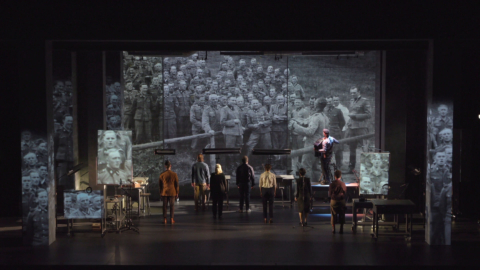
As a director, Kaufman shrewdly juxtaposes pictures from Höcker’s album with live action scenes involving Rebecca and her co-workers at the museum, sons and grandsons of the Nazi officers depicted, and Karl Höcker on trial.
At times, Kaufman will mirror a scene from a photograph by having an actor stand on a platform playing an accordion just like an accordionist in a picture is playing for the Auschwitz staff at a camp party or celebration.
Bobby McElver’s sound design includes a gut-wrenching moment when heavy doors, moving stage left to stage right, close over a photo of new arrivals at Auschwitz, with the slowness and ominous clanking of a door sealing prisoners being transported in a train’s stifling freight cars or, more movingly, of a door trapping condemned prisoners in a room to be filled with poison gas or with cremating flame.
Kaufman’s sense of theater covers all bases of the basic situation, an important archive being donated to a museum, with looks and sounds that amplify the story and turn the two-dimensional black-and-white snapshots taken with what in 1944 Germany would be a banal Leica camera into vivid scenes that make a time that is now 80 years past immediate.
A tone is set at the beginning of “Here There Are Blueberries,” when a narrator (Nemuna Ceesay) talks about the popularity of the Leica and how it preserved every German family in pictures.
It continues when an accordionist plays the timeless German folk tune, “Du, du liegst mir im Herzen,” with a gleeful lilt that typically belies its lyrics of unrequited love and declaration that the spurned is really too good to be so neglected.
It puts you among Germans of any era and sets up the accordionist’s role (and mirroring of a Höcker photo) when he returns to play one of most popular songs played during World War II (despite being from World War I), “Lili Marlene” (ironically used in a different context by Nazi resistor Marlene Dietrich and British singer Vera Lynn).
“‘Du, du” and “Lili Marlene” often serve as a leitmotif that provide contrasting lightness to sequences of high drama and tension, such as a gathering to mark what most would consider a sad achievement at Auschwitz.
From scenes in the museum to the use of Höcker’s photos and the comments of both categories of survivors, “Here There Are Blueberries” simultaneously entertains grandly and makes us consider multiple sides of what first seems to be a simple story of revelation.
Differences in attitude between two whose ancestors participated in Auschwitz creates extra interest, as does the memory of a surviving prisoner who can date a picture by seeing herself in it.
The business of a museum and responsibility of an historian also comes to light as brass at the Holocaust Museum decide whether displaying the Höcker photos would enhance or contradict the mission of the museum and whether the American officer’s donation should be accepted as anything more than an archive for scholars to consult privately.
Kaufman and Gronich are also sly about handing revelation. Returning to plausible deniability as a concept, quotes and sequences from “Here There Are Blueberries” belie the idea that people working administratively in the camp, even the telephone operators and telegraphers, weren’t aware of what was happening there. Documents and testimony from those who would know prove such ignorance to be impossible, evidence that earns a reaction when it’s unfolded.
On all levels, as of piece of engaging theater and as a different look from the usual regarding the Holocaust, “Here There Are Blueberries” hold interest, displays wit, and is as revealing as Höcker’s photos.
The ensemble cast from Kaufman and Gronich’s Tectonic Theater Project — Scott Barrow, Nemuna Ceesay, Delia Cunningham, Luke Forbes, Barbara Pitts, Jeanne Sakata, Marrick Smith, and Grant James Varjas — is uniformly excellent, Cunningham being a compelling narrator, Varjas being mysterious and flinty as the donor, and Forbes and Smith having a fascinating exchange as the children of war criminals.
Derek McLane’s set is versatile enough to be chameleon-like — a full museum one minute, a bandstand the next — and allows for orchestration by felicitously integrating a framed Höcker print with another object or person on the set. David Bengali’s projection design adds to this. David Lander’s lighting helps define time and place. Dede Ayite’s costumes exude what one would wear while working at a museum and casual dress in modern Europe.
Here There Are Blueberries, Matthews Theatre at McCarter, 91 University Place, Princeton. Through Sunday, February 9. Wednesday through Saturday, 7:30 p.m., and Saturday and Sunday, 2 p.m. $25 to $78. www.tickets.mccarter.org or 609-258-2787.