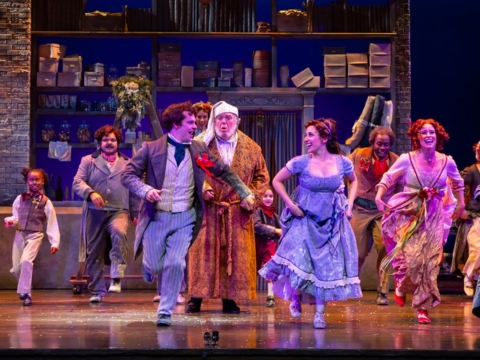
Though not as opulent or as realistic in mid-Victorian splendor as in previous years, Laura Keating’s 2023 production of “A Christmas Carol” for Princeton’s McCarter Theatre is alike in the warm, embracing spirit it evokes and has some charms that are unique to it.
Keating, who adapted Charles Dickens’s immortal tale as well as directing it, needs space and movement to make her vision of Scrooge, the ghosts, Cratchits, Fezziwigs, and memories come to life. She punctuates sequences with popular carols, keeps her cast travelling freely between settings as they re-enact the revelations the ghosts find conducive to Scrooge’s reform, and concentrates on immediate decoration, allowing a time-honored upstage drop, with St. Paul’s prominent, to pay homage to McCarter’s past “Carols” and suggest Scrooge’s London.
It makes for a brisk excursion through Scrooge’s life, yet Keating is wise in the passages she chooses to emphasize: Scrooge’s housekeeper, Mrs. Dilber (Polly Lee), dealing with the pawnbroker, Jo (Vilma Silva); the Cratchits showing their closeness; Scrooge’s nephew, Fred (Stephen Michael Spencer), being merrily ebullient; the critical scene between young Scrooge (Spencer) and his betrothed Belle (Maria Habeeb); and young Jacob Marley (Grayson DeJesus) influencing Scrooge. She also expands the role of Jo to make her a kind of mayor or benefactor to the corner of London Dickens’ characters occupy.
Keating makes adroit use of McCarter’s technical capability, having set pieces pop up from trap doors, in from the wings, and down from the flies. All in all, Keating’s is a good, solid production that does well by Dickens and is moving where it counts, the final scene eliciting joy, laughs, and moist eyes in equal measure.
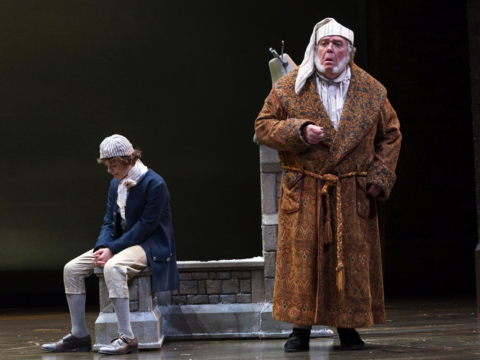
McCarter’s “Christmas Carol” is especially strong at its beginning and end because of the performance of Joel McKinnon Miller, known to television audience for myriad roles but mainly for Detective Norm Scully on “Brooklyn Nine-Nine” and Don Embry on “Big Love,” as Ebenezer Scrooge.
Miller sets a powerful tone as Scrooge sits in the counting house he once shared with Marley and bah-humbugs everyone who dares to trespass on his business while meanly lording over even the slightest of motions from his cringing clerk, Bob Cratchit (Kenneth De Abrew).
He is not so much the embodiment of evil as a serious man who doesn’t have time for frivolity or festive celebration when his personal affairs demand his constant vigilance. Miller allows his Scrooge some wry sarcasm, a brand of humor that entertains him because it so dismays his listeners, but he is primarily a man of single focus, the making of profit, who wants, as he clearly states, to be left alone.
Miller rivets with Scrooge’s monomania and delight in foiling the visitors who come wishing “Merry Christmas,” requesting time off for December 25, or, heaven forfend, solicit charitable funds for the needy.
Scrooge’s dialogue about his nephew being “poor enough,” Cratchit “picking his pocket” for wages unaccompanied by work each Christmas, and his reference to prisons, workhouses, and “decreasing the surplus population” are well-known. Miller makes their reading sound fresh and original. He is a man to be reckoned with, not because he is cruel or quick to anger, but because he has a ready answer for any occasion and, in his context, those answers make sense.
Miller also rallies in the last sequence of Keating’s production. He is especially marvelous as juxtaposing the old Scrooge, the one with which his section of London is familiar, with the new, revitalized Scrooge who makes a donation that covers “back payments” and becomes a friend and benefactor of the Cratchits.
Then there is the middle of the play, which is puzzling. Miller is either the most generous actor in the history of the profession, or Keating didn’t give him enough to do as Scrooge visits Christmases past, present, and yet to come.
The impressive, nuanced actor of the first two scenes fades into the background. The ghosts and supporting cast do all the work. Miller stares with interest and reacts to much of what Scrooge sees, but he seems relegated to the sidelines, uninvited to participate.
All Scrooge is seeing has merit. It’s entertaining and certainly tells Dickens’ story clearly, but I, for one, wanted more of Miller and from Miller in these sequences.
Stephen Michael Spencer’s younger Scrooge steps to the fore in the scenes in which he’s included. This is proper in a way, but I missed Miller, who, as Scrooge, complained to the ghosts he didn’t want to relive a particular instance or that he’d forgotten what should have been an important memory.
But those complaints and admissions are in Keating’s dialogue. They do not make Miller as active a participant as he needs to be as his life unfolds before him.
To give Miller credit, he does what he can to express concern, remorse, and even pleasure at certain memories. In general, though, he is the forgotten man. So much so, it’s a relief when the last ghost leaves, Christmas Day dawns, and Miller can once again dominate the stage as Scrooge.
Keating’s production never exactly flags. It’s consistently engaging. But the ghosts’ scenes lack an important element, and that’s a contributing Scrooge. The production, of course, is set, but it might be worth it to add more Scrooge to the middle section of this “Christmas Carol.”
Certainly, there are performances and moments that make up for Scrooge’s relative absence (though never offstage).
Spencer is a spirited Fred but makes his more potent mark as young Ebenezer apprenticing in Fezziwig’s warehouse. There, Spencer provides a vivid, telling, and moving contrast to the Scrooge he, Spencer, becomes before our very eyes. The 20-year-old Scrooge we meet is diligently dedicated to his ledgers and accounts, but he is also ripe for a lively game or spirited reel. Spencer conveys a rounded young adult who has his priorities in place but can let loose and have fun.
Then, with the sour, resistant, all-work-no-play Marley leering at Ebenezer’s abandon, harrumphing at the slightest gaiety, and personifying cheerlessness, young Scrooge gives into his business partner’s solemnness. He forgets balance, especially when levity is concerned. At McCarter, this makes for a heartbreaking scene with Belle, whose relationship with Scrooge becomes a parallel to Scrooge moving from a poised man of the world to a curmudgeon.
Grayson DeJesus is shrewdly deft as showing Marley’s malignant hold on Scrooge. Maria Habeeb is a wonderful Belle throughout and is as heartbreaking as she is candid as Belle dissolves her engagement to Scrooge.
Vilma Silva galvanizes the stage with every appearance as Jo. Kenneth De Abrew is sweet and fatherly as Cratchit. Alison Cimmet exudes sense and proportion as Mrs. Cratchit.
Dance is a big part of Keating’s staging, and Emily Maltby does a fine job choreographing. Watching the children go through their steps, the true hoofers among them are Zayda Knowles and Nathaniel Updegraff.
Sets by Daniel Ostling are precise in defining the homes characters occupy while giving Keating space to do all she wants in terms of accommodating carolers and keeping traffic moving. Linda Cho’s costumes are perfect. Fine work is done on lights and sound by Paul M. Kilsdonk and Palmer Hefferan, who wrote an apt score for the production.
A Christmas Carol, McCarter Theatre, 91 University Place, Princeton. Through Sunday, December 24. Wednesdays through Fridays, 7:30 p.m.; Saturdays and Sundays, 1 and 5:30 p.m.; and Christmas Eve, noon and 4 p.m. $55 to $90. 609-258-2787 or www.mccarter.org.