Backyard adventurers waylaid by COVID and looking to get back on the local exploration track can do so with a visit to the Abbott Marshlands, the more than 3,800 acres of open and mainly natural woods and meadows along the fringes of what was formerly known as the Trenton-Hamilton-Bordentown Marsh.
And those looking to get a quick orientation regarding the marsh’s size, sites, and attractions can easily get schooled with the recently opened exhibition “Abbott Marshlands Explorations,” currently on view at the Tulpehaking Nature Center in Hamilton through May 22.
Maintained by Mercer County Parks, the center is at the Westcott Avenue entrance to Roebling Park. Its name references the language of the site’s original people, the Lenape, and translates as “land of the turtle.”
While the turtle figures into Lenape stories and spiritual imagery, it is a reference to one of the area’s most visible inhabitants.
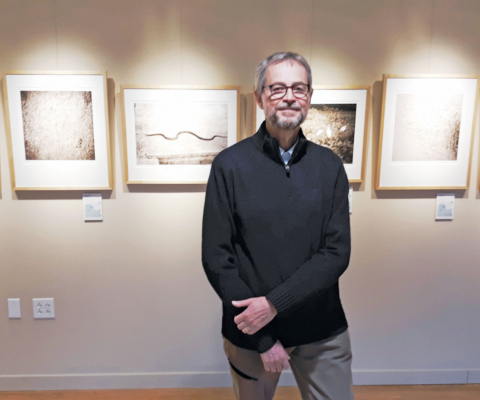
It is also one of the one of the subjects that appears in photographer Frank Sauer’s 33 images at the center.
“It is special to have such a center here,” says the Princeton-based photographer during a visit to the center to talk about his connection to the marsh, the exhibition, and his artistic process.
Sauer, who has lived in the region for decades and is retired from a career at Siemens and ATT, says his introduction to the marshlands came through a fellow photographer.
“I had a couple of photos in the Ellarslie Open (at the Trenton City Museum). One of them was of a tree trunk. (Photographer and retired Rider University professor of botany) Mary Leck went there and saw the picture. She liked it, found my email, contacted me, and said she loved my pictures.”
In addition to being a photographer whose work included tree trunks and bark, Leck was also a catalyst in bringing state attention to the Abbott Marshlands and the creation of the Tulpehaking Nature Center.
She was also the one who suggested that Sauer visit the marsh and photograph there.
“It was pre-COVID, and (the center staff members) were doing these walks every first Saturday. That’s when I met her, and the first time went it was in June and the mountain laurel was blooming then. I was drawn in.”
He says his first entry point was the area known as the Bordentown Bluffs, a spot near Route 206 where one can stand high over the Crosswicks Creek and scan acres of natural landscape between Bordentown and Trenton.
He then explored other entries: Spring Lake, off Seward Avenue in Hamilton; Roebling Park; Northern Community Park, off Groveville Road in Bordentown Township; and the D&R Canal path along Duck Islands in Hamilton.
“Then I continued on my own to explore on my own,” he says. “When I take my camera, I don’t want to go at anyone else’s pace. I can forget about the time and get immersed. That happens when I am alone.”
Sauer says he started exploring and made about 100 visits over four years.
“I started appreciating how things change,” he says about the site.
“There is, of course, the season change. But there is a change with the weather — rainy, sunny, and snow — that’s very special. Even if you come back the year later in the same season things have changed: Trees have fallen down and new things are growing up.
“Even if you stay in one place and go for all seasons, you see new things the next year. Once I started coming here, I found the places and things I found intriguing.”
He says after four years he had collected thousands of photos and approached Tulpehaking Center staff members and the Friends of Abbott Marshlands community support group about an exhibition.
“The idea was to bring more people here and show there is a lot of beauty out of your back door,” he says.
Sauer says that while such “back door” — or local sites — don’t have the name recognition of a national park and their popular images, places like the Abbott Marshland offer their own opportunities for photographers and artists.
“If you go into this intimate land space, you can find so many things. A small bug or a few flowers, many pretty and intriguing things, good in their own right without being part of (a noted national park).”
Sauer culled thousands of his marsh images to a 33-piece exhibit that breaks the center’s three gallery rooms into themes.
The first is a visual orientation to the marsh’s various landscapes: earth walls, tidal marshes, creeks, and meadows. “The section covers all the different parts” of the marsh, says Sauer.
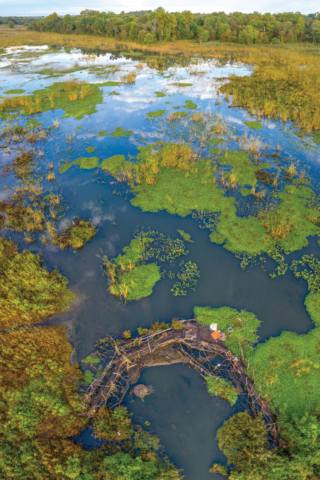
The second room contains aerial photography and “things that people don’t see,” he says, adding that while he had free reign to fly a drone over many parts, marsh portions owned by the state were off limits.
Nevertheless, the images capture much of the space as well as fog-softened landscape, veins of waterways, and acres of autumn-hued trees.
There is also an overhead view of a lone individual who uses branches and found objects to construct a bridge over a flowing tributary in a remote area of the marsh.
“It is a work of art,” Sauers says about it. “I came across it in the winter. It is a living art work. It’s constantly being remade. It is not a bridge over the water, it is on the water.”
The third space is devoted to wildlife and reflects the area’s large ecosystem with hundreds of species of birds, insects, reptiles, and fish.
“I’m more a landscape photographer, but there was so much wildlife around that I have a section on wildlife,” Sauer says
The section is also different for another reason.
“I did all the wildlife in black and white,” he says. “When you go black and white you can make (the images) more dramatic, you can increase the contrast.”
Adding that he looks at all his photographs in color and black and white, he says and then makes a choice. “You can balance (color) out that is more distracting. I like black and white if the shapes can be more prominent. If you simplify, it can become more powerful and stronger.”
The black and white in the section also gives the series, “a certain consistency,” something he says he also likes to do with the frames. “A whole series stands together. It has its own feel and you start exploring.”
Sauer says his approach to capturing his photos involves an attempt to visually frame the desired image without cropping and emphasizing the natural in a locale affected by human products (electric grids, distant factories, highways, and trash).
He is also interested in something that resonates beyond the captured image.
“If a picture is interesting, it should have layers, physically a foreground and background. It can also be a layer of meaning, or symbolism.”
He says a picture that works is also one that adheres to technical standards.
“There is this saying, ‘A photographer is responsible for every square inch of a photo.’ Someone who is a painter is responsible for every square inch (of the painting). A photographer should do the same thing, a combination of content and presentation. I’m a stickler for all of that.”
Instead of a calendar schedule, the photographer uses a weather-driven one to go on photo expeditions. “I like calm days when there is less wind. And I actually like overcast days. You have soft light. It is more difficult when you have harsh sunlight and shadows in the woods. They take away from the structures I like to see in the photo.
“I have days that pull me out, and days I’d rather say home. Once there is fog, I’m out. Some fog or snow, I’m out. Some special thing, I’m out. Spring and fall are more visually interesting. Winter without snow becomes gray and bleak, and summer becomes more monotonous.”
Sauer says he got interested in photography when he was a boy in Stuttgart, Germany. The son of a civil engineer father and stay-at-home mother says, “My father had a little camera when I was young and I just picked it up and it was something I was always interested in.”
While he says he didn’t use a camera when he was studying for a Ph.D. in physics, he did began after he came to New Jersey to work for AT&T and then for the Siemens in Princeton. “When I started a family. It was more family photography memories. When the children grew up they didn’t want to be photographed, so I stared doing it more for me. It was a creative outlet.”
It led to deeper involvement, including creating an exhibition for the Friends of Princeton Open Space, membership in the Princeton Photo Club, acceptance into an Ellarslie Open, and the current Tulpehaking Center exhibition.
“In a sense, this is a closure,” says Sauer of the exhibition. And while he says he will continue to come to the marsh and go on the Saturday walks, he says there are other places to see and photograph, such as Island Beach State Park and the Pinelands.
“If you look at the sections of the photos, it is a collection of highlights that I have been encountering over four years that have had an impact on me,” he says. “My hope is that by showing these highlights it transcends what you see if you do an occasional stroll.
“It shows the treasure you can find. And maybe helps the people appreciate the preciousness of this preserve.”
Abbott Marshlands Explorations, Tulpehaking Nature Center, 157 Westcott Avenue, Hamilton. Through Sunday, May 22.