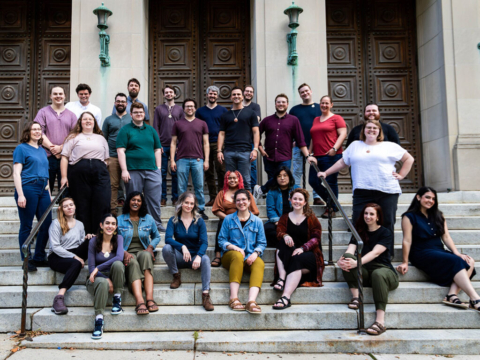
The LOTUS Project — along with the newly announced community LOTUS Chorale, Trenton Children’s Chorus, Bordentown Regional Middle School, and Frontline Arts — will present a Veterans Day-themed “Stay. Together. (A Vigil for Veterans)” concert on Saturday, November 11, at the Patriots Theater of the Trenton War Memorial.
The concert program includes British composer Howard Goodall’s 2005 “Eternal Light,” music from “Band of Brothers,” and stories of veterans submitted by community members.
The event will also feature images created by Frontline Paper. Formerly known as Combat Paper NJ and the Prince Making Center of New Jersey, the Somerset-county based organization houses a veterans’ arts project that includes transforming the uniforms of participating veterans into materials for art and personal expression.
Goodall has been called one of Britain’s best-known composers of choral music, stage musicals, and TV and film scores, including the theme music for “Mr. Bean,” “Blackadder,” “Red Dwarf,” “Q.I,” and “The Vicar of Dibley.”
Regarding the creation of “Eternal Light,” Goodall recalls in an article published in the Guardian, “I was approached by the artistic director of the orchestra London Musici, Mark Stephenson, to compose something to mark its 20th birthday, a work that would also be a new dance piece for the Rambert Dance Company, to be choreographed by Mark Baldwin. Because each year Musici also performs a Passion Oratorio with Stephen Darlington’s choir of Christ Church Cathedral Oxford, a piece with some kind of devotional or spiritual component seemed appropriate.”
He then notes that he and Stephenson agreed and focused on a “bespoke requiem” for choir, orchestra, soloists, and dance.
The composer then asked himself, “What — in the 21st century — is a requiem for; who is it for; and what does it mean?”
Goodman adds, “In an age in which the ‘sea of faith’ has been ‘retreating to the breath of the Night Wind’ — in Matthew Arnold’s prophetic words — the old religious reassurances and orthodoxies can sit uncomfortably with our modern experience of loss. Anyone who has witnessed the funeral of a child will have wondered why, in the words of the 1928 Anglican prayer book, ‘it hath pleased Almighty God of his great mercy to take unto himself the soul of this child here departed,’ or in the doctrine of the Catholic Mass for the Dead, what ‘sin’ the child may have committed to be sent to purgatory awaiting judgment.”
He then mentions that the structures and language of the famous requiems emphasize “the torments of hell, the natural wickedness of humankind and the urgent need to pray for the salvation of the departed. These requiems dangle the carrot of heavenly paradise and wave the stick of damnation in fairly even measure and seem to offer a mysterious, often haunting, but ultimately quite bleak, medieval way of looking at death, never mind the unbearable pain it causes for those left to mourn. I could not sincerely have adopted this approach to the writing of my requiem and looked for ways to reinterpret the form.”
To do so, Goodall “stripped the Latin text down to a handful of resonant phrases and went in search of poetry, some sacred, some secular, to shed new light on the various requiem concepts: peace, everlasting light, grief, comfort, and, most controversial of all, faith in an afterlife. The purpose would be to reconfigure the words to underline a sense of solace for the grieving, compassion for the despairing and some attempt — however modest — at assisting in the process of recovery.”
He adds that there could be “no glib reassurances about death being freedom or a passage to a ‘better place.’” Yet there “could be a recognition that the departed do live on in the minds, hearts and memories of others, that the love that existed between them and others is unbroken by death, and that the little we do know from those who have experienced near-death is that light is a powerful and universal sensation. To embrace a view of death as a passage towards light of some kind neither contradicts the teaching of the world’s religions nor what we have been told from description. Most importantly, it is what all those who have lost a loved one want to feel.”
He says he studied and incorporated a poem by Ann Thorp, “Belief, written from the mourner’s perspective, asserting: “I have to believe/ That you still exist/ Somewhere.” In this poem, as in the Requiem as a whole, faith is seen as the antidote to despair, a pilot in rough seas, a deliberate hanging on to the possibility of hope, however awful the path ahead.”
Goodall continues on the idea of a path and the “slow, day-by-day agony of carrying on” and says, “It was again light that provided the central image.”
According to the composer, “Music’s ability to transport us from the everyday, to evoke some other, peaceful place is one way we can offer any crumb of comfort. In the case of a work that will also be danced, it might also be possible to convey a sense of the flight of the soul. The music for ‘Eternal Light: A Requiem’ flooded into my head in a great rush, confirming the suspicion that I had been nudging towards something addressing grief for some time.”
He connects to the emotions he had creating a 2005 choir work to honor a young woman died in a tragic accident.
“Nothing can alleviate the suffering of losing a child,” he says. “But perhaps some things — kindness, the refusal to forget, and even, in this instance, a piece of choral music sung by young people — could mark the passing of a precious life and honor it with dignity, compassion and beauty. I do not make any claims as composer for ‘Eternal Light,’ other than this: if my new Requiem can do that for one person or one family, somewhere, someday, it will have been worth writing. For me that is what a modern Requiem is for, who it is for and what it means.”
The veterans’ concert is the first of eight events offered by The LOTUS Project this season. Other offerings include “Every Brain Needs Music,” exploring music’s effect on the mind and body, set for December 4, St. James Catholic Church, Pennington, and a reprise presentation of Joby Talbot’s “Path of Miracles,” featuring artwork by local Trenton artist, Chee Bravo.
Stay Together. (A Vigil for Veterans), LOTUS Project, Trenton War Memorial, 1 Memorial Drive, Trenton. Saturday, November 11, 7:30 p.m., suggested donation $25, online or at the door. thelotusprojectnj.org.