“This Side of Paradise,” “Leaves of Grass,” and … “Looking for America on the New Jersey Turnpike”?
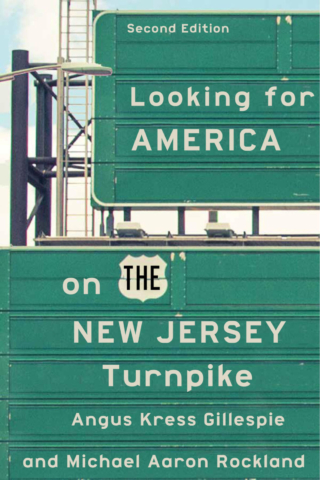
The book by Rutgers American studies professors Michael Rockland and Angus Gillespie was originally released in 1989 and updated and republished in 2024.
It’s an easy read, a short book, around 200 pages. From the get-go, readers are made to feel as if they are in the backseat of a car with Rockland and Gillespie as they drive up and down northern and southern stretches of the Turnpike, stopping at rest areas and talking to executives at the old headquarters near Route 18 in East Brunswick. Of course, they spend some time at the quarter-mile stretch near Elizabeth Seaport just south of Newark Airport, with the oil refineries and that stench in the air that so many out-of-staters think of when they picture the state of New Jersey.
Sales of the book’s original edition picked up after it was reviewed by the New York Times, Gillespie recalled recently from his home in East Brunswick.
“Even though people had both positive and negative views about the New Jersey Turnpike, either way, they were interested in reading it,” Gillespie said. But that early success did not prepare the authors for the shock they received a couple of years later. That’s when the New Jersey State Library came out with a list of the 10 best books ever written about New Jersey or by a New Jersey author – and on the list alongside classics by F. Scott Fitzgerald and Walt Whitman was “Looking for America on the New Jersey Turnpike.”
The original hardcover edition of about 10,000 copies sold out by the mid-1990s, very unusual for an academic press, so a paperback edition was ordered. Over time, that sold out, too. Prior to the release of Gillespie’s “Twin Towers” — sales of which took off after the tragedy of 9/11 — the Turnpike book was among the best sellers in the catalog.
After the paperback editions sold out, “there was still a lot of interest in the book,” said Gillespie, a two–time Fulbright Scholar.
“At the time, we had interviews on radio and television including ‘Good Morning America’ on TV, so Rutgers Press issued a second paperback edition. By 2022, that edition of another 10,000 or so also sold out,” Gillespie related.
“After that point, Michael and I approached the Press about doing an update to the book because so much had changed with the roadway and its culture between 1990 and 2022.”
“Often times, for a university press, sales are nominal and short-lived. Most scholarly books don’t have this kind of sales life, they’re not intended for a large audience, they’re often narrowly focused for a limited audience,” Gillespie said.
“Because our book had a wider appeal and sold so well, we were grateful and happy write an updated edition of ‘Looking for America on the New Jersey Turnpike,’” he added. The update includes the widening of the Turnpike south of Exit 9 down to Exit 6, the bumpy introduction of E-Z Pass to replace toll taker employees, and the merger of the Turnpike with the Garden State Parkway, which for years were two separate agencies.
Also covered is the renovation and redesign of all the rest areas – one positive consequence of the destruction wrought by Hurricane Sandy in 2012. The storm put the entire Grover Cleveland Service Area in Woodbridge underwater, and the storm damage was extensive at Exit 11. Once the renovated service area opened in 2015, Gillespie said, “it served as kind of an inspiration to renovate all the other service areas, as it got great reviews once it was re-opened.”
In total, it took Rockland and Gillespie about three years to write the updated chapters for the book.
They spent the better part of four years researching and writing the original 1989 book.
In the late 1980s, Rockland was trying to write his first novel, and it was Gillespie’s idea to research and write a book about the Turnpike. His idea was met with skepticism and laughter by Rockland and other colleagues and friends in American studies at Rutgers.
Gillespie, however, remained steadfast that the New Jersey Turnpike, a prime example of function over form for years – until the rest areas were renovated – reveals a lot about who we are as New Jerseyans – and Americans.
An amazing quality of both editions of “Looking for America on the New Jersey Turnpike” is how the reader feels as if he or she is sitting in the car much of the time with Gillespie and Rockland, but in fact the two scholars made no trips in a car together while researching the book and doing interviews in the late 1980s. They would meet once a month to discuss their progress at the Ruth Adams Building on the Douglass College campus, where Rutgers’ American Studies office is housed.
“When we started working on it in 1986, we gave each other an assignment, and we each had a word quota, like so many thousand words at the end of each month,” Gillespie said. “I was handling a lot of the engineering details, and Michael Rockland was handling a lot of the storytelling aspects of the Turnpike construction. It was a good blend of engineering information and anecdotal storytelling material.”
“For the first couple of months it worked fine with our quotas of so many words we were to have written,” he said, “but then at the end of three or four months I found I was falling behind with my word quota.” Rockland was chairman of the American studies department at Rutgers at that time. He had hired Gillespie in 1974.
Rockland had hired Gillespie in 1974. The son of a U.S. Navy flight surgeon father and high school English teacher mother, Gillespie earned his undergraduate degree at Yale and his master’s and doctorate degrees at the University of Pennsylvania. He taught high school in Philadelphia before he arrived at Rutgers. His other books include “Port Newark and the Origins of Container Shipping,” published in 2022 (see U.S. 1, April 26, 2023); and “Crossing Under the Hudson,” a 2011 book about the construction of the Holland and Lincoln tunnels.
“One day when I hadn’t met my quota again, Michael took me aside in the office and said: ‘Look, Angus, you don’t know everything about the Turnpike, I don’t know everything about the Turnpike, nobody knows everything about the Turnpike! Just tell them what you do know!’ I think that was the best piece of writing advice I ever got.”
Gillespie recalled that bit of advice increased his confidence level and motivated him again, so he began making his 3,000 word monthly quota.
Gillespie and Rockland are happy that Rutgers University Press has released the updated book in both hardcover and paperback.
“Michael has given some talks in libraries and I’ve given some talks to different groups, and I don’t know if anyone has reviewed it yet,” he said. They have hopes it will continue to sell.
In the following excerpts from the introduction to the 2024 edition, the authors contemplate both the present and the future of the New Jersey Turnpike:
“We should, before completing this introductory essay, discuss the future of the New Jersey Turnpike as best we can imagine it. Will it continue to expand forever is one question worth considering.” …
“Also considering the future: it would be interesting to know how soon all semblances of toll booths will disappear from the road. How will near-universal electric cars influence the Turnpike’s character and its service areas? Will the Turnpike be a reasonable place for the sure-to-come extensive use of self-driving cars, and will such cars move in concert with piloted cars?” …
“But while thinking of the future of the Turnpike, we would like to include some present reflection. Driving a car along the Turnpike tends to be an isolating and solitary experience.” …
“Most people driving on the Turnpike do not feel part of something larger or more important than themselves. They are simply going from point A to point B as quickly as possible. There is no interest in how the road was built and even less concern for the Turnpike’s relationship with its surrounding communities. This has been true since the Turnpike was built, which included running it right down the middle of Elizabeth, New Jersey, bisecting it, tearing down four hundred homes and businesses, and turning what had been a middle-class city into one seriously run down.
“We hope that reading our book will be an enriching experience for our readers and make future trips on the Turnpike not bereft of meaning. With a depth of background, there may be an increased interest in familiar landmarks and surroundings and a greater sense of belonging. We can even imagine sometime in the future when there might be guided tours of the Turnpike, traveling from the George Washington Bridge to the Delaware Memorial Bridge just as there are Circle Line boat trips around Manhattan and tours of Ground Zero and the 9/11 memorials.”
“Looking for America on the New Jersey Turnpike, Second Edition,” Rutgers University Press, 2024. $25.99 paperback; $69.95 hardcover. Available on Amazon.