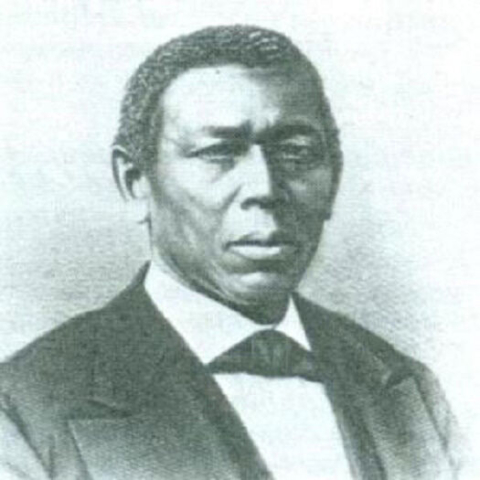
Preventative medicine has been a tool for health throughout history — in New Jersey that history includes an early 19th century man of African ancestry who became a noted doctor using herbs, wisdom, and preventive approaches.
“It is easier to ward off a monster than to fight him on his own vantage ground,” writes Dr. James Still about a disease in his 1877 autobiography, “The Early Recollections and Life of Dr. James Still.”
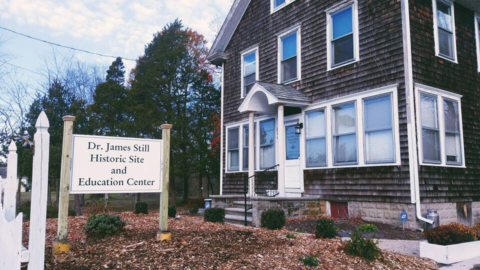
An historic figure who is gaining more visibility in and beyond New Jersey, Dr. James Still was born in 1812 in Indian Mills, Burlington County, where he lived most of his life and left behind both a legacy and his physical office (now owned a state-owned historic site).
State of New Jersey materials note that “Still was a renowned herbalist and homeopathic healer often called ‘The Black Doctor of the Pines.’
“One of 18 children born to former slaves Levin and Charity Still, his brothers included famed abolitionist William Still and Peter Still.
“Born into poverty and mostly self-educated, James Still became one of the wealthiest men in Burlington County,” his state biography notes. “He built a fine house with a small office next door and developed a hospital in an old tavern on Route 541. He married twice and had eight children.
“He prospered through his own industry and gave much of the credit to Providence. He and his family experienced poverty and prejudice but persevered with faith, modesty, and frugality.”
Other biographers, using Still’s writings, follow his early life working as a day laborer chopping wood, grubbing, cutting trees, and digging up roots.
This acquaintance with roots, and presumably their lore, led him to purchase a still in 1831, distill roots and herbs for oils and tinctures, and provide an income for his family.
Still enhanced his education through reading medical botany books purchased on his trips to Philadelphia. Then, in 1941, he inadvertently began his practice when a man offered him some sassafras in return for a treatment.
Others patients followed, and within 10 years his business flourished and continued to do so until his death in 1882.
At the beginning of his autobiography, Still sets up his family situation and eventually provides some self-help tips. “It was my lot in early life to be debarred from the advantages of education. It is very true my parents were poor and unable to school their children, as was also the case with many others in our section of country. Their main object was to provide bread for their children, and they had reason to congratulate themselves on their success were they thus fortunate.”
Yet, he says, he happened to receive three months instruction in reading, writing, and arithmetic, which “completed me to start out in life. If so be I should prefer a professional life of any kind, as doctor, lawyer, or minister, or whatever pursuit I chose to follow, I stood robed with three months education with which to start. For this much I feel truly thankful, when I look around and see so many deprived of even this.”
Then mixing self-help and preventative approaches, he says he hopes his book “may be a stimulus to some poor, dejected fellow-man, who, almost hopelessly, sits down and folds his arms and says, ‘I know nothing, and can do nothing’; Let me say to you, Study nature and its laws, the source from which these mighty truths are drawn. Great minds are not made in schools. I am speaking to men whose pecuniary circumstances are such as to prevent them from being partakers of these blissful privileges.
“A great mind is planted within us in the beginning of our lives, and, like other plants, it needs cultivation and watering from the best fountains. If these are out of reach, cultivate and water as best you can, and trust to the great Ruler of the universe for a crop, and you will not be disappointed in reaping a bountiful harvest, though you are often caused to feel depressed for want of a proper mode of utterance when in the company of the learned. Nevertheless, they will understand you if you cannot understand them.”
Although he does not use the term preventative medicine, his approach reflects the “ounce of prevention is worth a pound of cure” type of thinking.
For example, as he puts it, “It has been always my impression that the doctor was sent for to prevent protraction in disease, and by proper remedies to alleviate the suffering patient. My impression is, and always has been, that the duty of the practitioner is to prevent long or protracted illness.”
And elsewhere he says, “It has often seemed strange to me that persons will study interests in lands, stocks, financial and commercial; study how to accumulate wealth, how to make good bargains in their own favor, and how to prevent themselves from being imposed upon, and yet neglect the study of health and longevity, two of the most important things in an earthly career. Health is a greater boon than riches, surpassing every earthly blessing.”
One formula for health, he notes, is that he had “long considered vegetable medicine all that is needed for the ills of the human family, and the most simple compounds the better,” and that “it seems to me that vegetable medicine is all that is needed for the restoration of health, the voice of the medical faculty to the contrary notwithstanding.”
Although Dr. Still’s work and legacy were the stuff of New Jersey history, his home had been razed in 1937.
However, his property and the building where he had his office, a worn yet familiar feature of rural Burlington County, was purchased by the State of New Jersey in 2005 — the first African American historical property acquired for preservation and interpretation by the state.
The state also purchased the farm property next to office where it is partnering with the Medford Historical Society on an interpretative center.
Speaking from his 144-year-old book, Still continues to share some preventative wisdom from his years as a botanist and herbalist.
But he also shares herbs for the soul and offers the following as an anecdote against another illness, personal and social discord: “In all our dealings let truth be our guiding-star, which, if we keep in view, we shall not go astray, and our way will be lit up with justice to all men, a diadem of beauty on our heads.”
For more on Dr. James Still and the James Still Center at 211 Church Road, Medford, visit www.drjamesstillcenter.org.