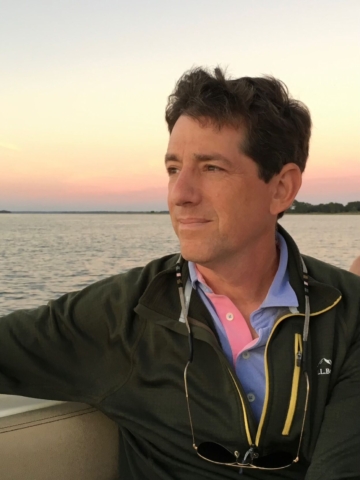
Joe Kossow is a Princeton-based representational painter who makes paintings the way he sees the world. With thorough drawings and an eye for interesting composition, Kossow is strong in his three favorite subject matters: still life, landscape, and figures.
A solo exhibition of Kossow’s paintings will show at the Taplin Gallery at the Arts Council of Princeton. The exhibition titled, “Still Lives from a (Mostly) Stilled Life,” will run from April 2 through April 30. A free opening reception is set for Saturday, April 2, from 2 to 5 p.m.
There will be approximately 60 oil paintings in the show that range in size from 4” x 6” up to 20” x 24”.
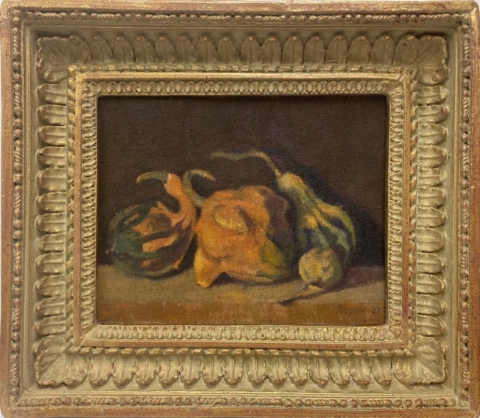
The still life paintings appear to be simple compositions, but close attention must be paid to the spaces in between, the negative shapes and the careful planning of the shadows. A short depth of field showing many familiar elements gives the work a comfortable feel that is very approachable.
Kossow is originally from Washington D.C., where he pursued his master’s of fine arts at American University.
But it was while he was a junior at Trinity College im Hartford, Connecticut, that a twist of fate changed Kossow’s path and outlook.
“A girlfriend in college painted my portrait and used blue for a shadow color. I asked her why, knowing that there was no blue in my hair. She set up a mirror and asked me to look, really look, and it was as if I started seeing the world in color instead of black and white. I had one of those ‘blink moments,’ when I knew that the course of my college class selection and future life had just change,.” he says.
Kossow’s work is a “loose record of the way I draw. I am painting for 15 hours on a piece and hoping a viewer will look for longer than 15 seconds.”
“I’m not ever truly sure what people see or think or feel when they look at my work, so I’m not certain what gets communicated. Some people like the work, others are unmoved; some accept that representational/perceptual painting is valuable in and of itself; others require that subject matter deals more explicitly with the political and social injustices of history and our time. All of that plays into what actually gets communicated,” Kossow says. He is cognizant that art, today as in the past, can show many different views and also express the artist’s interests.
Kossow says he enjoys the process as much as the finished products. “I hope that my work communicates something of the quiet joy I find in observing and contemplating everyday objects. I like things that show their age, old bottles, tools, pitchers, and such, so these objects often find their way into my work. But the subject of my work is painting itself: the conscious act of looking, perceiving, drawing, and composing in color. Ultimately I seek to suggest shapes and objects, to find the spaces between things and illuminate them, to see an object as light and dark shapes that are sometimes blurred, sometimes clear. When I lose myself in the act of painting, sometimes good paintings emerge. That’s what I strive for.”
The paintings filling the Taplin Gallery were all painted during the past three years, a time of isolation and challenges for many.
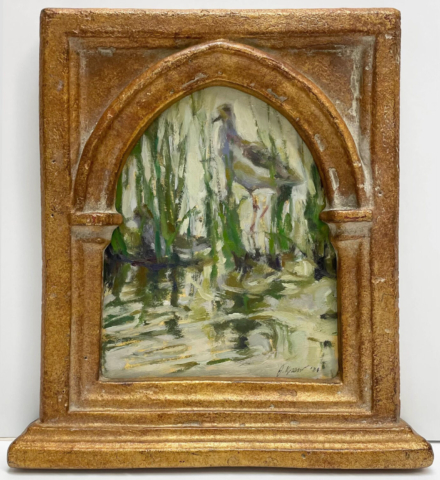
Many are in Robert Kulicke-designed frames. The late Kulicke was an East coast painter, frame maker, and teacher. Some of the frames are arched in shape and offered compositional and painting challenges.
Kossow says he made different substrates for the paintings to fit the openings in the differently shaped frames. “They were inspired by beautiful frames from art history, starting in ancient Egypt and working forward through centuries of European frames. Composing paintings to fit these shapes posed a series of interesting challenges, but the end result was well worth it.
“The shapes of these historic frames dictate the compositions. Several times I thought I had a good composition in mind for a shaped frame, but when I executed it, I found that the objects were too close to one side of the frame or another. Time to start over. Object scale and placement and the positions of shadows as they grow towards the edge of a frame are all of first importance. These frames are a tricky challenge, but delightful when they are made/allowed to work with the composition.”
After Kossow received his MFA, he along with a group of recent American University art graduates began a school. Founded in Washington D.C. in 1983, the aptly titled Washington Studio School was founded to teach drawing and painting. Kossow taught at the school and area colleges for eight years.
“I have a high admiration for teachers. My struggle was to keep it fresh, not just for the students but for myself. Teaching is a true calling,” he says about the experience.
Kossow teaches still, as a substitute advanced placement art history teacher at Princeton Day School. He prepares thoroughly for this role and brings the enthusiasm of a working artist to the classroom. It appears to invigorate him also.
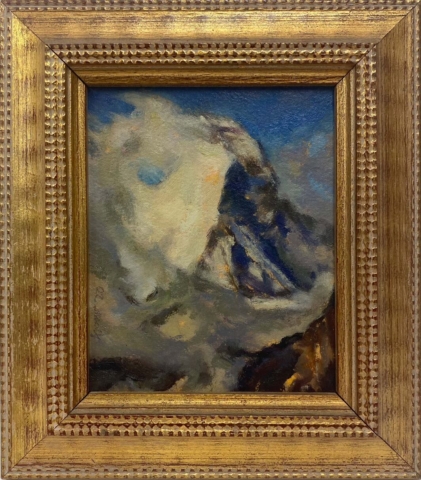
Regarding his paintings, Kossow says, “Mainly I paint from life. All the still lifes are from life. Many of the landscapes, given the homebound nature of COVID, have been painted from photos, which can be challenging, because what a camera sees and what our eyes see are different things. Editing has to be done to avoid recreating the distortions inherent in photography. I use photography as an aid to memory. My paintings from photos are usually the loosest and least detailed, surprisingly.”
Kossow showed work in the upstairs gallery at the Arts Council of Princeton building a few years ago. He was then asked to show solo in the main Taplin Gallery. That show, however, was delayed because of COVID.
Citing many influences, such as post-impressionist French painters Paul Cezanne and Edouard Vuillard, 19th-century French artist Jean-Baptiste Corot, and 20th-century Italian artist Giorgio Morandi, Kossow adds several others, “I was very strongly influenced by my MFA teachers: Robert D’Arista, Ben Summerford, and Jack Boul. I’ve been influenced by colleagues and friends whose work I admire: Lee Newman, Carlton Fletcher, and Susan Yanero (each a graduate of American University and cofounders the Washington School). And I’ve found a number of really strong artists online whose work I also follow: Francois Dupuis (based in Burgundy, France), Martin Yeoman (Royal Academy trained English artist), and Yael Scalia (New York-born artist in Jerusalem) to name but a few.”
It may be normal to see reflections of Jean-Baptiste Chardin, an 18th-century French still life painter, and Jan Van Eyck, Renaissance Netherlands artist, in Kossow’s work. “I love the low viewing angle for the still life paintings. I love Chardin and what he did with a narrow shelf controlling the depth of field. I built a shelf in my studio to use for composing my paintings.
“Though I use 18 different colors I never have all the colors figured out before I start. I have all the possibilities before me. I have the real life in front of me, I have decisions to make.”
“The struggle is to make good paintings. Everything else is up to me. I’m insanely fortunate enough to have the time and health enough to work. Sometimes on particularly conscious days it feels like I’m just a conduit; the process takes over, it’s a selfless feeling. On those days, three hours feels like three minutes, and I leave the studio with more energy than I had.”
Still Lives from a (Mostly) Stilled Life, Joe Kossow, Taplin Gallery, Arts Council of Princeton, 102 Witherspoon Street, Princeton, opens with a reception, Saturday, April 2, 2 to 5 p.m. and on view through April 30. Free. For more information: www.artscouncilofprinceton.org.
For more on artist Joe Kossow: www.jkossow.com.