Our Lady of Guadalupe has been celebrated and revered in Mexico for nearly five centuries. As the story goes, in December of the year 1531 at the hill of Tepeyac in Tenochtitlan (what is now Mexico City), a vision of a girl about 15 or 16 years of age, surrounded by light, appeared to the Indian peasant Juan Diego. She spoke to him in Nahuatl, his language, asking that a church be built in her honor. Juan Diego recognized her as the Virgin Mary, and when he went to the Archbishop of Mexico City, he was instructed to return to Tepeyac Hill and ask the girl for a miraculous sign that would prove her identity.
When Juan Diego returned home, he saw that his uncle was dying and en route to get a priest, he encountered the Virgin of Guadalupe who assured him his uncle had been healed. That was the first of four miraculous signs. Another was to send Juan Diego to gather flowers from the top of Tepeyac Hill in December, when nothing would have been in bloom. Juan Diego came back with Castilian roses from the barren hilltop. The Virgin arranged these flowers in his cloak, and when Juan Diego opened that cloak before the bishop, the flowers fell to the floor. In their place was imprinted the image of the Virgin.
When Guadalupe Reyes was growing up in Oaxaca, Mexico, this was one of her favorite stories told by her grandmother. Both were named Guadalupe. Reyes’ grandmother would take her to church for the Our Lady of Guadalupe celebration every December 12 — also the grandmother’s birthday — and tell her the story of Juan Diego and the Virgin. “She took us to places where the appearances of the Virgin occurred,” recounts Reyes. “I loved listening to those stories. I am Catholic, and I believe in the Virgin of Guadalupe strongly. Every time I feel worry, I pray to her, and I feel she listens to me.”
Reyes is putting the finishing touches on “Cubreme con tu Manto” (“Cover Me with your Mantle”). At the center of the enormous, lushly painted canvas is a young woman encircled with a large green cloak. The figure is holding a rosary, symbolizing the artist’s faith. Her face is painted white, with blue circles around her eyes and nose. Red twigs grow from a green tree trunk, and a large mystical butterfly looms overhead. Behind a brick wall is a large industrial city.
“The mantle is from the Virgin of Guadalupe,” says Reyes. “So ‘Cover Me with Your Mantle’ means I want the Virgin of Guadalupe to protect us.”
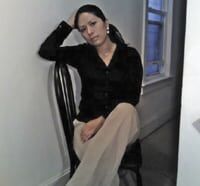
Reyes often uses herself as a model — “I am a very willing and inexpensive model” — but here she has used a Mexican immigrant to model the central figure “who symbolizes every Mexican who sees in herself the desire to immigrate to this country because she wants to have a better life.”
Reyes’ paintings are filled with magical realism, stories, symbolism, fantasy, and dreams. The butterfly in “Cubreme con tu Manto” signifies rebirth and liberty. The red branches are full of blood, says Reyes, representing the connection between faith and life, and the Virgin’s cloak is attached to the tree, and the tree is attached to the heart. A little dress hangs from the tree, homage to the artist’s muse, Frida Kahlo. Reyes quotes Kahlo: “I may be in America, but only my dress hangs there. My life is in Mexico.”
“Cubreme con tu Manto” has been completed just in time for Reyes’ first solo exhibition, “Arte de mi Corazon” (Art of My Heart), at the Pennington School’s Silva Gallery, through Friday, November 22, with a reception Friday, November 1, 5 to 7 p.m.
There is a Day of the Dead theme throughout the works, in conjunction with Mexico’s Dia de los Muertos celebrations on November 1 and 2 of the lives of those who have died. “That’s one of the biggest celebrations in Mexico and I have loved it since I was little. I remember families and friends would have a lot of food everywhere, and the flowers were so beautiful.”
The face painting in “Cubreme con tu Manto” is part of that celebration. “Skulls — known as calaveras or calacas in Mexico — are an essential part of the symbolism of Dia de los Muertos in Mexico,” writes Reyes. “They are used not only as the basis for painting faces, but also are the shape of candy such as sugar skulls and for many skeleton-inspired decorations.”
The Day of the Dead is a fascinating mixture of Spanish Catholic and native Aztec traditions and beliefs. People in Mexico wear traditional skull masks, and the tradition of painting faces to look like a skull has grown up as a variation to this. The wearing of masks has been a powerful symbol throughout traditional cultures, of the ability of humans to get in touch with their darker, chaotic side. Face painting as skulls is a chance to overcome fear of death, act recklessly and get up to the mischief that is forbidden at other times of the year.”
Silva Gallery Director Dolores Eaton first discovered Reyes when jurying the Mercer County Artists Exhibition 2013. “I was struck by her use of color and the story evoked by her imagery,” she says. “I was delighted to find that she is just like her paintings — bright and inviting with a deep story.”
Eaton chose Guadalupe’s work for the Silva Gallery “because it is a merging of excellent technique and deep meaning — which is what we teach our art students to strive for at Pennington.” The school’s Spanish teachers plan to have classes meet the artist during a gallery talk by Reyes in Spanish. For Dia de los Muertos, part of the Spanish curriculum, students will build a Day of the Dead altar in the gallery.
Reyes is unabashedly influenced by Kahlo. Her Hightstown High School art teacher, Bill Plank, first introduced her to Mexico’s cultural icon. Intrigued by Kahlo’s volatile marriage to Diego Rivera, her political activities, and relationships with Isamu Noguchi and Leon Trotsky, Reyes did a presentation on Kahlo for English class.
“One night I had a dream,” recounts Reyes. “I was lying in bed and she was in her wheelchair next to me, and when I greeted her I saw her soul coming out and entering into my body. She said ‘Don’t you want to be like me,’ and I said ‘Yeah but I don’t want to be crazy like you.’ When I woke up, that’s what happened to me. Sometimes I think I’m crazy. I want to do a series on her, photographs that I want to paint.”
Reyes has painted Kahlo six or seven times. At age 29, Reyes not only is having her first solo show, but has exhibited in California, New York, and New Jersey. She has a website as lush in design as her paintings, well organized and up to date, a blog, and is savvy about marketing herself on social media — she credits classes at MCCC for teaching her to develop a business plan. This is especially remarkable because Reyes first immigrated to this country when she was 15, learning English for the first time.
Raised in Oaxaco by her grandmother, a ceramic artist, Reyes’ father was involved in cattle sales. Her mother divorced him when Reyes was 3, and later moved to the U.S., where she cleans houses.
Although she drew and used crayons as a child, copying cartoons from the newspaper, Reyes first began taking art classes in high school. At Mercer County Community College, she earned an associate’s degree in management and works as a quality control inspector at Coregistics, a company in the contract packaging business in Cranbury. She went back for a second associate’s degree in art at MCCC, taking classes with Mel Leipzig, Terry McNichol, and Kyle Stevenson.
She was awarded two talent-based painting scholarships in 2011 that allowed her to continue her education. In 2013, she was recognized with both the Jack Harris Memorial Scholarship for painting excellence and the Mel Leipzig Scholarship for outstanding work by a graduating artist.
“My grandmother said I’d be a painter one day,” says Reyes. Her grandmother made clay tortilla pans. When Reyes came to the U.S., she called her mother “Abuela” (Spanish for grandmother) for a long time. Reyes’ abuela died two years after Reyes’ immigration, and Reyes misses her very much. By painting her culture, Reyes, who researches imagery of Mexican culture online and rearranges things, is bringing back her grandmother. “When I’m painting, doing what I like, she’s with me.” She hopes to return to Mexico some day to teach art. “My dream is to be able to help poor children. I want to be a recognized artist, but first I want to help kids in Mexico.”
“I can still close my eyes today and smell the flavors of that food, the land and the flowers,” Reyes writes of her homeland. “I can see my grandmother cooking and laughing with us still. These are some of the feelings and impressions that I hope to share in my work.”
Arte de mi Corazon, Silva Gallery of Art, Pennington School, 112 West Delaware Avenue, Pennington. Thursday, October 17, through Friday, November 22, Mondays through Thursdays, 11 a.m. to 4 p.m., and Fridays 11 a.m. to 1 p.m. Opening reception, Friday, November 1, 5 to 7 p.m. Free. 609-737-8069 or www.pennington.org.