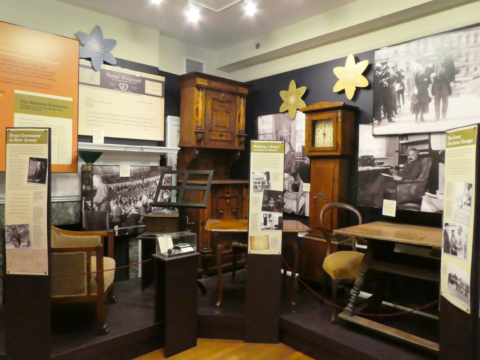
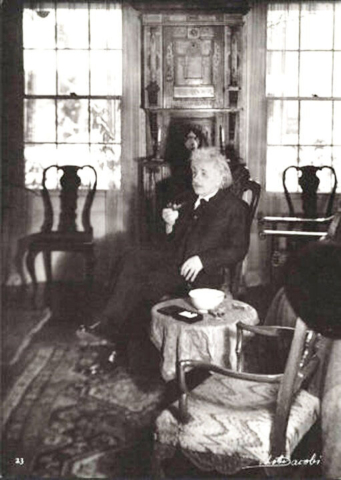
Those wanting to celebrate Albert Einstein’s March 14 birthday in his living room will have the opportunity to do so at the Historical Society of Princeton’s “Einstein Salon” exhibit that features items from the Princeton house where the great physicist lived until his death in 1955.
The organization reopened its doors in January after being closed in 2020 by the pandemic.
And while the HSP boasts a collection that provides the history of the community, it also curates the collection of materials related to Einstein — arguably Princeton’s most famous citizen.
Even though the small permanent “Einstein Salon” exhibition is on view throughout the year, it takes on greater significance on his birthday.
Part of it is because of the town’s events related to Pi Day, a day to celebrate math and science. The tie-in is that it connects Einstein’s birth date, represented by the 3rd month plus the 14th day, or 3-14, to the phenomenon of Pi, a mathematical constant related to the circumference of circles expressed as an infinite decimal typically shortened 3.14. That it’s Einstein’s 143rd birthday adds to the geeky fun.
But a big part of it is that Einstein lived in Princeton for 23 years, accepting a 1933 invitation to join the Institute for Advanced Study when he was forced to leave Nazi Germany because he was Jewish.
While his physical remains were scattered in an undisclosed location following his death, many of his photographs, documents, and physical objects taken from his home at 112 Mercer Street are in the HSP salon.
HSP Curator of Collections and Research Stephanie Schwartz says that exhibit pulls from only one of the four Einstein collections managed by the organization founded in 1938 as a museum, research center, and public programming site dedicated to showcasing Princeton’s history.
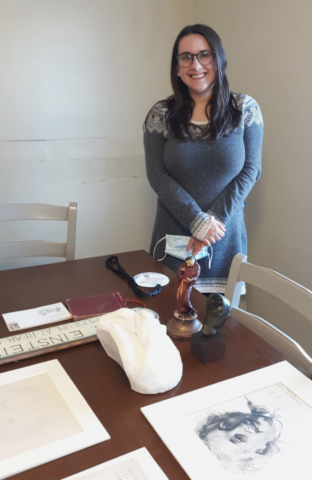
During a recent interview at one of the Updike Farm’s upstairs meeting room, Schwartz sits amidst one-of-a-kind materials, including a document featuring Einstein’s handwritten mathematical notations and self-portrait doodle, and describes the collections.
The first is the furniture collection. “It’s 65 pieces form the Einstein house and given to us by the Institute for Advanced Study” in 2002, says Schwartz. “Some of the pieces are on permanent display and include his desk and music stand.”
The second is a collection that belonged to Princeton University curator, collector, and scholar Grillett Griffin.
Schwartz says the collection was given to HSP in 2016 and includes more than “50 pieces of a large variety of materials, artwork and ephemera, a lot of secondary research, correspondence, newspaper clippings. There are also Einstein’s personal items.”
They include a compass, an object that fascinated Einstein as a youngster; handheld puzzles games that Einstein would hand out to visitors; an autographed photo of Einstein sitting on his porch while wearing large fuzzy slippers; and several small sculptures by his stepdaughter, Margo.
A third collection is an oral history from a series of interviews conducted in the 1970s with Einstein’s contemporaries — including area community members — by Princeton writer Jamie Sayen for his 1985 book “Einstein in America.”
According to HSP information, Sayen “spoke to over 29 people who knew Einstein, including his secretary Helen Dukas. Sayen donated his tapes to HSP in 2005 and they were digitized in late 2020.”
Schwartz says there are plans to use this collection as an interactive component of the salon and provide visitors with an opportunity to hear discussions on such curated topics as Einstein on music and his hobbies.
And the final collection, which is also the newest but perhaps best known in the region, is the mini-museum exhibit displayed for years at Landau’s Store on Nassau Street in Princeton.
“We got (the collection) in early 2021 when the store closed,” says Schwartz, adding that the Landau brothers, Henry and Robert, had an interest in preserving the materials and donating them to HSP.
“It was something both parties wanted, and we’re happy to have it here. It supplements the rest of our Einstein holdings and shows great testimony to Einstein in Princeton.”
While the University of Jerusalem has the major collection, especially of Einstein’s scientific thoughts, the HSP collection is important for showing “his relationship with the town of Princeton and the people” and that it shows his “humanizing characteristics: his love of music, love of sailing, and the (recollections of) people seeing him walk around town, and the stories from that,” Schwartz says.
Consequently, she says, “This is our most popular draw. People love Einstein. A lot of our visitors are visiting Princeton (and) seek this out due to an interest in Einstein. Locals who have people visiting bring them here. People really enjoy the furniture, and the pipe is a big draw. I believe the only other (pipe) is in a Smithsonian collection.”
Schwartz also has her own favorites. “I really love the puzzle games,” she says, adding that there are stories about him giving them to kids and visitors when they came to his house. “I don’t know if it was to break the tension for him or for others. But he’d pull them out.”
Another favorite is the music stand. “I love Einstein’s love of music and how integral it was to his character. It was a way he interacted with the town. He was involved with the Princeton orchestra. It was a different side of Einstein.”
About her own background, Schwarz says she was raised in Robbinsville to parents who were involved with science — a nurse mother and engineer father.
After attending Connecticut College and pursuing graduate studies at Simmons, she saw an online HSP employment opening and applied. “I’ve been here in a variety capacities from 2012. I handled HSP’s research inquiries and became curator of collection and research in 2016.”
She says that while the “mythic figure” of Einstein has always been part of her memory, she never imagined she would be maintaining his collection and helping to tell his story in Princeton.
She also oversees collections at Updike Farm and an undisclosed storage area in the region and helps tell other stories.
“There’s a lot documenting early Princeton history,” she says. “We have the Stockton family papers,” including the poet Annis Boudinot Stockton, wife of Declaration of Independence signer Richard Stockton, in which she declares herself as a patriot.
“We have the Olden family papers, related to early families in Princeton, and a collection of things about the Princeton Prep School.”
There are also collections dealing with architecture. That includes the papers and drawings of prolific mid-20th century Princeton architect Rolf Bauhan.
Though there are thousands of objects in the collection, Schwartz turns to her favorites, including the “wonderful photo collections, mainly from the Rose Studio, a multi-generation photographer in Princeton, Nassau Street. We have a collection of glass plate negative from the turn of that century, and portrait shots of Princeton history and buildings. I love the photo collections.”
Other loves include collections related to the history of area schools, like dance programs from the “Princeton Model School” and ephemera such as concert tickets and programs that “tell a great story and are visually striking.”
Overall, she says, “There are some cool items that are a significant and have great stories.”
Yet, the “big draw” is Einstein and the HSP’s growing collection that gets bigger attention in mid-March.
In addition to the “Einstein’s Salon” on view Wednesdays through Sundays, HSP is offering a “Sketching Einstein” event held on Tuesday, March 15, a day after the official Einstein’s birthday and Pi Day, at 7 p.m.
The pay-what-you-can Zoom presentation includes Schwartz sharing objects and drawings from the Griffin Collection and a drawing session with Arts Council of Princeton teaching artist Barbara DiLorenzo.
Historical Society of Princeton at Updike Farm is located at 354 Quaker Road in Princeton. In addition to the “Einstein Salon,” current exhibits include “Princeton Portraits,” “Rex Goreleigh: Migrant Worker’s Witness,” and more. It is open Wednesday, Friday, Saturday, and Sunday, noon to 4 p.m., and Thursdays, noon to 7 p.m. Tickets are $4.
For more information: 609-921-6748 or visit www.princetonhistory.org.