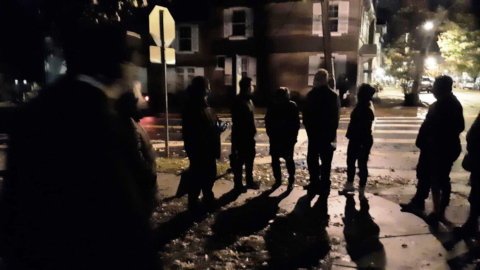
It’s the season of ghosts, and what better way to enjoy it than to go on one of the ghost tours being offered in Princeton, New Hope, and Bordentown.
And while it can be fun just to stand in the dark and hope that ghosts appear, it is also fun to consider how the art behind such tours can make even the most skeptical of participants willing to give the spiritual world a ghost of a chance.
Hamilton-born theater artist, founder of the former Odd Act Theater Group, and theater professor Rob Thompson is the right person to talk about this distinct genre of theater: He not only led ghost tours in Gettysburg, Pennsylvania, but focused on ghost tours and sacred rituals for doctoral work at the University of Maryland.
“Religion and theater come out of the same practice. The shaman put on a great show but asked the big questions. I ask students to think about the bigger meaning of things,” Thompson says in the following archival interview.
“The most effective ghost tour is the tour best able to render ghosts as a potential truth and perform potential truth as a form of entertainment,” he says.
Though tourists can seem doubtful about meeting a ghost, the job of the ghost tour guide is to persuade the tourist that she or he may actually encounter something from another dimension.
“On an effective tour, the longer the tour goes, the more convinced the tourist becomes. There may be moments when doubt peeks through, but a new story or a new site convinces the tourist anew. The more convinced the tourist becomes that she or he may encounter a ghost, the more thrilling the tour.”
Sharpening his point, Thompson says, “Ghost tours do not promise ghosts; they perform them. They blend the quest for the genuine ghost encounter with the quest for pleasure and entertainment. They entertain their tour groups by enticing them to entertain the possibility of ghosts. Ghost tour guides consistently reference the number of the dead and the horrific nature of their deaths. Quantity and trauma form an important basis for the assertion that there are significant ghostly phenomena.”
A ghost, Thompson says, is the manifestation of a past presence or “a visceral encounter with the feelings and sensations that (a person) experienced in life. Haunting implies that a ghost is regularly present in that space. In other words, whether or not the ghost chooses to render a manifestation, she or he is likely to be occupying the haunted site. The ghost encounter happens when a tourist experiences a manifestation in a haunted space.”
He adds that “haunted” spaces are locations in which manifestations are more common, referring to such well known sites made popular through television shows and books: Salem, Massachusetts, and New Orleans.
According to Thompson, there are several components that make a successful ghost tour. One is for the planner to understand why people join such a tour in the first place. “The typical ghost tourist does have at least some desire for the authentic ghost meeting and often demonstrates a predisposition to believe in ghosts by sharing their own ghost stories with their guides,” he says.
While a ghost tourist may want a paranormal encounter, they understand that it is unlikely and do not demand results. Instead, ghost tourists seem to accept their lack of ability to encounter spirits on their own and enlist “the services of a ghost tour guide in order to seek out or be ‘guided’ to the ghosts. The ghost tour guide’s task is to mediate between the world of the ghost and the world of the ghost tourist in order to perform an effective tour”; however, “(ghost tourists) are content to accept a potential rather than the actual meeting,” says Thompson.
Another component is a direct contrast to the tourists’ hopes and beliefs and focuses on the ghost tour guide’s task of engaging and holding the tour group’s attention. To do this, the guide combines history and “purportedly true stories about ghosts in order to establish the idea that they might appear on the tour. The ghost tour guide, although similarly interested in authenticity (in terms of the ghost encounter), has a far greater focus on entertaining and engaging the tour group. “
The guide also keeps his audience engaged by reducing fear. “Dangerous ghosts are excluded from tours as a matter of course. Ghost narratives may discuss ghosts who are deadly or macabre, but these ghosts are never made a danger to the tourist. They remain in the narrative or manifest themselves in non-threatening ways. Cupboards are rattled, hair pulled, even clothes folded, but the walls never run with blood.”
Just as in theater, a ghost tour’s success rests on the ability of the performer. “The ghost tour guide is the central feature,” says Thompson. “There are two ways to view the guide’s performance, dependent upon whether or not we hold that ghosts are actually present in the spaces that tours visit. From a non-believer’s perspective, the tour guide can be understood as the entirety of the performance. In other words, if we hold that there never were, are, or will be ghosts, the guide’s performance is all that tourists purchase with their ticket. From the believer’s perspective, however, the guide is not alone because the ghosts serve as some portion of the evening’s experience.”
The performance is enhanced by costumes reminiscent of the era of the haunting, “not to portray a historical character but rather to make a connection with the history of the space in which they are performing,” says Thompson, adding that “two distinctive props complete the ghost tour guide’s ensemble: the satchel [which serves the utilitarian purpose of holding water, tickets, etc.] and the lantern, an important key for the guide’s performance.”
Another key is the guide’s sincerity and “ability to convince the tour group of anything, let alone the existence of ghosts. Guides create a performance persona in order to present a routine, often performed on a nightly basis during the height of the tour season. Guides’ stories are rarely ever scripted word for word, but all guides have routes that they are comfortable with and narratives that they perform regularly.”
Thompson says the implicit message for the audience is that the guide can be trusted even though the performance cannot. “This poses an interesting problem for the guide’s objective to persuade tourists of the possibility of ghosts. If the tourist cannot trust the performance, the guide’s own personal beliefs become increasingly important to the tourist’s ability to believe or entertain belief.”
This mixture of truth, sincerity, and potential creates what Thompson calls the “ghost connection,” or “the moment in the ghost tour narrative when the facts presented can no longer be explained without the ghost. This occurs when the ghost must be used to connect a mysterious circumstance to either documented history or a compelling piece of evidence. Through the ghost connection, the narrative asserts, either implicitly or explicitly, that ghosts must exist.”
Such moments touch an important part of the ghost tour performance: “the tenuous and fragile problem of paranormal belief. Ghost tours play with this belief, teasing tourists with questions of its truth or falsehood, dancing around the hotly contentious issue of the afterlife, but always maintaining a safe distance for fear of getting burned.” After all, he says, “Ghost tours are about fun and entertainment.”
To join the fun, check out the following:
Bordentown Walking Tours’ Haunted History Tours. Wednesday and Thursday, October 25 and 26, 7 p.m.; Friday and Saturday, October 27 and 28, 6, 7, and 8:15 p.m.; Sunday, October 29, 6 p.m.; and Saturday, November 4, 6 and 7 p.m. 1 hour. $15 to $20. bordentownwalkingtours.com
Princeton Tour Company’s Guided Ghost Tours. Friday and Saturday, October 27 and 28, 7 p.m. 2 hours. $35. princetontourcompany.com
Ghost Tours of New Hope. Friday, Saturday, and Tuesday, October 27, 28, and 31, 8 p.m. 1 hour. $12. ghosttoursofnewhope.com.