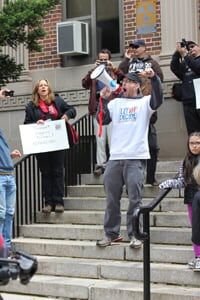
Theresa Lam, organizer of the Princeton March Against Monsanto coming up on Saturday, October 12, will tell you that you don’t have to be opposed to that ag-biotech giant or to genetically engineered foods (sometimes called GMOs, for genetically modified organisms) to join in. You should just want to know what’s in the food you eat. “We’re all responsible for the food that winds up on our plate,” Lam says, “so everybody should be out there fighting to know what’s in it. We’re advocating for food labeling.”
In a related press release she writes, “the majority of people want genetically engineered foods labeled. We are asking people to show their support for labeling and to raise awareness about the importance of voting with their wallets by purchasing organic local foods.” The Princeton march, which kicks off at 2 p.m. at the Whole Earth Center, will be one of 500 such events around the world that day in which tens of thousands of people are expected to participate.
Partners working to organize the Princeton event include the Whole Earth Center, the Northeast Organic Farming Association of New Jersey (NOFA-NJ), Food & Water Watch of New Jersey, and GMO-Free NJ.
Although there’s a food labeling bill currently circulating in the New Jersey legislature that Lam and like-minded citizens support, part of their frustration, she says, is that that bill (AB.2955/SB.1367), first introduced in May, 2012, is mired in politics. “Trenton is just spinning its wheels,” she says.
Lam, who has a degree in biology from Rutgers University (1990) and has worked as a chemical technician at a soil and water-testing lab and at major research and development laboratories, thinks that “everyone should learn not to buy or eat GMOs.” That belief is what motivated her last year to join the NOFA-NJ board as a volunteer, where she heads up the policy committee. “I prefer to use the term ‘transgenics’ over ‘genetically modified,’” says the former middle school science teacher. “These foods are bad for farmers, for the environment, and for human health.” She cites as one example Monsanto’s own safety data sheet for its herbicide Roundup, the most widely used among genetically engineered crops. “It reports that in very small amounts in rats, ‘post implantation is lost’ meaning, spontaneous abortions. Does that carry over to humans? We don’t know because studies aren’t being done.”
That’s why the organizers are also calling for further scientific research on the health effects of GMOs. They also decry what they call the cronyism between the ag-biotech industry and government regulators. Michael R. Taylor, for example, is the FDA deputy commissioner of the Office of Foods. Before that he was vice president of public policy for Monsanto.
The GMO battle is, of course, hotly debated, with each side accusing the other of misleading the public. But the movement to label foods that contain genetically engineered ingredients is gaining traction in the U.S. (The European Union already has stringent GMO labeling regulations in place.) More than 20 states have introduced labeling legislation this year alone. Whole Foods Market, the influential national juggernaut, announced in March that by 2018 all products in its U.S. and Canadian stores must be labeled to indicate whether they contain genetically modified organisms. Princeton’s own Whole Earth Center, a sponsor of the march, prides itself on having been a source of natural foods since 1970. On November 5 Washington State voters will cast their ballots for or against a bill that mandates labels on all genetically modified food sold in grocery stores. To help citizens understand GMOs and the issues surrounding them journalist/chef Kim O’Donnel compiled a fairly reasoned primer called the ABCS of GMOS. It can be accessed at https://crosscut.com.
“The pro-GMO people are characterizing us activists as fear mongers,” Lam says. “But many scientists have studied and found harmful effects from GMOs and Roundup. Roundup is systemic, meaning it penetrates every cell, so cannot be washed away.” She also mentions corn seed that has been engineered to contain a soil bacterium commonly known as Bt, which acts as a built-in insecticide. “The Bt toxin is produced by every cell in the corn,” she says. “They say it is not toxic to humans, but I want a chance to decide not to eat anything with the Bt toxin. Why can’t I choose? And how do they know it’s not toxic? How can they follow its effects in humans if the products containing it aren’t labeled?”
Many Americans have faith that a federal agency such as the Food and Drug Administration tests, monitors, and protects our food supply. “The FDA does not test; they leave it up to Monsanto to test,” Lam says. “And those tests have a 90-day limit! It’s shabby. We need long-term feeding studies of GMOs.” She jokingly says that GMO advocates should volunteer to be the subjects of human studies. (A list of nearly 600 peer-reviewed studies on the safety of GM foods — 120 of them conducted by labs with independent funding — can be accessed at www.biofortified.org/genera/studies-for-genera.)
Lam, who is 50 and lives in East Brunswick with her husband and two teenage daughters, describes herself as a “local food activist.” She organized a previous March Against Monsanto last May, which took place in New Brunswick. “I had been reading on Facebook about the actions and movement on the West Coast and, in fact, worldwide. I saw that New Jersey didn’t have an organizational chair so I hopped on the wagon.” That march was one of approximately 400 held worldwide on May 25. Organizers estimated that 2 million marchers participated — 800 of them in New Brunswick. “That first march was amazing,” Lam says. “I was so thrilled. I organized it totally on Facebook. I pushed some people I knew to join the march, and then others just started joining. People are learning.”
She backs up this claim by comparing those numbers to a telephone campaign she participated in three years ago, trying to mobilize people for a march in New York City. “We got 50 people. This past May, we had 4,000 people march in New York City.” She won’t estimate how many she expects for the Princeton event, though more than 200 had signed up on the March Against Monsanto Princeton Facebook page by the beginning of October. “We won’t know until it happens,” she says. “Anything can happen.”
Princeton March Against Monsanto, Whole Earth Center, 360 Nassau Street, Princeton. Saturday, October 12, 2 p.m. Featured speakers include Jim Walsh of Food & Water Watch and Barbara Thomas of GMO-Free NJ. Marchers will follow a route that ends with a rally at Monument Park on Monument Drive. On Facebook: Princeton March Against Monsanto. On Twitter: hashtag #mamprinceton. www.march-against-monsanto.com.
Pat Tanner blogs at dinewithpat.com.