At first, Melissa Maxwell’s production of “Clyde’s” for New Brunswick’s George Street Playhouse doesn’t seem like a typical Lynn Nottage play.
Via works such as “Intimate Apparel,” “Sweat,” and “Ruined,” Nottage has established herself as one of America’s most important playwrights. In the plays mentioned, purpose and intention are realized immediately. Naturally, the plays build texture as their stories proceed, but the depth they will achieve is perceived from scene one.
“Clyde’s” is different. It takes time to reveal all of its facets. It isn’t until the play ends that the sum of its parts coalesce in a way that puts it in a league with other Nottage pieces.
The opening scenes of “Clyde’s” are entertaining, but they don’t seem to lead anywhere worth going. A situation is established before a theme takes root. The characters, all ex-convicts employed by Clyde (Darlene Hope) at her truck-stop diner, are given more to gossip, petty gripes, and horseplay than they are to anything that moves them beyond the surface or makes them interesting as individuals.
There are plenty of wisecracks, and personalities are clear, but “Clyde’s” begins as a standard comedy that has little to offer in spite of a few good jokes and characters who mostly complain about the drudgery of their job, about the only one they can get because of their prison records. Clyde, who has also served jail time, is the lone person who will hire them. In fact, she only hires ex-cons, but she reminds them of that every time she comes from the front of the diner to the kitchen and has no compunction about firing employees or placing them at the mercy of parole or probation officers.
The characters seem stuck in a mire. Whatever aptitude they have, and however harmless they may seem, they get a cold ‘no’ from any place they apply, so Clyde’s becomes a refuge that provides income and insulation from the criminal justice system. Because of this, they put up with Clyde’s threats and overall abuse. They have no choice.
Some aspects of the characters and Nottage’s story make more sense as “Clyde’s” develops.
For instance, the former prisoners, especially those still experiencing adjudication, don’t have much, so they become territorial. When a new worker shows up, one whose arrival Clyde neglected to tell her staff to expect, they look at him with suspicion, refuse to help him learn the ropes of sandwich making, and defensively yell, “Mine,” any time he approaches their work station or asks a question.
It doesn’t help that this new hire, Jason (Ryan Czerwonko), has numerous tattoos acquired in prison including a swastika over his Adam’s apple with an unfriendly message (one that begins with an “f” and ends with “you”) on each side of it. The fascist symbols are only part of Jason’s colleague’s problems. The bigger worry is whether his presence gives Clyde leverage to dismiss someone already there or if he’ll set a standard that the others, who don’t exactly hustle or demonstrate much diligence, can’t or won’t meet.
The scene when Jason appears seems more annoying than enlightening at George Street because the reaction to his hiring seems so extreme. It’s only later, as we learn more about each of Clyde’s staff that some context is established that puts the workers’ behavior in perspective.
Early in “Clyde’s,” I searched for a theme. Is Nottage’s purpose here redemption? Is it showing that all of Clyde’s workers seem capable of living peacefully within society? Is it an indictment of the prison system or employers like Clyde, who despite her own past, keeps her staff in a kind of thrall, making them afraid to displease her lest they have to seek a new boss that might not exist?
Eventually, several of these ideas come into play. “Clyde’s” happens to be a play that makes you wait for its payoff, that by the 70th of its 95 minutes, finally makes it plain why Nottage wrote it in the first place.
The key is actually in the first scene. One of Clyde’s staff, Montrellous (Gabriel Lawrence), has a knack for making tasty food. Clyde likes to keep her sandwiches simple, ham and cheese on rye with some lettuce, tomato, and mayonnaise. She is not looking for creativity and believes too much of it might hurt her business.
Nonetheless, Montrellous asks her to sample more complex or more carefully made sandwiches he creates. Although Clyde admonishes him not to waste her food on his experiments, she tastes what Montrellous makes. She doesn’t, and won’t, put it on the menu, but you know she appreciates Montrellous’s talent on some begrudging level.
Montrellous’s quest to make perfect sandwiches rubs off on the others. He leads sessions in which the staff – Tish (Sydney Lolita Cusic), Rafael (Xavier Reyes), and Jason – imagine ideal sandwiches they would like to make. When Clyde isn’t looking, or minding inventory too closely, they realize their creations, each taster giving constructive criticism.
It’s this deep delve into creativity that gives “Clyde’s” its theatrical wheels. Devising a new sandwich inspires the workers. It gives them ambition.
“Clyde’s” finds its way and becomes infinitely more satisfying when it’s clear that Nottage is aiming towards genuine independence for a group that has been condemned by the courts, stigmatized by a society that fears criminals, even reformed criminals, and has been cowed by mistreatment of alleged benefactors like Clyde.
“Clyde’s” take off when the characters bloom into more confident beings.
It takes a while. A lot that seems inconsequential or repetitive must be slogged through before “Clyde’s” finds its stride. Sequences when each ex-con tells his or her story help. They show that the characters are mostly victims of circumstance, criminals because of one thoughtless moment. Only one actually planned his crime. Another turns out to be a martyr of sorts.
It’s worth the wait to see the various elements that looked so flimsy congeal into ideas that are worth considering and say something about human beings and the way we regard each other. The final scenes at George Street are particularly grand as each of Clyde’s workers make a decision about his or her life.
About the only scene in which I sided with Clyde is one in which she comes to the kitchen to ask that relish be put on a sandwich by customer request. Montrellous refuses. He calls the condiment an abomination for that sandwich. Clyde endures refusals from the others until she slathers the sandwich with the desired relish. Integrity comes second to practicality when a customer is concerned.
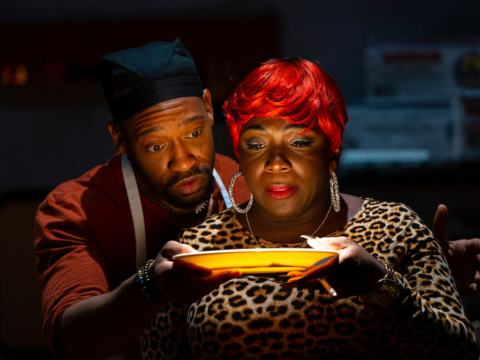
Maxwell’s cast at George Street keep things lively even when the play seems to border on being a flapdoodle. Czerwonko deftly shows the decent, quiet side of guy who appears to be tough as nails and is decorated in Nazi symbols. Hope, bedecked in stretch outfits with animal prints and crisscrossed with gold jewelry, brings out the meanness and business savvy of Clyde. Lawrence subtly shows the Montrellous’s leadership while the hopeful catalyst to a more rewarding life for himself and his colleagues. Reyes exudes joy as Rafael. And Cusic is wise and purposeful as Tish.
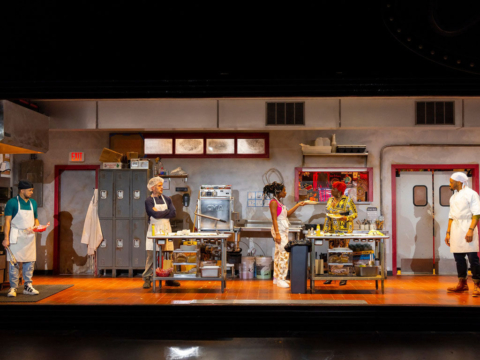
Riw Rakkulchon’s set would be welcome in any kitchen. It looks ready to go into operation. Azalea Fairley’s costume for Clyde show the designer’s wit and mettle. Lighting by Cheyenne Sykes and sound by Scott O’Brien give tone to Maxwell’s production.
Clyde’s, George Street Playhouse, New Brunswick Performing Arts Center, 11 Livingston Avenue, New Brunswick. Through Sunday, February 19, Wednesday through Saturday, 8 p.m. and Thursday, Saturday, and Sunday, 2 p.m. $25 to $90. 732-246-7717 or www.georgestreetplayhouse.org.