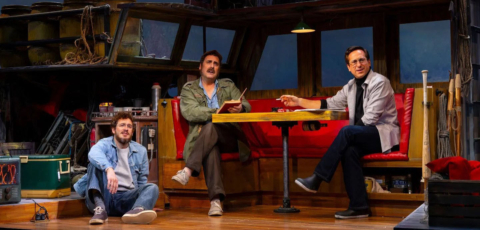
If I didn’t know Roy Scheider died in 2008 and would be age 92 if alive today, I’d swear the “French Connection”/“All That Jazz” actor was on stage at New Brunswick’s George Street Playhouse portraying himself in “The Shark is Broken,” a play that depicts downtime among Scheider, Robert Shaw, and Richard Dreyfuss during the making of Steven Spielberg’s 1975 film classic, “Jaws.”
That how much Scheider’s George Street portrayer, Jason Babinsky, looks like Scheider and captured his signature mannerisms.
Because of Babinsky’s even-handed approach and Scheider’s position as the smartest and most reasonable of the co-stars, it is Babinsky who steals Peter Flynn’s production of Ian Shaw and Joseph Nixon’s engaging, revealing, but generally inconsequential piece.
Ian Shaw is Robert Shaw’s son, so it’s probable that the elder Shaw’s memories and reflections inform “The Shark is Broken’s’” script.
Babinsky’s co-stars — as with “Jaws,” I consider all three actors to be leads. — Jeffrey M. Bender as Shaw and Max Wolkowitz as Dreyfuss also bring their characters to vivid life in a play that shows some of the dynamics of filmmaking but mostly centers on how three diametrically different actors with wildly different training, understanding, and emotions coalesce into an ensemble and work to get along between takes.
“The Shark is Broken’s” title tells you those pauses between shooting scenes were numerous and protracted because the mechanical shark that was to menace the scientist (Dreyfuss), shark hunter (Shaw), and politician (Scheider) kept getting waterlogged or plagued by technical glitches that precluded filming for days at a time.
That gave its co-stars more than the usual time to hang out on the boat Scheider’s famous ad lib says needs to be “bigger” and get on each other’s nerves.
Or reveal something about the actors behind the characters and their attitudes towards “Jaws” and their roles.
Ironically, all but Dreyfuss thought they were making a populist bagatelle that would attract a summer audience who liked thrillers or enjoyed Peter Benchley’s best-selling novel and fade from sight, never to be remembered much past 1975. Shaw and Nixon get a lot of mileage, perhaps too much, out of denigrating the art and excitement that would earn “Jaws” lasting acclaim.
Babinsky, Bender, and Wolkowitz are lively and likable, so George Street’s “The Shark is Broken” is consistently entertaining and keeps you amused with the gossip about “Jaws,” Spielberg, and moviemaking in general. There’s also fun in watching current actors play famous actors and their equally famous characters.
I took particular pleasure in that. I not only saw “Jaws” but also all three of its stars in key roles on stage. I interviewed Shaw, who died way too young (age 51) and had lots more to offer theater and movie audiences, and Dreyfuss, who was less neurotic and irritating in person that he is depicted in this play. To their credit, Babinsky, Bender, and Wolkowitz conveyed the spark that made their characters special on the screen. I also like that they or Flynn included habits that would lead of each of their eventual downfalls — Shaw’s drinking, Scheider’s chain smoking, and Dreyfuss’s childish antics.
Somehow, I think Dreyfuss comes off as too much of the buffoon in Shaw and Nixon’s play, always being more interested in his career than in the art of acting and always being ignorant of historical and cultural information the constant reader, Scheider, and broadly education Shaw have at their fingertips.
The laugh is, of course, Dreyfuss has the most successful career, with more leading roles than either Scheider or Shaw and a reputation for doing what he did well, even if not to the level of a magnetic performer like Robert Shaw.
Flynn’s George Street production has a star besides the three excellent actors. Set designer Anne Mundell’s too-little boat earns due applause when it materializes from behind a movie screen showing the boat from “Jaws” floating in Long Island Sound.
Mundell’s craft comes at the George Street audience like a behemoth. The actors are deft at maneuvering around its various ladders and decks. Flynn is canny about having his cast duck as if they’re going to a downstairs cabin when they exit from the upstage side of the Orca.
Every actor gets his moments to shine.
Jeffrey M. Bender captures both the poet and gruff Irish lad in Robert Shaw.
Better than that, he captures the lilt and power that informed Shaw’s line readings in everything from Strindberg to Pinter, and in so many films. (Shaw’s Henry VIII in “A Man for All Seasons” stands out in my memory as I write.)
Among tasks Bender acquits with Shaw’s ability to key into anything he said is doing a difficult scene from “Jaws” that recounts the shark hunter’s experience with the murderous creatures and which Shaw rewrote for the film.
Jason Babinsky may have the most difficult part because Roy Scheider is the calm, relatively relaxed raisonneur of the group. He has to keep peace while holding his own when artistry and matters about “Jaws” are being discussed.
Babinsky not only did his part well, but he managed to attract attention equal to theirs despite not having their showy, dramatic, or temperamental scenes.
In one wonderfully acted quiet moment, Babinsky shows how Scheider, told he would have the afternoon off, settled into some sun bathing on the Orca’s deck only to get a summons to come to the onshore set after all. The facial expressions and hesitation Babinsky gives Scheider as he determines whether to acknowledge the radioed summons is a lesson in how to do a scene that has more subtle action than dialogue.
Bender has no end of dramatic moments as he never relaxes Shaw’s general disdain for Dreyfuss and brings off a great scene when Shaw, a dependent alcoholic, lapses into desperation when he can’t find a bottle of whiskey he hid somewhere on the Orca.
Max Wolkowitz meets the task of making Dreyfuss and his antics understood even as the younger, less art-driven actor shows himself to be an impetuous lout.
As I noted earlier, Shaw and Nixon’s writing turns Dreyfuss into an irredeemable jerk who is looking for the vehicle that will put his career into full gear, cement him as a star, and has no regard for whether “Jaws” will be good or knowledge of much beyond what he needs to keep succeeding in Hollywood.
Wolkowitz has no trouble playing Dreyfuss with all his annoying traits. He makes Dreyfuss the character richer and more human by showing signs that Scheider’s discipline and subtle humor, and Shaw’s artistic bent, are rubbing off on him. Wolkowitz is especially good at showing Dreyfuss’ jubilation after reading a Variety review that turns his work in “The Apprenticeship of Daddy Kravitz” from a thorn to something that might advance his already vaunted ambition. He is also fun to watch as he helps Shaw search for that much needed elusive bottle of hooch.
No one could design a set for “The Shark is Broken” better than Anne Mundell’s lifelike boat that in addition to looking familiar and authentic, has several surfaces to give Flynn a choice about where to stage scenes and keep action moving.
Mundell is abetted well by lightning designer Alan C. Edwards who not only provides the sun and clouds that surround the Orca but sets the mood for several scenes. Edwards is helped by projections designed by Adam J. Thompson.
Joanna Lynne Staub’s sound design puts you into the middle of a sea and accurately creates the way a voice would sound coming across of ship radio from the 1970s. Siena Zoë Allen’s costumes mirror those worn by Scheider, Shaw, and Dreyfuss’ characters in “Jaws.”
Once more, George Street disappoints by handing out a promotional card, albeit with a QR code, in lieu of an actual program. Relying on a card is shoddy enough. Since the card requires type, it can at least use some space to tell which actor plays which character.
Thrift, Horatio! (Bah! Humbug!)
The Shark is Broken, George Street Playhouse, New Brunswick Performing Arts Center, 11 Livingston Avenue, New Brunswick. Through Sunday, May 18, 7:30 p.m. Wednesday through Saturday and 2 p.m. Thursday, Saturday, and Sunday. $51.50 to $116.50. www.georgestreetplayhouse.org or 732-246-7717.