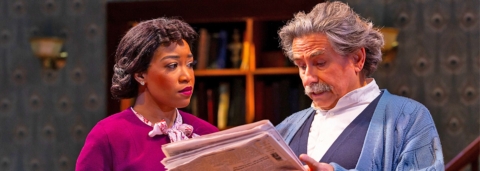
As Marian Anderson and Albert Einstein enter Einstein’s cluttered, untended Princeton home in Deborah Brevoort’s “My Lord, What a Night,” both international icons emerge as living, breathing human beings first and celebrities second.
To the credit of Rashidra Scott and Anthony Cochrane, neither character wanders into stereotype or caricature in the two hours and two acts it take for Brevoort’s straightforward but consistently engaging play to unfold in Sheldon Epps’s solid production at New Brunswick’s George Street Playhouse, where it runs through Sunday, May 17.
Naturalness prevails on the George Street stage. Anderson and Einstein don’t have to prove their credentials to each other of Epps’s audience. Their fame and achievements travel with them. Scott and Cochrane relax into people, however famous, coping with a thorny situation. It is their individual attitudes, outlooks, and experience, more than their separate stardom, that drives “My Lord, What a Night” and makes one eager to hear what they have to say and how they hash through differences in approach and perceptions of the stakes involved as they find themselves discussing how to react from an insult Anderson endured and Einstein witnessed.
Prejudice and injustice are as much a part of “My Lord, What a Night” as Anderson and Einstein are. Their involvement in an incident that would generate far more outrage now than it did in 1937 Princeton and the whirlpooling ideas, strategies, and contingencies Brevoort reveals springboard into a look at an age-old, universal problem that rears its head throughout history, including in 2026. Brevoort’s talent is crafting her lead characters, the episode that binds them as friends, the repercussions of that experience, and centuries of history into a play that never drifts into polemic, advocacy, or exaggeration of its most salient points. The beauty of “My Lord, What a Night” is how much ground it covers and how much thought it provokes by letting the people on stage live a case rather than presenting it.
“My Lord, What a Night,” the title deriving from “My Lord, What a Morning,” a favorite spiritual Anderson included in most of her concerts, is remarkable for what it bring to the fore, two real situations that demand some kind of response, and what it avoids, the 21st century tendency to throw issues into an audience’s face as if they were clubs that audience has to be beaten with to make a point.
Brevoort tells her story by showing how events affect people, the ultra-famous as well as the anonymous everyman, and letting any outrage or attendant anger seep in. She makes her points by illustrating them. And by showing the complications history, circumstance, and decorum impose on dealing with that anger.
She doesn’t do this in a dry, lecturing way. She does it by displaying Einstein’s wit and empathy, Anderson’s reluctance to stir pots in which Einstein has already dropped large wooden paddle spoons, and the added points of view of two prominent if not as lastingly famous figures of the 1930s, civil rights leader Mary Church Terrell and physicist Abraham Flexner.
The combination of Brevoort’s deft jostling of attitudes and attacks, her ability to make history alive and immediate, Epps’s smart, well-measured staging, and shrewd performances by four excellent actors make “My Lord, What a Night” special among 21st century plays.
It is not a blockbuster. It engages the way an intelligent, through, emotionally controlled conversation does. It is a work that makes one think and brings prejudice and persecution deriving from one’s culture, pigment, religion, or marital status to the fore.
The year 1937 turns out to be historic for Princeton.
Socialite industrialist Edgar Palmer opens a hotel adjacent to the university’s campus on a square that will be named for him. Marian Anderson performs in concert in Princeton. Albert Einstein, in Anderson’s audience, goes backstage to meet Anderson and ends up walking her to her lodging of the evening, Palmer’s new Nassau Inn.
That walk is Brevoort’s starting point for “My Lord, What a Night.”
Anderson arrives at the Nassau Inn to get needed rest in rooms reserved by her manager, the great impresario, Sol Hurok, and is denied entrance to the hotel.
Palmer himself tells her she cannot stay at his inn because she is black. Or in the parlance of the day, “a person of color.”
This, although Palmer was also in Anderson’s audience.
Einstein, present for the snub, invites Anderson to spend the night at his home. Their arrival chez Einstein is where “My Lord, What a Night” begins.
A shaken Anderson and a livid Einstein are seen at lights up, Einstein, through his torpor, carrying the bulk of Anderson’s luggage and offering to make tea while pointing to where Anderson’s bedroom is located.
The press assembles outside of Einstein’s house, apparently a regular event since the Pantheon scientist came to Princeton a few years earlier. Abraham Flexner, the head of Princeton’s Institute for Advanced Study, for which he recruited Einstein, rescuing him from Hitler’s Germany, soon comes to Einstein’s back door to acquaint the riled genius with the university’s point of view on Palmer and the Nassau Inn. Braving the press at the front door is Mary Church Terrell, national president of the National Association of Colored Women, who came from her D.C. home to attend Anderson’s show, is denied entrance because she’s late and later refuses entrance because she’s told she can sit only in a section reserved for black people no matter what her purchased ticket says.
The dynamic becomes quite heady and quite telling. Einstein, who has endured anti-Semitism in Germany, wants to do further battle with Palmer, renouncing him to the press and stating aloud what a horror it is that a major artist of her time, who achieved acclaim and fame despite prejudice, should be treated so shabbily. Anderson wants to downplay the incident. She wants her music and the fact that audiences of all kind see her art and all a labelled woman achieve to speak for her. She and Sol Hurok don’t want to do anything that might jeopardize an upcoming tour to the South. Flexner advises caution, partially to protect Princeton University, apparently a den of quotas and slights in 1937, from both negative publicity and a possible scandal ensuing from a single woman lodging alone with a bachelor (recent widower). Terrell wants Anderson to speak to the cause she as a civil right leader has been advancing since the 19th century.
Again, Brevoort keeps these conflicts on a human scale. They derive their dramatic power by the way the characters defend their individual side and drift between allegiances.
The same issue rear their heads in “My Lord, What a Night’s” second act, which deals with the more famous 1939 incident, the Daughters of the American Revolution refusing to let Anderson appear for a scheduled concert at Washington’s Constitution Hall, again because of her color. Eleanor Roosevelt, unseen, steps into this battle. Brevoort supplied a fact I did not know in terms of how the Lincoln Memorial took Constitution Hall’s place for Anderson’s show.
Deborah Brevoort shows great wit and she builds laughs and ironies into her intrinsic, skillfully structured play. Sheldon Epps and his company do not a single moment to make points and to do so naturally, as humans not archetypes or advocates.
Anthony Cochrane is a delightful Einstein, displaying equal doses of spunk, genius, and modesty. Cochrane moves Einstein from a stuffy or eccentric figure to a detailed man who worries about his productivity, agonizes over the imminent atomic bomb, takes outrage while giving succor to Anderson, and being a man first and a famous scientist second.
He even gets to play the violin. One whole note of D-flat (incidentally the key in which I sing) that he and Anderson agree is a surefire tone to relax a tense situation.
Rashidra Scott uses posture and precision in diction to denote Marian Anderson’s formality while creating a full-blooded being who can state points, take ground, and remain in control of tense situations.
Scott’s Anderson is a woman who know what she wants and has the independence that would seeming come from being one of the first black women to come to prominence in classical and folk music.
Scott also demonstrates Anderson’s hauntingly beautiful contralto as she sings “My Lord, What a Morning” to Einstein.
You can see both conflict and determination on Mitch Greenberg’s face as he puts Princeton, and one of its primary donors, Edgar Palmer, first in his argument for calm while, as a Jew, realizing the anti-Semitism that has been institutionalized at Princeton via quotas for Jewish students and faculty and prohibition of students of color.
Greenberg is the picture of someone who must represent a stance that doesn’t completely gibe with some deeper sentiments.
Gayle Summers shows the dignity and fight in the formidable Mary Church Terrell, who did not campaign lightly for either civil rights or the vote for women.
Meghan Raham shows Einstein’s home as a genius’s sty with papers filled with failed equations littering the floor, books in disarray, dust everywhere, and a desk on which only its occupant could find anything.
Karen Perry’s costumes denote each character perfectly. Katy Atwell and Jeff Croiter provide a sense of time and enhance the tension of key moments with their lighting. John Gromada’s sound design includes disruption by a rabid press and other household noises that add to the authenticity of Epps’s production.
“My Lord, What a Night” runs through Sunday, May 17, at the George Street Playhouse in the New Brunswick Performing Arts Center, 11 Livingston Avenue, in New Brunswick. Showtimes are not regular for this production. In general, they are 7:30 p.m. Wednesday through Saturday, 7 p.m. May 10 and 12, 2 p.m. Wednesday through Sunday the week of May 12, and 1 p.m. May 6. Tickets range from $90 to $64 and can be obtained by visiting www.georgestreetplayhouse.org or calling 732-246-7717.