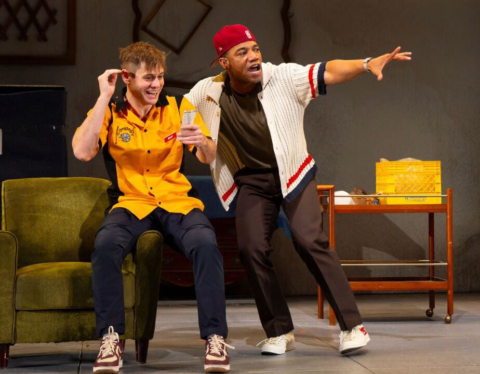
Rajiv Joseph’s new play, “King James,” at New Brunswick’s George Street Playhouse through Sunday, April 6, holds so many aces, from excellent acting to sporadically stirring scenes, from sharp insights to a quick-flowing script, it’s painful to say it never coalesces into a full and finished work.
The near miss is sort of like the fate of “King James’s” focal figure, basketball great LeBron James, who brings his original, and hometown, team, the NBA’s Cleveland Cavaliers, to championship series after championship series in the naught years of this decade and can’t muster enough wins to take home the ultimate prize.
“King James” is constantly entertaining. Actors Blake Morris and Doug Harris have a knack for keeping their byplays conversational and interesting while director Ryan George sets a lively pace and gives his cast room for range of both emotion and personality. Frank J. Oliva’s three sets are complete and witty wonders that go far beyond most modern construction for fun and detail. (I love the neon basketball, arrow pointing to music downstairs, and far stage-right photo of LeBron wearing a Sharpie-drawn freestyle crown that decorate the bar scene, and the various knickknacks that populate the curio shop.)
Scene-introducing video of James’ career and prowess provide context while letting the George Street audience in on what Morris and Harris’ characters are talking about. The always provocative Rajiv Joseph covers large themes such as friendship, loyalty, and shifting fortune while delving into issues such as underlying racial tension, community, what constitutes success, and what one individual might owe another.
Like its characters, “King James” is rich in potential, but it can’t quite manage to grab the brass ring. Despite its spiraling assets and Ryan George’s deft production, it keeps you searching for the reason the play exists at all. There’s no payoff, no knot at the end of the balloon to make all the tension and good moments Joseph, Harris, Morris, and George create remain inflated and retain shape.
Except in video, and in a pre-show/intermission loop that repeatedle draws a white freestyle crown on his head, LeBron James does not appear in “King James.” His rookie year and long career (ongoing since 2004) set up each of its scenes, and James is discussed in detail, especially when he elects to leave Cleveland to play for the Miami Heat, then pivots back to the Cavs.
Call LeBron an influencer. The crux of Joseph’s play is the relationship between two Cleveland guys of different backgrounds, skills, and ambition who meet and build a close friendship by discussing Cleveland basketball and James’ here, there, and everywhere approach to where he will play.
Matt (Doug Harris), when we meet him, works at a posh wine bar and has an entrepreneurial bent by which he conjures good business ideas but has serious trouble with luck.
That trouble brings Shawn (Blake Morris) to the wine bar to hear about and make an offer for 2004 Cavalier season tickets, multiplied in value by expectations surrounding LeBron James in his rookie season.
An interesting situation brings Matt and Shawn together for the duration of that rookie season and bonds them for what is likely to be life.
As with all friendships, there are disagreements, including about whether LeBron James or Michael Jordan is the GOAT (greatest of all time), ups and downs in moods and outlook, separations, and wear and tear. These vicissitudes take on meaning as Matt and Shawn negotiate their various careers. Shawn is a writer who works odd jobs to support his writing habit when we meet him but is eventually able to live well from his writing skills.
Matt has a big personality from the get-go. Shawn wants to keep business business at first but warms to Matt’s relentless chatter and attendant charm, especially as the conversation turns to their mutual interest, basketball.
“King James” spans the first 13 seasons of LeBron’s professional career, with Matt and Shawn growing, diminishing, switching roles, and growing and diminishing more. Their seemingly ongoing conversations jump from basketball to love, then basketball to friendship, then basketball to being at hand for one another.
Wherever the conversations go, they remain lively, with a flow that keeps interest and allows each character to display his personality.
The problem is that those conversations remain fun to witness but never get past the froth or superficiality of a situation to express something pithy or profound.
Intense moments come. In each of the four or five scenes Joseph includes, there’s a moment when “King James” slows down and Matt and Shawn get into something deeper than their usual banter. Sequences involving their individual revelations, dreams, and conflicts can measurably up the temperature in the George Street theater.
Joseph is smart and has his characters say thoughtful things, but, again, the big close eludes him.
“King James” seems to be coming to a head in a late scene in which Shawn, who is Black, questions Matt, who is white, on his use of the phrase, “know his place,” as in “LeBron needs to know his place,” a reference to James yo-yoing back forth from the Cavaliers to the Heat and back.
Shawn regards Matt’s comment as a racial statement, something he’s heard all of his life and usually pejoratively.
Matt says it was just some words he blurted out that meant nothing, but he was angry at LeBron for deserting Cleveland for Miami, then coming home as if he was some kind of hero.
Either way, Matt’s blurt leads to the most dramatic, tension-fraught sequence in Joseph’s play. It asks whether a close friendship between two guys named Matt and Shawn always carries some semblance of racial overtones and whether that ties into Matt constantly talking about “the problem with America.”
The scene is a chance for “King James” to make that last hurdle and go beyond a well-done, engaging show to a piece that has something important to hash out.
The chance is missed. While the sequence makes one sit up and take involved notice, it rings false. It plays like a contrivance to force the moment that will elevate “King James” beyond a pleasant, and intelligent, night at the theater.
The scene might just need another context, one that can’t come down to a matter of interpretation or is based on a different, more egregious example of underlying prejudice, even between obvious best buddies.
Joseph may be commenting on the power of language or how something innocuous to one listener is a red flag to another,. A tossed-off line, LeBron saying he’s “taking his talent” to Miami when he signs with a heat, sets up a previous conflict between Matt and Shawn.
This unseen-until-it-is-seen transgression and its subtle presence in the world in general looks to me what Joseph was aiming to convey in “King James.” It fits with much of his past work (“Bengal Tiger at the Baghdad Zoo,” “Describe the Night,” “Guards at the Taj”). His intention is worth pursuing, but it isn’t realized here. It comes too suddenly, too intensely, and too unconvincingly.
Somehow this idea comes across more genuinely and poignantly when Shawn tells Matt about his experience as one of eight in a TV writer’s room working on a hit weekly series.
The acting in “King James” couldn’t be better. Doug Harris engages immediately as the talkative Matt, whose brightness comes and goes and can be a bull in a china shop one minute and a sweet sincere guy just trying to get along the next. Blake Morris shows well how Shawn’s natural reserve and discipline relax around Matt’s garrulousness. Morris is adroit at playing the nuances that show how much Shawn has going on inside while Harris surprises in moments when Matt spouts some wisdom or says something that shows he’s paying attention to more than we might think.
Together, Morris and Harris — everyone connected with this production has a last name than can be a first name — are thrilling in their ability to sustain audience interest even when they’re discussing something banal or are indulging in juvenile hijinks. The bits in which they enact basketball moves or josh around in the silly way friends might, always work.
Frank J. Oliva’s sets have you looking at all of the details and facets Oliva puts in them. These sets stun when they appear yet give George a lot of room for flexibility.
Azalea Fairley’s costumes match the characters’ demeanors and situation. The sweater Shawn wears when he returns from Hollywood (for the 2016 Cavaliers parade) is spot on.
George Street Playhouse has followed other theaters in forgoing programs or making them available only by QR code. Whatever the reason, this a disservice. If it wasn’t for photos in the lobby, I would not have known which actor was Blake Morris and which Doug Harris. An advertising card given in lieu of a program doesn’t say.
King James, George Street Playhouse, New Brunswick Performing Arts Center, 11 Livingston Avenue, New Brunswick. Through Sunday, April 6. Showtimes are 7:30 p.m. Wednesday through Saturday and 2 p.m. Thursday, Saturday, and Sunday. $25 to $90. www.georgestreetplayhouse.org or 732-246-7717.