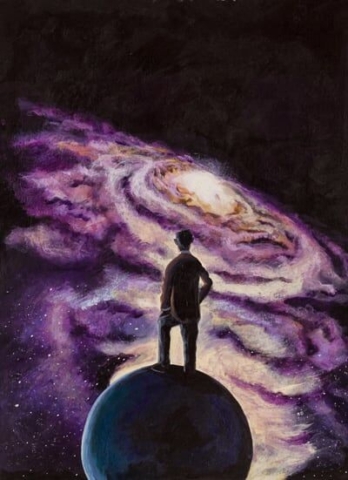
The Institute for Advanced Study honors 150 years in the life of mathematician/scientist Freeman Dyson with a two-day celebration at the Institute on Friday and Saturday, September 27 and 28. The total of 150 years is derived by adding Dyson’s approaching 90th birthday to his having been at the Institute for 60 years.
The celebration, titled “Dreams of Earth and Sky,” consists of four half-day sessions in the fields of mathematics, physics, astronomy, and public affairs. The lecturers come from the Institute and various institutions in the United States and abroad.
The sessions, Dyson says during an interview in his comfortable book-lined office at the Institute, “correspond to what I am doing. There’s a disconnect between my interests and my work. My work is mathematics. My interests are wider than my profession. I’ve been promoting the study of space exploration all my life. It’s a hobby. As a scientist, I am relatively narrow. As a writer, I am relatively broad.”
The breadth of Dyson’s interests is reflected in the celebration brochure itself, which features a painting by the multi-talented Institute director, Robbert Dijkgraaf, showing the silhouette of a man, who could be Dyson, standing atop a small globe and staring into the cosmos.
“The title of the celebration, ‘Dreams of Earth and Sky’ is mine,” Dyson says. “It’s the name of a book by Russian scientist Konstantin Tsiolkovsky, and I used it as the title for the last chapter in one of my books.”
Tsiolkovsky (1857-1935) was a pioneer of space travel. At the beginning of the 20th century he derived the governing equation for rocket-based propulsion. The language of that equation is perfectly clear to mathematicians, though it may be opaque to general readers, as is Dyson’s technical writing.
Indeed, Dyson declines to explain in general language what he calls “probably the most important thing I did.” Still, its importance is obvious without the technical details. In 1949, at age 26(!), Dyson published a paper unifying three(!) theories about the behavior of electrical phenomena in terms of quantum theory — those of Richard Feynman, Sin-Itiro Tomonaga, and Julian Schwinger. Dyson considers the differences in the theories to be primarily a matter of style. But he considers their divergence too technical to explain even to a willing interviewer.
On the other side, Dyson’s writing for a general audience is a model of lucidity. “I take a lot of trouble about writing,” he says. “I’m always thinking of the reader when I write about human problems. I write as if it was for my sister. She’s a medical social worker, very intelligent, and interested in many things. Writing is just as important as calculating. The secret is to know whom you’re writing for.”
The quantity of Dyson’s writings for the general public is formidable. He has for many years provided articles for the New York Review of Books, welcoming the opportunity to express himself at length and to reflect on topics raised by the matter at hand.
In addition he has published a number of terse, readable books that demonstrate his broad range of interests, including “Disturbing the Universe” (1979), a portrait gallery of people he has known during his career as a scientist; “Weapons of Hope” (1984), a study of ethical problems of war and peace; “Infinite in All Directions” (1988), a philosophical meditation based on his lectures on natural theology given at the University of Aberdeen in Scotland; “Origins of Life” (1986), a study of one of the major unsolved problems of science; “From Eros to Gaia” (1992), essays and lectures that start with a science-fiction story written by Dyson at the age of nine and end with a mugging in Washington at age 54; and “Imagined Worlds” (1997), based on his Hebrew University in Jerusalem lectures on human destiny, literature, and science. The more recent publications include his collection of book reviews and essays, mostly published in the New York Review of Books, “The Scientist as Rebel” (2006), and “A Many-colored Glass: Reflections on the Place of Life in the Universe” (2007), his 2004 University of Virginia lectures.
Curiously, Dyson has not yet tried to explain science to general readers. He says, simply, “I never wrote pop science books.”
Dyson was born in England, the son of composer Sir George Dyson and a mother who had a law degree but then worked as a social worker after Freeman was born. As a boy Freeman knew about the work of astronomer Frank Watson Dyson (not a relative) and credited the shared surname with his interest in science. Though he says now that “music has a limited role in my life,” his father’s work as a prominent composer, teacher, and organist took the family to Winchester College, where the young Dyson read mathematical works in French and German and at age 13 taught himself calculus from an Encyclopedia Britannica article.
Music surfaced again in Dyson’s own family. “I had six kids, three of them studied Suzuki violin,” he says. As a Suzuki father, Dyson participated in their lessons.
And in his book “The Sun, the Genome, and the Internet,” written when his youngest daughter was 10, Dyson used the analogy of a Mozart duet to help readers understand the coding for protein sequencing in DNA. The Mozart composition calls for two violinists sitting opposite each other and reading from opposite ends of a one-page score placed between them. DNA coding could be read in the same way, Dyson argued. The 1999 book was written to explore the question of whether modern technology could be used to narrow the gap between rich and poor rather than widen it.
Dyson’s academic ascent began in 1945, when he graduated from the University of Cambridge with a degree in mathematics. In 1947 he went to Cornell to work with physicist Hans Bethe. In 1949 he published his groundbreaking paper on quantum electrodynamics. In 1951 he was appointed professor of physics at Cornell, and in 1953 professor of physics at the Institute for Advanced Study.
Two of his children, from his first marriage to mathematician Verena Huber-Dyson, have also become known for explaining science and technology to the general public. Esther is a digital technology consultant. George is a historian of science. With his second wife, Imme, whom Dyson married in 1958, he had four daughters.
Dyson never earned a Ph.D., though he has received 23 honorary degrees. “I slipped through the cracks,” he explains, “mostly because I came from England, where the system is not so rigid.”
He is opposed to the Ph.D. system for young people today. “It was designed for producing German academics in the 19th century,” he says, “people who would be important and highly respected and pompous. It is not well suited to young people today.”
“The problem is that the Ph. D. is the entrance ticket to many professions. But it has disastrous effects. Among Ph.D. candidates I’ve known, one committed suicide, and several ended up in mental institutions. And what can be more disastrous than wasting time? People unsuited for research are forced to pretend. If they’re not suited for research, they shouldn’t be doing it. They should be allowed to get into practical work and don’t need to spend five or six years preparing.”
Dyson is known for advocating minority views. His stand against the dangers of global warming has gained him a reputation as an iconoclast. “When I act like a heretic or rebel I do it more as a citizen than as a scientist,” he says. “When I get involved in public disputes it’s about public policy. It’s likely to be about economic things.”
“Global warming is an economic thing. The public is putting huge amounts of money into trying to stop climate change. The question is whether that is hurting the poor and benefiting the rich. Private individuals benefit from advocating a stop to global warming. Furthermore, spending to stop global warming does not consider what best benefits the poor.”
When asked if he enjoys being eccentric, he replies, “I don’t like to be eccentric. I only disagree with the majority when there is a serious issue at stake, not just for fun.”
Dyson says that he likes it when an interviewer asks what he has been working on lately, and he readily answers. “I never work on big projects,” he says. “I have a lot of little projects. The most immediate one is because of a four-day scientific meeting in Singapore in late August. The fellow who organized the meeting is K.K. Phua, a publisher in Singapore. His firm is World Scientific, the best publishers of scientific books. They produce good-looking high quality books cheap enough so students can buy them.”
“They invited me to publish a second volume of my collected works,” he says, “everything after age 70. So I’ve been mostly writing introductions.” Both editions, the first published by the American Mathematical Society and the second by World Scientific, open with commentaries on the scientific papers. “The commentaries at the beginning give you a story, which makes the papers readable,” he says.
Speaking about another recent activity, Dyson says, “About two years ago I started a new career as a game theorist. It turns out to be more interesting than I expected because biologists imagine that game theory has something to do with evolution.” Dyson’s foray into game theory deals with a game known as “the prisoner’s dilemma.”
“Alice and Bob are both involved in a crime,” Dyson explains. “They are picked up by the police and questioned in separate rooms. The dilemma has to do with how they respond to questioning. If one claims to be innocent and says that the accomplice committed the crime, the denier gets a lighter sentence and the betrayed person gets a heavier sentence. If they both refuse to talk, both get lighter sentences. In the short run, it pays to squeal; in the long run, it pays to refuse to talk.”
“Bill Press, a friend of mine who is president of the American Association for the Advancement of Science, and I worked together on this. He found a new strategy. That’s astonishing because the game has been studied for 50 years. Press had the idea and I worked out the math. I’m only interested in the math. He works numerically; I wrote the equations. The paper made a stir in the biological community. Biologists concerned with the functioning of social groups are interested in this.”
“What else have I been doing that’s interesting?” Dyson asks rhetorically. After a pause, he says, “I do a fair amount of propaganda to get rid of nuclear weapons.”
Dyson is eager for the next day, Tuesday, to come. “Tuesday is my favorite day of the week,” he says. “The astronomers meet. We have a lecture at 11 and lunch afterwards. There’s always something going on in the sky.”
Dreams of Earth and Sky: A Celebration of Freeman Dyson, Institute for Advanced Study, Einstein Drive, Princeton, Friday and Saturday, September 27 and 28. Free, registration required. $10 for lunch. For information, visit www.ias.edu/news/dyson-dreams-registration, send an E-mail to dysondreams@ias.edu, or call 609-734-8000.