
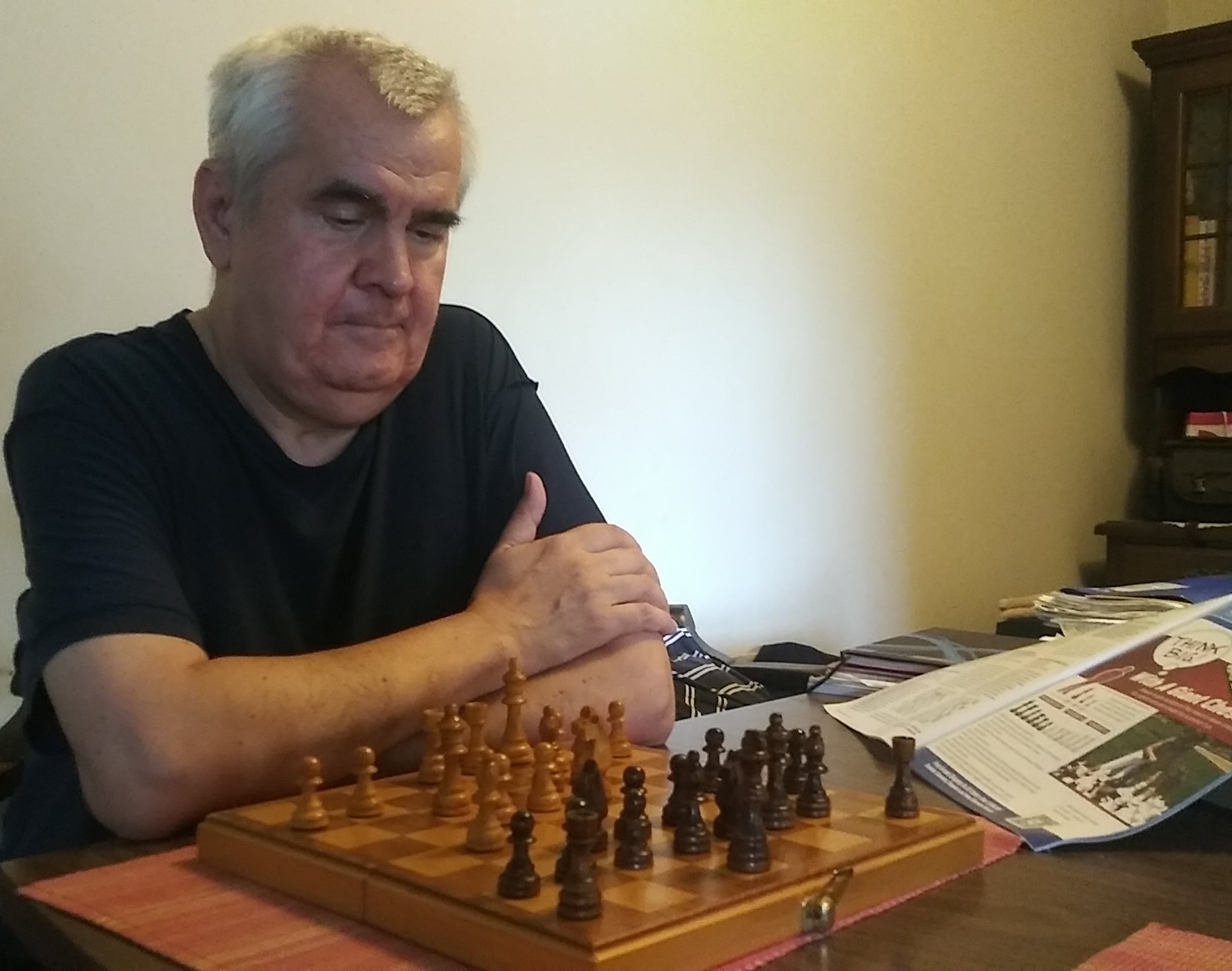
Chess is a thinking person’s game. Skill requires experience to recognize patterns and strategies. Countering an opponent’s moves can come with deliberate study and many, many games played.
Dragan Milovanovic is a master-level chess player. He is in the top tier of competitive chess tournament players. He has been named Hamilton, New Jersey, Chess Club champion 15 times in the last 25 years. He is a quiet, contemplative man, thinking of the game and what move should be made next.
When and where did you begin playing chess?
I started playing chess at the age of 14 in Tuzla, which is a small city in Bosnia and Herzegovina, north of Sarajevo. I learned the rules even earlier, but I didn’t really start playing until I became a teenager.
When did you realize that you had the ability to progress and become proficient at the game?
When I started participating in local tournaments. With my first victories there, I became more confident in my abilities. I also realized that talent alone was not enough to increase my level of competitiveness, and that is why I started to study chess theory more seriously.
Please tell us about your journey to the U.S. How did it begin, and how were your first few years here?
I immigrated to the United States in 1998. The first few years were financially difficult, but once I was able to find steady employment, things stabilized. Not long after that, I started researching the local chess scene, and I discovered the Hamilton Chess Club in late 1999. In 2000, I became club champion and held the title for several years.
I found many friends in the club who have the same passion for this venerable game, and many of them are still attending our weekly meetings.
How many times a week do you play chess? How much time does it take for a beginner to learn the game well enough to be competitive?
There’s a distinction between playing chess against an opponent and analyzing the game through replay. I analyze my games and those of others nearly every day, but I play chess against opponents once a week, mostly in the club.
The time it takes for a beginner to reach a competitive level depends on various factors, but most importantly, their passion and how willing they are to dedicate themselves to learning the game. Individual study is important, but practicing through games against stronger opponents is usually key to real progress.
Please tell us a little about the Hamilton, New Jersey, Chess Club.
I’m told that it has been around since 1982, but I don’t really know much about the history of the club before I joined.
Currently, there are around 50 members, but every weekly meeting hosts around 20. Some people attend less frequently than others, and we have no strict attendance rules.
Each year, the Hamilton Chess Club enters a team in the U.S. Amateur Team East Tournament, held during Presidents Day weekend in Parsippany, New Jersey. Several members of the club also play as a team in the Garden State Chess League, where we won first place in six of the last eight years.
Have you seen chess becoming more popular since the pandemic and with recent television series such as “The Queen’s Gambit”?
I never watched this series, but it wouldn’t surprise me if shows like these raised interest in the game.
However, I have yet to see the kind of popularity boost that was present during the Cold War, when Bobby Fischer stunned the world after taking the title of world champion from the Soviet grandmasters.
What fight or struggle do you have regarding your playing and the progression of your game?
Chess is, in large part, a psychological struggle, not only with your opponent but also with yourself. This is especially true if you know that your opponent is a strong player. It takes constant mental effort to remain focused on the board and to continue making good moves, even after you make bad ones.
There is also the danger of underestimating your opponent: If you’re too relaxed or too confident because you have a higher rating or you’re convinced that you’re technically superior, you can make irreversible mistakes and ultimately lose to a weaker player.
Humility is a key virtue in chess.
Are there national and international ranking systems for chess? How does that work for local players like yourself?
There are national and international ranking systems for chess players. In the U.S., the USCF, or United States Chess Federation, is the main governing body for player ratings.
Internationally, the governing body is FIDE, or Fédération Internationale des Échecs.
My rating is about 2,200, which is in the “National Master” range. That said, I don’t really care much about my rating. I play for the love of the game.
To be a better chess player, do you study historical games and strategies, or is it more about having more playing time against well-matched opponents?
Chess is both study and competition. Studying the games of great masters, both in the past and present, is incredibly useful. My favorites are Alexander Alekhine, from the late 19th to early 20th century, and Mikhail Botvinnik, a Soviet grandmaster and world champion from 1948 to 1963.
It is equally important to practice against well-matched opponents. The strongest player I played was Yugoslavian and Bosnian grandmaster Predrag Nikolic. It was a difficult game. He made a single mistake, which I exploited to gain an advantage, leading him to offer me a draw. I think he assumed that I would accept due to his intimidating status as a grandmaster, but I felt my position was strong, so I refused. Unfortunately, as the game progressed, he managed to equalize, and I found myself offering him a draw. At this stage, there was no chance of victory for either side, so he accepted. I played that game in 1998, and I still remember it to this day.
A lot of people play chess online. Have you tried this, and do you think this is a normal, more convenient progression of the game?
I tried playing online for a bit, and for a while, I found it interesting. However, for me, chess is a battle between two people playing face to face, and that’s mostly why I don’t play online.
Women historically have not played chess as much as men. Is this still the case, and why do you think this is the case?
It still seems to be the case. I personally think that both men and women have equal potential in chess. I suspect that differences in representation, such as they are, stem largely from sociocultural reasons, but ultimately, I don’t know. Some of the strongest women players that I know of include grandmaster Nona Gaprindashvili from Soviet Georgia, who was women’s world champion from 1962 to 1978. I also admire Judit Polgar from Hungary, now 50 years old and considered the best female player of all time.
Regarding chess, what are you looking forward to? What do you have on the horizon?
Chess was, is and will probably remain my passion. I don’t have any specific plans or goals other than to keep playing as long as I can and as long as it brings me joy.
How can people get involved in the Hamilton Chess Club? Are novices and beginners welcome to the club?
We have a website, sites.google.com/site/hamiltonchessclub/hamilton-chess-club, where all the relevant information can be found.
Of course, we welcome everyone, no matter what their skill level.