The newly restored barn at St. Michaels Farm Preserve in Hopewell is set on a hill, where visitors can see rolling farmland and grazing animals. A few hundred feet away is the “office” of D&R Greenway Farm Manager Bill Flemer. In this shed, where farm equipment is stored, he is building an enormous wooden trailer in the shape of a guitar — it will be used for transporting musical instruments. His life combines passions for making music and growing things, and lucky for him, the two overlap.
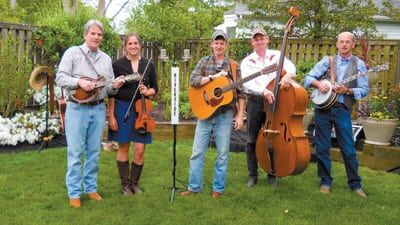
Flemer’s Riverside Blue Grass Band will perform during a special dedication ceremony for the barn on Saturday, September 28, from 5 to 8 p.m. Flemer is excited about the new barn — in it he can dry and store the native plant seed he has been raising at St. Michaels for the New York City Parks Department.
The site of the former St. Michaels Orphanage was preserved by D&R Greenway Land Trust in 2010. With 360 acres of preserved farmland, part of the property is used for pasture, part is walking trails, and several acres have been set aside for the native seed project.
An existing barn on the property was so old passersby could see right through its broken and missing slats. So the Greenway worked with the New Jersey Barn Company and several partners and donors to restore a 19th-century timber frame barn from Belle Mead. The original barn was razed at the end of August after the nesting barn swallows had completed their life cycle. Nesting holes and boxes have been built into the new barn, says Flemer. “We hope they will find the new barn a welcoming place to raise their babies. We’ll leave the windows open so they can nest in the rafters and be a part of the landscape as they always have been.”
Flemer knows about welcoming babies. His first grandchild, born this year to his daughter Emma and her husband, Jake Morrow, comes to rehearsals and performances, often in a sling attached to her mother. Emma and Jake are two of the members of Riverside. Flemer’s granddaughter is immersed in the music, just as Emma and her sister, Nell, were with their parents. And Flemer learned his first guitar chords from his father, William Flemer III.
William III played cowboy songs, according to his son, and his mother, who had been a music composition major at Sarah Lawrence in the ’40s, played mandolin. “My father’s Martin guitar was always under the piano,” Flemer says.
Flemer’s mother sang with the Princeton Musical Amateurs Society, practicing Sunday nights in the gym at Miss Fine’s School. “She would bring us kids,” he says. Flemer’s older sister, Louise, became a member of Princeton Pro Musica.
Bill grew up in Kingston, where his father and Uncle John ran Princeton Nurseries. His great grandfather, William Flemer, founded the nursery in 1913. Princeton Nurseries was internationally renowned for providing strong cultivars of exceptional beauty and was one of the largest commercial nurseries in the country, selling to municipalities and even the New York City Parks Department.
The allee of elm trees on Washington Road leading into Princeton and the towering London Plane trees lining Mapleton Road in Kingston are just two of many contributions the Flemer family has made to the region. In its heyday, Princeton Nurseries encompassed 1,200 acres in Plainsboro, Kingston, West Windsor, Princeton, and South Brunswick, employing 300 people and providing the water for Kingston. Here, disease resistant elm trees were developed to be planted from Boston to Chicago and Washington, D.C., when, after World War I, shade tree commissions set out to beautify our cities and towns.
William Flemer III held patents for October Glory Red Maple, Greenspire Linden, and the Shademaster Locust, as well as various machinery, including a tree digging machine. Princeton Nurseries was an innovator in bare-root shipping, a lighter way of transporting trees without heavy root balls during the dormant season.
The firm closed its Kingston operation in 1995 and closed its Allentown facility in 2009. Development had increased property values and pushed agriculture further south. There was also increased competition from box stores.
When the Allentown facility closed in 2009, the John and William Flemer families preserved 1,900 acres — the largest farmland and open space protection transaction in state history, more than five times the size of St. Michaels.
In 1997, when the Kingston property was sold to Princeton University, Friends of Princeton Nursery Lands formed to preserve and protect the historic agricultural property at Mapleton Preserve. Today it is 230 acres of passive open space, with offices in the former Princeton Nurseries headquarters, renovated in the mid 1900s by Princeton architect Rolf Bauhan. Historic trees are preserved and an arboretum has been established with cultivars developed by Princeton Nurseries. Earlier this month, FPNL held a celebration of Princeton Nurseries 100th anniversary. The musical entertainment? Bill Flemer’s other band, the Bare Root Band.
Beginning at age 14, Bill found friends to make music with — music was a language for them. While at PDS he played at dances and parties with rock bands. In the 1960s he formed a band, the Steel Hinge.
At the University of Wisconsin Flemer studied botany and horticulture. He played in bands, then left school to pursue music, playing in a country rock band in Madison, Wisconsin, in the mid-1970s. He was first exposed to bluegrass there, and when he returned to New Jersey to work in his father’s nursery business, he formed his first bluegrass band. The Tokamak Mountain Boys (thus named because the banjo player worked at Princeton Plasma Physics Laboratory where that magnetic device was used), together from 1979 to 1987, included some of the same band members as Riverside Bluegrass: Steve Hendershott on mandolin and fiddle, and David Olsen on five-string guitar.
In the late 1980s Flemer and his first wife, Jane, moved to North Carolina with Emma and her younger sister, Nell, and he started his own nursery business there, as well as joining a country band, Irons in the Fire. Emma and Nell were given a foundation in classical music and fiddle technique from their mother, a pianist and music teacher who was teaching at the New School in Kingston when Flemer first met her.
Flemer, who doesn’t read music, taught his daughters to play by ear, giving them guitars at ages 12 and 9. “They grew up singing harmony in the back of the car going to and from North Carolina,” says Flemer, an autodidact in six-string guitar, bass guitar, and bass fiddle. “Growing up in a musical household trained my ear,” he says. “People who grow up surrounded by music develop an ear. It’s the folk tradition for the music to go from one person to another that way.
“Reading opens a world of classical music, but it makes it harder to develop an ear,” he continues. “In high school band you’re given sheet music, but if let loose to improvise, people who rely on sheet music have a harder time. And conversely, those of us who learn by ear have a harder time submitting to the discipline of playing by sheet music. It’s harder to make yourself read if you already play music you like without reading it. Of course serious musicians surmount this and do both.”
When he returned to Princeton in 1993, Flemer found his old bandmates and they were reborn as Riverside. In 2007, Emma, who majored in creative writing at Ithaca College and is developing the school garden at the Lawrenceville School, joined Riverside. When sister Nell is in town, she plays with the group. Morrow, who played trumpet in the Princeton High School band and teaches Latin at the Lawrenceville School, came on board in 2009 — he plays guitar, mandolin and bass.
“It’s a gift to be able to make music with family,” says Flemer. “It’s a form of communication between generations. A lot of what Riverside plays comes from Emma and Jake — they’re plugged into contemporary bluegrass and are teaching us.”
Riverside Bluegrass Band will perform at the St. Michaels Farm Preserve Barn Celebration Saturday, September 28, 5 to 8 p.m. — other activities include music and movement with Music Together, a nature walk at 5:15 p.m., tours of the new barn led by the New Jersey Barn Company, and yoga at sunset led by Lara Heimann from Yogastream Studio in Princeton.
Guests are invited to bring picnic suppers, and Hopewell area food vendors will offer refreshments for sale. There will be dancing to music by Riverside Bluegrass Band at 7 p.m. Visitors can examine the barn’s special features, including a specially designed loft where barn swallows can nest.
Riverside Bluegrass Band, St. Michaels Farm Preserve, Princeton Road, Hopewell. Saturday, September 28, 5 to 8 p.m. $5 donation to supports D&R Greenway. For more information, go to www.drgreenway.org.
Terhune Orchard, 330 Cold Soil Road, Princeton. Sunday, September 29, noon to 4 p.m. $5. 609-924-2310 or www.terhuneorchards.com.