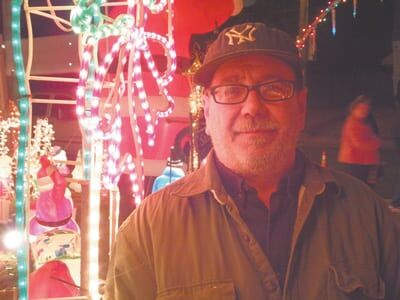
‘I have 2,065 lights up!” That’s my stepfather telling me over the telephone about his Christmas light display. It’s funny that he’s announcing this to me. I was just starting this article on holiday lights —or to be more correct the idea of how some people exceed the limits of outdoor holiday decorations.
While my relative is higher on lights than many, he’s low voltage in comparison to others, as a couple of area light displays will show.
We’ve seen them pop up here and there in the past, but now it seems that more and more we are seeing some guy — although there’s no evidence it seems to be a guy thing — who seems hardwired to string lights on every square inch of a house or piece of property. You know, a real life Clark Griswold —the holiday light-obsessed character played by Chevy Chase in “National Lampoon’s Christmas Vacation.”
The end result is that these light enthusiasts set houses aglow with more wattage than some villages elsewhere in the world, attract a high volume traffic of drive-by admirers, run up electric bills, connect with communities, sometimes disconnect with neighbors, and, of course, find the satisfaction best summed up by Frank Sinatra in his song “My Way.”
Affordability and technological advances in lighting, sound systems, and computerization conspire to help practitioners to coordinate (some say “choreograph”) the visual with musical arrangements.
If there is little doubt that more and more people are plugging into the trend, pushing their circuit breakers to the limit to see if their light fest nabs a spot on local TV news or becomes a YouTube posting or even more, just consider ABC television’s recently announced show: “Lights, Camera, Christmas!” That’s where 16 families from around the nation will go bulb to bulb to win a $50,000 grand prize.
And if there is also little doubt that some people will risk their health to make their Christmas merry by making it very bright, a 2010 report from the United States Consumer Product Safety Commission estimated that between November and December “more than 13,000 people were treated in emergency departments nationwide due to injuries involving holiday decorations. This is an increase from 10,000 in 2007 and 12,000 in 2008 and in 2009.”
While it is easy to think that the bright light syndrome is just an American Bigger-Is-Better phenomenon, think again. A glance through online news sites brought news from England that “outlandish Christmas light displays are becoming more and more prevalent in the UK, but as our research shows, motorists need to be extremely careful when looking at them whilst driving,” The report attributed nearly a half million accidents to drivers distracted by the displays.
So what’s going on? Psychologist John Grohol, author of the book “The Insider’s Guide to Mental Health Resources Online” and frequent contributor to the Huffington Post, says something to which many people will nod in agreement in his article “Christmas Lighting Addiction”: “I think the core of why many people over-adorn their homes in Christmas lights is a desire to show off, attention-seeking behavior meant to demonstrate how into the holidays one is. At the same time, people who go overboard with Christmas lights are playing a ridiculous (but mostly harmless) game of one-upmanship with one’s neighbor.”
He goes on to say, “If you’re one of these folks who can’t live without their million-light holiday display, seek help. Imagine how much better your gift to the world would be if you donated your electricity costs to a local charity or homeless shelter. Leave the holiday lighting spectaculars to Radio City Music Hall or professional displays found in most communities done in formal gardens or the like. Let’s try and get back to celebrating Christmas in a way that honors the heart of the tradition without turning it into some sort of glitzy and tacky sideshow of lighting horror.”
But hold that thought. There may be something more at play.
First, the human practice of creating light events around the winter solstice can be traced to early civilizations and religious rituals. Yule logs, advent candles, and Menorahs are all symbols of endurance, of light against the dark.
Second, one-upsmanship and attention seeking come in many flavors: status cars, clothing labels, trophy wives, demands for astronomical incomes, and culture-related acquisitions. Take, for example, a recent Christie auction where two wealthy men engaged in what one art professional called a “pissing match” to purchase an art work, spending a record $142.4 million in process.
And third, this 100-year-old use of electronic holiday lights is starting to take on elements of a tradition and an expression approaching an art, perhaps a type of contemporary or modern-day folk art.
While art definitions are slippery, there are some consistent characteristics: the work is something beyond functionality, reflects a system of choice, and has an underlying intent.
The New Jersey State Council on the Arts (for which I once worked in a variety of arts management positions) says that “folk arts and crafts are those that are traditionally learned as part of the lifestyle of a community whose members share identity based upon ethnic origin, religion, occupation, or geographical region. Highly varied, these traditions are shaped by the esthetics and values of the community and are passed from generation to generation.”
As for putting electric lights on a house being a folk art, there are some interesting considerations: it is cultural, one generation introduces practices to another, and it has a level of meaning and intent.
Add to the reality that electronic lights have been recognized as art forms —Dan Flavin’s painting of space with fluorescent illumination, James Turrell’s recent installation of slowly modulating light at the Guggenheim, and Leni Schwendiger’s light and video camera project at the Liberty Science Center —and the argument starts getting brighter. And the imagination really lights up when one includes Marcel Duchamp’s concepts of ready-made art (placing everyday objects in an exhibition context) and installations such as the recent Princeton University exhibition of David Dobkin’s collection of everyday objects (U.S. 1, September 18).
The Visionary Art Museum in Baltimore — an institute that focuses on non-mainstream art — offers an interesting perspective about “art produced by self-taught individuals, usually without formal training, whose works arise from an innate personal vision that revels foremost in the creative act itself. In short, visionary art begins by listening to the inner voices of the soul, and often may not even be thought of as ‘art’ by its creator.”
Whether or not a light display is art or just a bunch of lights, of course, relates to a variety of other factors, including the cultural references of the beholder. A 2010 New York Times article, “A Tug of War, With Strings of Lights,” hits a nerve with an overview of married couples battling over the color choice to illuminate a house for the holidays: white versus multi-colored lights, with the former supposedly a more acceptable choice. The article questions that bias: “Simon Doonan, the creative director of Barneys New York — a place that would seem to suggest sophistication — said the notion that white lights implied good taste was ‘about a quarter-century out of date’. . . ‘People who are pathological about white lights are usually the same people who stuff their TV into an armoire and try to pretend they don’t have one.’ Colored lights, by contrast, Mr. Doonan said, are ‘beautiful and magical’ and carnival-like. ‘When I pass a suburban house festooned with twinkly colored fairy lights,’ Mr. Doonan wrote, ‘I always scream Bravo out of the window of my car.’”
The article quotes a psychologist who says that couples —and probably people in general —who struggle with the question of what constitutes the proper holiday decoration are participating in a potential “power struggle” or “a reluctance to stray from traditions from one’s childhood.”
All of the above suggests that holiday lights are more than meets the eye, and two bright spots in our region provide a good example for many of the above discussion points. They also provide good destinations for families to visit or for the holiday light junkie.
First up: Martel’s Winter Wonderland. While it sounds like a business or theme park, it is actually the home of Bob Martel at 21 Phillips Avenue in Hamilton.
Martel launched his festival of lights in 1986 and has coated his house and packed his small suburban yard with thousands of glittering bulbs and hundreds of animated figures and inflatables that span from the religious to the secular (and are organized by themes, he says). The display —which invites visitors to enter, view the assemblage, and even meet Santa Claus —starts the day after Thanksgiving and continues nightly 6 to 9 p.m. until January 1. The figures remain up all year.
“I had two Italian uncles who decorated with lights and figures on South Broad Street in Trenton and in Ewing in the 1960s,” says Martel. “I used to get a kick out of it. You know, it grows on you. And I said, ‘If I ever did this, I’d overkill.’”
To emphasize the family connection, Martel leads a tour of his yard —where rows of inflatable figures wait in formation —and points to a series of choir boys painted onto plywood panels by one his uncles more than 50 years ago. The figures are part of the annual display.
Martel, who has worked in maintenance at Trane Cooling and Heating for 27 years, says that while it was reported that he has 90,000 lights he doesn’t really know how many he uses, especially since he has recently annexed his next door neighbor’s property. “I run a couple of electric lines from the house so he doesn’t have to pay,” he says. The one-month energy cost average for illumination, air pumps, and sound systems has been quoted at $1,500. Another $500 goes to replacement bulbs.
The use of electricity had been an attraction for many years when visitors would stop and watch the analog electric meter wheel spin wildly, but that changed a few years ago. “When the lights went up, the meter started smoking,” he says, adding that it is not as fun to watch the new digital one.
While he has tried to cut costs by using more energy-efficient bulbs, Martel describes himself as “old school” and says he is not interested in pre-programmed computer light shows, prefers to stay away from LED lights, cannot bring himself to use the theatrical lighting that he has stored in a box, and has an affinity for the old fashioned plumb C-9 colored bulbs.
His choice of music is also more old-fashioned: Bing Crosby, Alvin and the Chipmunks, and a choir. “It’s mellow, and I tune it down. If you don’t overdo it, people don’t mind,” he says.
The “people” are his neighbors, some of whom join in or support the festivities. “It doesn’t bother them,” he says. “Around 20 friends and neighbors were here on opening night. When I started, neighbors had kids and liked what was going on. Now the kids have kids and we have new people with kids.”
On the night of my visit a group of family and neighbors sit on lawn chairs around a fire pit in the driveway. A middle-aged woman volunteers that she moved into the neighborhood because she knew Martel and liked what he did each season.
“One guy was a problem, but he moved away,” says Martel. “He tried to start a petition, but nobody would sign it. (Neighbors) put up with it for the most part.”
They do more than that. In 2010 Martel’s pre-Thanksgiving preparation took a wrong turn when his ladder flipped, and he was left on a fence post that pierced through his buttocks to his leg. “It’s a good thing I had my cell phone. I called my wife —and not wanting to scare her —I asked if she would have my son come out of the house and help me,” he says.
As Martel lay in the hospital, he advised his family, friends, fellow Robbinsville Hot Rods Car Club members, and neighbors who came together to keep the tradition on schedule.
Martel says that his effort is “all about community,” and the estimated 10,000 visitors give an idea of his impact. Many who come are parents with children from the region; others are from far away —some very far. During my visit, a group of young Italian tourists gaze with wonder and take photos of one another in front of the “overkill” of lights. When their guide introduces them to Martel, they seem as enchanted as meeting a celebrity and exclaim “bella” and “bellissima.”
“My wife thinks I’m crazy,” he tells me, smiling in the glow of the lights.
Martel’s Winter Wonderland, 21 Phillips Avenue, Hamilton. 6 to 9 p.m. to January 1. Free.
New technology is the rule at the second stop: the Christmas Spectacular at 128 North Main Street, Cranbury. It features a display “like a Broadway show with over 100,000 lights dancing to the music while being controlled by 640 channels,” notes Keith Shaw, who creates the spectacle now in its seventh year.
“When I moved to Cranbury I saw it as a perfect place to start my own endeavor,” Shaw says. “At the time I had a two-and-a-half-year-old and a six-month-old boy so I wanted to tie it into Christmas. That October I got onto the Internet and searched for the best Christmas displays in the world. All of the displays that I came up with used a system called Light-O-Rama. I had been in the wine business for 20 years at the time, did not know a thing about programming lights and music, and certainly did not know how to use this system but committed myself to learning, ordered the equipment, and did a lot of reading over the next 30 days.
“In early November I received the equipment and the program to make it all work. The next 30 days was a huge learning curve, a lot of trial and error, but by December 6 I had the first song up and running. In the next 10 days I had another five songs done. That first year I only had 15,000 light and 32 channels controlling them to the music. It was a huge success. We had thousands of people who came to see our display. It was by the end of that December that I decided to make it bigger the next year and each year since I have added onto the display.”
This year, Shaw says, “Our two newest additions are the falling lights on our house and additional lights on our Mega Tree, which now had has 30,000 lights. Our display is truly unique with our own designs including a 10,000 (bulbs) Shooting Fountain of Light, a 20-feet-by-20-feet wall of snowflakes with 6,400 lights, and our lawn which has over 25,000 lights on it.”
The site features recorded music — 15 traditional and child appealing songs played over speakers from 6 to 9 p.m. — and concerts. Recently Grammy-nominated singer-songwriter Judy Pancoast returned to the Shaw lawn for her third concert as part of an annual tour celebrating her 1998 song “The House on Christmas Street” — a paean to houses and halls that are more than just decked out.
Additionally, the attraction is used to raise funds for charities, and donations are requested. Last year $6,870 was raised for the He Cares We Care Food Bank.
Shaw says out-of-pocket costs are low, about the cost of running an air conditioning unit over the summer. “Our electric bill really does surprise most people. Last year (our regular bill) went up about $130. This year we are expecting it to go up around $140. Our display is 99 percent LED. Replacements lights, each year we average about 10 strands that fail; this year we had about 20. Not bad out of over 2,000,” he says.
While Shaw says that he sees Cranbury as the perfect place for such a display, others see things differently. Over the past year the house of light has turned into a lightening rod with neighbors complaining of traffic, parking, music, and signage requesting donations. The township — which added police and Community Emergency Response Team members to help with traffic — sent Shaw a letter in February and advised him of several “potential violations.” Shaw questioned the zoning board’s interpretation and involved the non-profit Liberty Counsel, an education and policy organization dedicated to advancing religious freedom, the sanctity of life, and the family by providing pro bono assistance and representation.
In October the Cranbury Zoning Board of Adjustment backed the zoning office’s interpretation of the township’s land use codes.
“Of course I’m very disappointed that the zoning board made the decision that they did,” Shaw told a reporter afterwards. “The board seemed to feel that the display is not in the character of Cranbury. I disagree.”
While during public meetings some neighbors said that the spectacle creates unsafe conditions for motorists and pedestrians, causes noise and parking problems, and creates a “nightclub-like” atmosphere in their homes, others called Shaw a great neighbor who in addition to controlling the situation wanted to teach his children to contribute back to society by collecting contributions.
This season Shaw —who is unsure of just how many people visit the site —is continuing the display but with modifications, noting on the website, cranburychristmaslights.com, that “due to zoning issues we can only have the lights and music together on 20 nights this year. That is 12 less than last year so we really need your help to make this Christmas display bring the much needed help to those who need it.”
The days that lights dance with music are now set for December 12 through 15 and 19 through 31. On other nights the house will have silent lights only. Other modifications include reduction or redesign of music, restriction on street parking, designated parking areas for visitors to walk to the lawn for viewing, and less presence on the Internet.
But what is not diminished is a spirit or zeal of these self-appointed keepers of the lights. As Shaw noted in October before the township hearing, “We’re definitely going to be doing a Christmas display this year.” Martel said something similar after his accident: “As long as I can climb that ladder, I will keep it going.” Same with my stepfather, who is marking the first holiday season after my mother’s death.
Perhaps deep in all of these light bearers is a simple belief that rather than curse the darkness, it is better to light a bulb —a whole lot of them.
Christmas Spectacular, 128 North Main Street, Cranbury. 6 to 9 p.m. to December 31. (Lights and music, December 12 through 15 and 19 through 31). cranburychristmaslights.com.
Other Light Attractions
The McCormick Family’s second annual Community Open House, 153 Route 526, Allentown, Saturday, December 21, 1 to 8 p.m. More than 200 indoor and outside Christmas trees decorated with almost 20,000 lights. Free, but donations benefit the Friends of the Allentown Library, and Allentown Cub Scout Pack 18.
Monmouth Mobile Home Park, 4017 Route 1, South Brunswick, community effort with decorated homes and a tree of 100,000 lights. A recent visit suggested that either the community has not turned on the juice or is missing the spirit, so check before you go. mmhp.com/events/tree-lighting.
Grounds for Sculpture continues its winter lights theme and sets the famous art park ablaze with thousands of traditionally “artful” lights and decorations through January, Tuesdays, Wednesdays, Thursdays, and Sundays 10 a.m. to 6 p.m., and Fridays and Saturdays 10 a.m. to 9 p.m. Weekend tram car rides available through December. Park admission $8 to $12. www.groundsforsculpture.org.