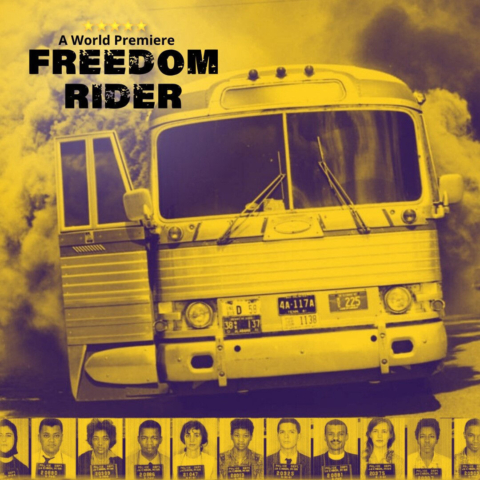
Ricardo Khan and four other writers had dramatic fodder galore to work with as they composed “Freedom Rider,” which is currently having its world premiere at New Brunswick’s Crossroads Theatre.
While the playwriting team — Khan, Kathleen McGhee-Anderson, Murray Horowitz, Nathan Louis Jackson, and Nikkole Salter — covers several salient topics, ranging from recruitment of non-violent civil protestors to the violence and humiliation those activists encounter while advancing the need for civil rights reform in 1961, “Freedom Rider” rarely endows its material with solid intensity or depth.
Some scenes, naturally, speak for themselves in terms of the inherent hardship, hatred, or dilemma they depict. Scattered others, usually involving individual discussions, manage to achieve the cohesiveness and tone “Freedom Rider” has the potential to muster all along. In general, sequences register as obvious or flat, at instances on the verge of cliche.
They may be an accurate account of what happened as an idealistic corps of mostly students headed by bus from Washington, D.C., to the deep South to bring national attention to ingrained de facto segregation already declared unconstitutional by the U.S. Supreme Court, but Khan and company’s script and Khan’s production often lack the juice or emotional heft that would take “Freedom Rider” beyond being an interesting, occasionally even poignant, representation of what those sincere, committed protestors wanted to accomplish or faced.
The absence of intensity is an opportunity missed. Khan is an experienced hand at bringing history vividly to the stage, as he demonstrated earlier this season with another pastiche piece, “When Day Comes,” and at the brink of Crossroads’ existence when he directed Leslie Lee’s play about the Tuskegee Air Group, “Black Eagles.” Those pieces didn’t take their subject or material as much for emotional granted as “Freedom Rider” does.
The problems with “Freedom Rider” tend to fall into two categories. One is overkill. To meet its core characters, a quintet, audiences will follow through a series of challenging situations. And to do so, the writers take us to various locales across the U.S. to witness would-be protestors grapple with resistance or doubt upon announcing his or her intention to join civil rights leader James Farmer and his organization, CORE (Congress of Racial Equality) on the buses signaling reform in the South.
In the process, Jennifer (Alexis Louise Young), from Detroit, has to convince her well-heeled, protective parents she has the emotional stamina and physical strength to withstand the heat and vileness she is likely to find when Farmer’s freedom riders are confronted with counter-protestors who view the students as instigators and unwelcome critics of their habits and traditions.
Carl (Martin K. Lewis), from New York City, has to find the resolve to defy his well-spoken and concerned mother who is worried about his safety and doesn’t want him to jeopardize a college education, the first enjoyed by anyone in his family.
Joan (Kelsey Anne Brown), from suburban Los Angeles, Compton to be specific, is driven by her reaction to having a hide a committed relationship with her Black boyfriend, Lloyd (Ryan Foreman), who is not motivated toward activism and prefers Joan stay in California with him.
And Phillip (Josh Lerner), a student in Ohio, has no impetus to protest anything, particularly if it means facing danger to his physical being or preferred laziness. But he loses a bet to a classmate and out of pride and gambler’s honor, satisfies the winner by signing up for the bus ride, persuading another classmate, Swanson (Alex Scoloveno), a witness to his loss, to come with him.
Except for the scene with Phillip, Swanson, and the winner of the bet (Daniel Cooney), the sequences featuring Jennifer, Carl, and Joan have a similar ring. The obstacles may be different for each of them, but the dramatic paradigm of them having to battle someone to get permission to fulfill their commitment to the civil rights cause is the same, a happenstance that takes its toll on “Freedom Riders” by making it seem as if it had no variation.
In addition to this set of scenes being too identical in structure to hold interest, each takes too long. At the least the portion featuring Phillip and his bet has some physical action and provides some relief from what looks as if it could have been theatrically accomplished by one scene that could have served for all involved.
The second, larger problem, is the simplicity with which sequences unfold, even when they are pregnant with complexity and crying for deeper expression.
Statements on stage have to ring with passion or create a tension that gives them dimension and does not assume the clarity of a situation or the importance of what is being said or transmitted is enough to make it involving or entertaining.
In the majority of its sequences, even those that deal with heady matter and get to the crux of what is happening in the South in 1961 and how it affects people, are blandly placed on the Crossroads stage.
They don’t jell. They make their points. One understands what is being said and, often, the importance of it. What’s missing in an intensity that makes all we’re hearing compelling. Even a scene in which counter protestors firebomb a bus carrying the focal characters and begin to beat people in a vicious, excessive manner comes off as matter-of-fact rather than harrowing or exhausting.
The drama in “Freedom Rider” leaves no mark. You expect to watch such a scene with a sense of horror. You supply the horror, but Khan, as director, has to go further to bring a feeling of disgust, shame, sadism, shock, repulsion, panic, and alarm to the stage. He doesn’t.
Better from a dramatic point of view and more telling in illustrating what the freedom riders encounters is a scene in a Southern coffee shop in which, in non-violent protest, Carl, who is Black, takes a seat at the counter next to Joan, who is white, and Jennifer, who is Black but pale to be point she is often, and usually, taken for being white.
When Carl refuses to move when bidden by the waitress, that waitress summons a policeman (Cooney, who gets to play most of the villains). For once, a scene elicits dread. That officer bullies Carl, who following the guidelines set by CORE, does not move or respond in any way that can be construed as confrontational. The officer then pours a sundae on Carl’s head before pummeling him nastily in his midsection, neck, and other vulnerable areas.
This scene works and take on extra poignancy because we not only see Carl beaten, but we see Phillip abused and humiliated for being Jewish, and witness one more instance of Jennifer having her identity denied, a situation that, at age 17, has been a lifelong issue for her. As she says once, she is not accepted by white classmates for being Black and shunned by Black classmates for being too pale.
“Freedom Rider” is chock full of information and difficult personal predicaments such as Jennifer’s. Khan and company’s play touches all the bases. It just doesn’t leave an imprint in the way a theater piece does. A certain level of engagement is missing that renders “Freedom Rider” more of a lecture or history lesson. Lines that should register as vital come off as pedantic or preachy because they lack even an attempt at dramatic tone.
If Khan, as director, could construe a headier atmosphere within “Freedom Rider’s” scenes, the play and production would improve markedly by the end of its Crossroads run.
“Freedom Rider” runs in repertory with Guy Davis’ “Sugarbelly” through Sunday, June 26, at the Crossroads Theatre in the New Brunswick Performing Arts Center, 11 Livingston Avenue, New Brunswick. Thursday through Saturday, 7 p.m., Saturday and Sunday, 3 p.m., and Wednesday, 11 a.m. $20 to $65. 732-545-8100 or www.crossroadstheatercompany.org.