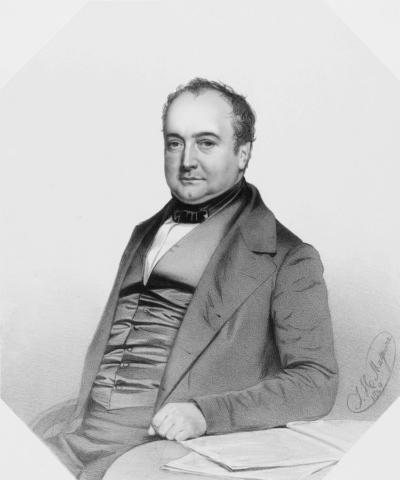
Birds of a feather really do flock together in the case of Charles Lucien Bonaparte, the ornithologist nephew of Joseph Bonaparte who lived for a time at the latter’s Point Breeze estate in Bordentown. The French naturalist renowned as the “father of American descriptive ornithology” lives on in the current of conservation that flows throughout Bordentown, especially by the waterways of Crosswicks Creek and the Delaware River, where the historic property stands at the confluence.
Taking in everything from the swans in the lake to the European pheasants in Joseph’s aviary, Charles Lucien continued building on his extensive body of work documenting birds while staying at the Lake House with his wife, Zénaïde, the daughter of the exiled king Joseph — making Charles Lucien also the former king’s son-in-law — at the grand property.
Joseph began constructing the property of his dreams at Bordentown in 1816, erecting the Lake House around the same time as the Gardener’s House, the structure where he briefly resided in between losing his first mansion to a fire and converting his stables to be the second one.
During their time in America, both Bonaparte men became active members of the Academy of Natural Sciences of Philadelphia, making it more than fitting for an upcoming Bordentown Historical Society lecture to feature Charles Lucien from the institution itself.
In “Charles Lucien Bonaparte and the Academy of Natural Science’s Bonaparte Collection,” the collections manager for the Department of Vertebrate Paleontology at the Academy of Natural Sciences of Drexel University, Ned Gilmore, will discuss the various specimens at the natural history museum on Saturday, June 3, from 3 to 4 p.m. at the Friends Meeting House, 302 Farnsworth Avenue, in Bordentown.
The event is free to attend, but donations are appreciated. Registration is available online at the event page on the BHS website, bordentownhistory.org/our-upcoming-events. The talk is a companion to the BHS Joseph Bonaparte exhibit that, as the online materials continue, debuted in May 2022 with displays including “large Empire style sofas and sideboards, impressive paintings, china, books, silver wear, a lock of Joseph’s hair, and more.”
As reported in a previous U.S. 1 article from May 17, “Be a ‘Parte’ of the Past and Present at Point Breeze,” the Gardener’s House is the only building remaining from his time on the property, which opened to the public on May 20 as the Discovery Center at historic Point Breeze. The property itself was saved due to joint efforts between the city, the nonprofit D&R Greenway, the state of New Jersey, and its previous owners, Divine Word missionaries, in a dedication to stewardship honoring memories like that of Charles Lucien.
The “Natural World” room on the upper level of the renovated Gardener’s House highlights the beauty of the site and its location on the Abbott Marshlands, but before the exhibits expand on that connection, visitors can spot Charles Lucien’s influence hanging in an artistic rendition on the wall.
As depicted in a framed watercolor illustration by D&R trustee and artist James Fiorentino, “Bonaparte’s Gulls,” a smaller species of bird and the only one that routinely nests in trees, were named after Charles Lucien. Chroicocephalus Philadelphia was first described in 1815 by zoologist George Ord, who is assumed to have seen the specimen at Point Breeze, according to its entry on Cornell University’s “All About Birds” website.
According to the exhibit materials at the site, Charles Lucien played a key role in “contributing to the understanding of the taxonomy and nomenclature of birds in America and elsewhere,” with this documented further in the “Natural World” room at Point Breeze.
Charles Lucien was born in Paris in 1803 to aristocrat Alexandrine de Bleschamp and politician Lucien Bonaparte, the younger brother of Joseph and Napoleon. Lucien had a contentious relationship with the ruthless military general, which resulted in Napoleon subjecting his family to imperial exile in England after Charles Lucien had been raised in Italy.
But it was there, as the exhibit continues, that the young Charles Lucien developed his love of nature, “training birds, collecting insects, hunting snakes, and even planting a vegetable garden” in a comprehensive cataloging of plants and wildlife similar to what he would do at Point Breeze. When Napoleon was defeated, Charles Lucien returned to Rome and pursued his passion for studying birds. That journey took him to America in 1822, but just prior to moving, the Dutch botanist Coenraad Jacob Temminck had credited the second Prince of Canino, or a 20-year-old Charles Lucien, for the classification of the new type specimen in his 1832 publication about the Moustached Warbler.
After gaining prominence in the local scientific community, Charles Lucien befriended and collaborated with wildlife artist John James Audubon, whose collection of printed, life-size renditions recording every known species of bird in the country at the time, “The Birds of America,” catapulted him to a fame still visible at Audubon Societies around the world.
Although Audubon’s name is often seen as synonymous with birding and nature, his work did not gain the respect of those same circles. He never gained entrance into the Academy of Natural Sciences in part because Ord, a vocal opponent of Audubon, was a friend of the late author Alexander Wilson, who published the first multi-volume series of books to feature artwork and descriptions of bird species in the nation, “American Ornithology,” years before Audubon would express a similar inspiration.
Charles Lucien, who could not help Audubon get into the good graces of his academic acquaintances, produced an acclaimed, updated version of Wilson’s “American Ornithology” book supplemented with the new species that had been found since Wilson’s death.
Charles Lucien’s reputation in the field, though, would fall short of the international recognition that Audubon received later in life, although Audubon’s image has been tarnished by a legacy of racism, slave-owning, fraud, and more.
Charles Lucien, who wanted to document a global range of birds, returned to Europe a few years later before settling again in Italy, where he pursued political engagements while balancing his studies and publishing at a prolific speed. Rather than title species he identified after a royal, Charles Lucien, who became an active Republican idealist able to juggle being an assemblyman and his aspirations to classify every species of bird, honored the late ornithological author by naming the Wilson’s bird-of-paradise.
As stated in the “Natural World” panel, before his death in 1857 at age 54, Charles Lucien also “coined the genus Zenaida, in honor of his wife, for the mourning dove and its relatives.” In total, the exhibit continues, he discovered and “developed Latin names for 165 genera, 203 species, and 202 subspecies of birds.”
In terms of modern recognition, Charles Lucien has flown relatively under the radar, but from Point Breeze to the Bordentown Historical Society, Charles Lucien’s ornithological ambitions are commended by the same community whose commitment to conservation saved the American estate he once called home.
Charles Lucien Bonaparte and the Academy of Natural Science’s Bonaparte Collection, Friends Meeting House, 302 Farnsworth Avenue, Bordentown. Saturday, June 3, 3 to 4 p.m. Free; donations accepted. www.bordentownhistory.org.