The “new” of the new arts season will be pronounced over the next few weeks with the regional premieres of two works by two composers with connections to the region: Steve Mackey’s “One Red Rose” (performed by the Brentano Quartet on Friday, September 27,) and Derek Bermel’s “Migration Series” (Princeton Symphony Orchestra and Juilliard Jazz Orchestra on Sunday, October 6).
“One Red Rose” commemorates the 50th anniversary of the assassination of John F. Kennedy. It comprises three movements: “Five Short Studies,” “Fugue and Fantasy,” and “Anthem and Aria.”
Before the work’s February Carnegie Hall premiere, Mackey explained his approach in an online music magazine: “I wanted the piece to be connected to the assassination but not be dependent on it. The governing metaphors for the work were more abstract than representational. A dominant thread throughout the piece is the exploration of the dialectic between public versus private as manifested in the events of late November, 1963.”
To clarify the statement Mackey then brought in his personal recollections of the tragedy. “I was seven years old. I was home from school sick in bed, watching TV, when the news broke in. I heard my neighbor burst in the house screaming the news to my mother. They both became transfixed by this international news story while sobbing as if it was their personal loss.
“Another example is the idea of a state funeral, which is a very public event governed by strict protocols. The members of the family are in some sense performing the rite for the sake of a broader public and for that performance a certain dignity and stoicism is assumed. Yet, their own deep loss and personal grief have to be dealt with at some point.
“The third movement — ‘Anthem and Aria’ — embodies that dialectic quite clearly: an anthem is typically a musical expression of public feelings like patriotism, devotion, etc. while an aria is the place in an opera where an individual character expresses personal emotion.”
The composer notes that another thread connecting the piece to the assassination was the simultaneous chaos and control on many different levels. “I see this as being related to the idea of public and private or group versus individual. The swirling chaos of a manhunt and the meticulous, microscopic examination of the sixth floor of the book depository for clues. A frenzied race to the hospital while Jackie Kennedy immovably comforts her husband. ‘Fugue and Fantasy’ embodies this kind of contrast in that a fugue is a highly structured musical form but, in this case, it’s expressive character is wild, even chaotic.”
The title, Mackey says on his website (stevenmackey.com), connects to Jackie Kennedy, who “had been given a bouquet of roses when she landed in Dallas. Immediately after the president and governor Connally were taken into the emergency room at Parkland Hospital a Secret Service agent examined the limousine for bullets or other possible clues but found only a solitary blood soaked red rose on the floor of the car.”
At the work’s premiere the New York Times wrote that “‘One Red Rose’ showed Mr. Mackey’s expert grasp of the string quartet idiom: not only the timbres, textures and expressive effects of its component instruments, but also the genre’s distinctive capacities for parity, transparency, and discernible impact of disparate, simultaneous threads.”
Mackey is the award-winning professor of music and chair of the department of music at Princeton University, where he has been a member of the faculty 1985. With the electric guitar his entry into music, his work combines Western formal and popular traditions. “I want music to be very human,” he says. “It’s not that I’m on a mission to make music more accessible with vernacular music. I just think that’s how music should go, and my models are Mozart and Stravinsky.”
“One Red Rose” will be performed on a program with Beethoven’s “Quartet in D Major, Op. 18, No. 3” and Mendelssohn’s “Quartet in D Major, Op. 44, No. 1.”
Brentano String Quartet, Richardson Auditorium, Friday, September 27, free (reservations required). Call 609-258-9220 or visit www.princeton.edu.
‘Migration Series,” by Derek Bermel, former artist in residence at the Institute for Advanced Study, was commissioned by Wynton Marsalis for the Jazz at Lincoln Center Orchestra and the American Composers Orchestra and premiered in 2006 at the Rose Theater in New York City.
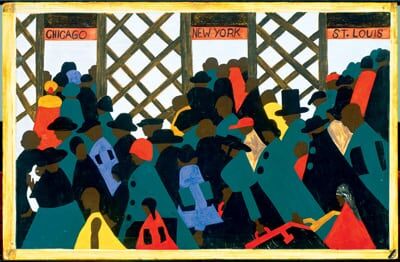
The work is based on the monumental 60-piece Migration Series paintings by the important African-American (and New Jersey native) artist Jacob Lawrence (1917-2000). The works depict the movement of African-Americans from the south to northern cities during the early 20th century.
Bermel, who ended his tenure at the institute in June, notes on his blog (www.derekbermel.com) that he was a young boy in New York City when he encountered Lawrence’s ambitious artist effort. “The paintings have remained etched in my consciousness ever since, and as I began work on this piece, many of the sounds in my head evoked memories of the series. Because Lawrence didn’t regard the paintings as separate entities, but instead as components of a larger cycle, it felt natural for me to focus on the shapes, colors, moods, and atmospheres evoked by groups of scenes within the series, rather than individual paintings. In this grand American story, I gravitated toward the larger themes, those of determination, mystery, despair, and hope; Lawrence’s unique sense of perspective and distance — his generosity and universality of narrative — allowed the space for me to add.”
The composition — in five movements connected by three interludes — strives to convey both the emotions of what the composer calls the “grand American story” as well as the rhythms and tones of the Lawrence’s masterwork. The music evokes southern landscapes and moving trains, rising hopes, the pain and despair of racial prejudice, and an entry into American spaces where joy, fear, and hate collide.
In a statement about his work Lawrence — whose parents came north to Atlantic City (where the artist was born) to Philadelphia and then Harlem — says, “For me, a painting should have three things: universality, clarity, and strength. Universality so that it may be understood by all men. Clarity and strength so that it may be esthetically good. Most of my work depicts events from the many Harlems that exist throughout the United States. This is my genre. My surroundings.”
The composer reflects the voices of black artists and says his “’Migration Series’ is a concerto for jazz band and orchestra, influenced by many of my compositional heroes, including Charlie Parker, Stevie Wonder, Sarah Vaughan, Eric Dolphy, Thelonious Monk, John Zorn, and the rappers Rakim and Mos Def.”
“Migration Series” will be part of the October 4 through 6 weekend when the orchestra pays tribute to the 150th anniversary of the Emancipation Proclamation, working on an arts and history weekend developed in collaboration with the Princeton University Art Museum, the Princeton Public Library, the Historical Society of Princeton, the Princeton Adult School, and the Princeton Committee of the NAACP Legal Defense and Educational Fund.
On Friday, October 4, the PSO presents its Behind the Music program, where Bermel will describe the creative process he used in composing “Migration Series” and be joined by PSO music director Rossen Milanov and Juilliard Jazz Orchestra conductor James Burton III. Free (advanced reservations requested), 4:30 p.m., Arts Council of Princeton.
Saturday, October 5, is when the Princeton University Art Museum and Princeton Symphony Orchestra will present an all-day art festival that includes the PSO Family Concert: A Salute to African Americans’ Jazz Heritage (12:30 p.m. to 1:30 p.m., Richardson Auditorium, $10), Art for Families: African American Art (free, 10 a.m. to 5 p.m., Princeton University Art Museum), and Photography Exhibit: African Americans in Princeton (noon to 2 p.m., Richardson Auditorium Lobby).
On Sunday, October 6, the PSO presents a pre-concert lecture during which PSO’s Milanov, Bermel, and Burton join to discuss the “Migration Series” and the other featured works by Copland and Gershwin. 3 p.m., Richardson Auditorium. Open to Classical Series Concert ticket holders only followed by the American Voices concert featuring “Migration Series” concerto for jazz band and orchestra performed with the Juilliard Jazz Orchestra.
For the American Voices concert — which also includes Aaron Copland’s “Suite from Appalachian Spring” and George Gershwin’s “Porgy and Bess: A Symphonic Picture” — tickets are $25 to $75; a post-concert reception with refreshments and private tour highlighting the Princeton University Art Museum’s African American art collection follows at 6 p.m.
609-497-0020 or www.princetonsymphony.org.